Ivo Babuska - Böcker
Visar alla böcker från författaren Ivo Babuska. Handla med fri frakt och snabb leverans.
10 produkter
10 produkter
3 453 kr
Skickas inom 7-10 vardagar
The finite element method is a numerical method widely used in engineering. Experience shows that unreliable computation can lead to very serious consequences. Hence reliability questions stand more and more at the forefront of engineering and theoretical interests. The present book presents the mathematical theory of the finite element method and focuses on the question of how reliable computed results really are. It addresses among other topics the local behaviour, errors caused by pollution, superconvergence, and optimal meshes. Many computational examples illustrate the importance of the theoretical conclusions for practical computations. Graduate students, lecturers, and researchers in mathematics, engineering, and scientific computation will benefit from the clear structure of the book, and will find this a very useful reference.
1 827 kr
Skickas inom 7-10 vardagar
Most of the many books on finite elements are devoted either to mathematical theory or to engineering applications, but not to both. This book seeks to bridge the gap by presenting the main theoretical ideas of the finite element method and the analysis of its errors in an accessible way. At the same time it presents computed numbers which not only illustrate the theory but can only be analysed using the theory. This approach, both dual and interacting between theory and computation makes this book unique. Much research is currently being done into reliability in computational modelling, involving both validation of the mathematical models and verification of the numerical schemes. By treating finite element error analysis in this way this book is a significant contribution to the verification process of finite element modelling in the context of reliability.
713 kr
Skickas inom 7-10 vardagar
Most of the many books on finite elements are devoted either to mathematical theory or to engineering applications, but not to both. This book seeks to bridge the gap by presenting the main theoretical ideas of the finite element method and the analysis of its errors in an accessible way. At the same time it presents computed numbers which not only illustrate the theory but can only be analysed using the theory. This approach, both dual and interacting between theory and computation makes this book unique. Much research is currently being done into reliability in computational modelling, involving both validation of the mathematical models and verification of the numerical schemes. By treating finite element error analysis in this way this book is a significant contribution to the verification process of finite element modelling in the context of reliability.
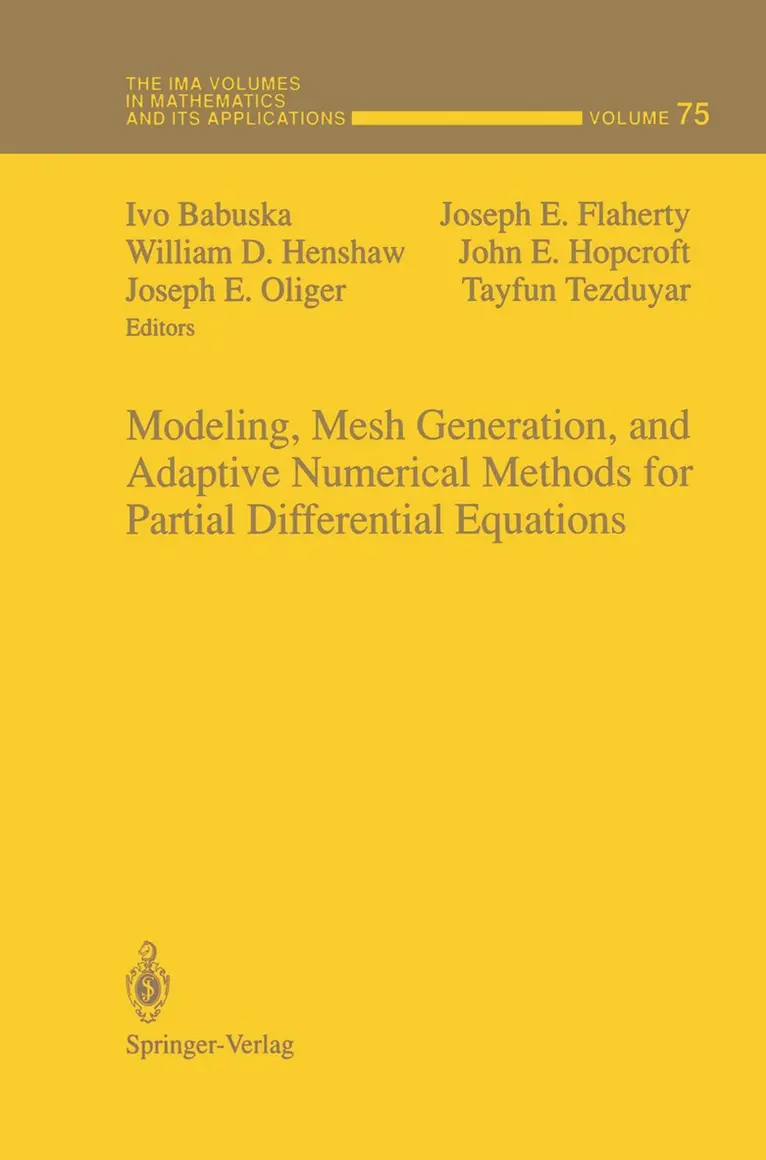
Del 75 - IMA Volumes in Mathematics and its Applications
Modeling, Mesh Generation, and Adaptive Numerical Methods for Partial Differential Equations
Inbunden, Engelska, 1995
2 636 kr
Skickas inom 10-15 vardagar
This IMA Volume in Mathematics and its Applications MODELING, MESH GENERATION, AND ADAPTIVE NUMERICAL METHODS FOR PARTIAL DIFFERENTIAL EQUATIONS is based on the proceedings of the 1993 IMA Summer Program "Modeling, Mesh Generation, and Adaptive Numerical Methods for Partial Differential Equations." We thank Ivo Babuska, Joseph E. Flaherty, William D. Hen- shaw, John E. Hopcroft, Joseph E. Oliger, and Tayfun Tezduyar for orga- nizing the workshop and editing the proceedings. We also take this oppor- tunity to thank those agencies whose financial support made the summer program possible: the National Science Foundation (NSF), the Army Re- search Office (ARO) the Department of Energy (DOE), the Minnesota Su- percomputer Institute (MSI), and the Army High Performance Computing Research Center (AHPCRC). A vner Friedman Willard Miller, Jr. xiii PREFACE Mesh generation is one of the most time consuming aspects of com- putational solutions of problems involving partial differential equations. It is, furthermore, no longer acceptable to compute solutions without proper verification that specified accuracy criteria are being satisfied.Mesh gen- eration must be related to the solution through computable estimates of discretization errors. Thus, an iterative process of alternate mesh and so- lution generation evolves in an adaptive manner with the end result that the solution is computed to prescribed specifications in an optimal, or at least efficient, manner. While mesh generation and adaptive strategies are becoming available, major computational challenges remain. One, in particular, involves moving boundaries and interfaces, such as free-surface flows and fluid-structure interactions.
Del 46 - North-Holland Series in Applied Mathematics and Mechanics
Uncertain Input Data Problems and the Worst Scenario Method
Inbunden, Engelska, 2004
1 809 kr
Skickas inom 5-8 vardagar
This book deals with the impact of uncertainty in input data on the outputs of mathematical models. Uncertain inputs as scalars, tensors, functions, or domain boundaries are considered. In practical terms, material parameters or constitutive laws, for instance, are uncertain, and quantities as local temperature, local mechanical stress, or local displacement are monitored. The goal of the worst scenario method is to extremize the quantity over the set of uncertain input data.A general mathematical scheme of the worst scenario method, including approximation by finite element methods, is presented, and then applied to various state problems modeled by differential equations or variational inequalities: nonlinear heat flow, Timoshenko beam vibration and buckling, plate buckling, contact problems in elasticity and thermoelasticity with and without friction, and various models of plastic deformation, to list some of the topics. Dozens of examples, figures, and tables are included.Although the book concentrates on the mathematical aspects of the subject, a substantial part is written in an accessible style and is devoted to various facets of uncertainty in modeling and to the state of the art techniques proposed to deal with uncertain input data.A chapter on sensitivity analysis and on functional and convex analysis is included for the reader's convenience.�Rigorous theory is established for the treatment of uncertainty in modeling� Uncertainty is considered in complex models based on partial differential equations or variational inequalities � Applications to nonlinear and linear problems with uncertain data are presented in detail: quasilinear steady heat flow, buckling of beams and plates, vibration of beams, frictional contact of bodies, several models of plastic deformation, and more �Although emphasis is put on theoretical analysis and approximation techniques, numerical examples are also present�Main ideas and approaches used today to handle uncertainties in modeling are described in an accessible form�Fairly self-contained book
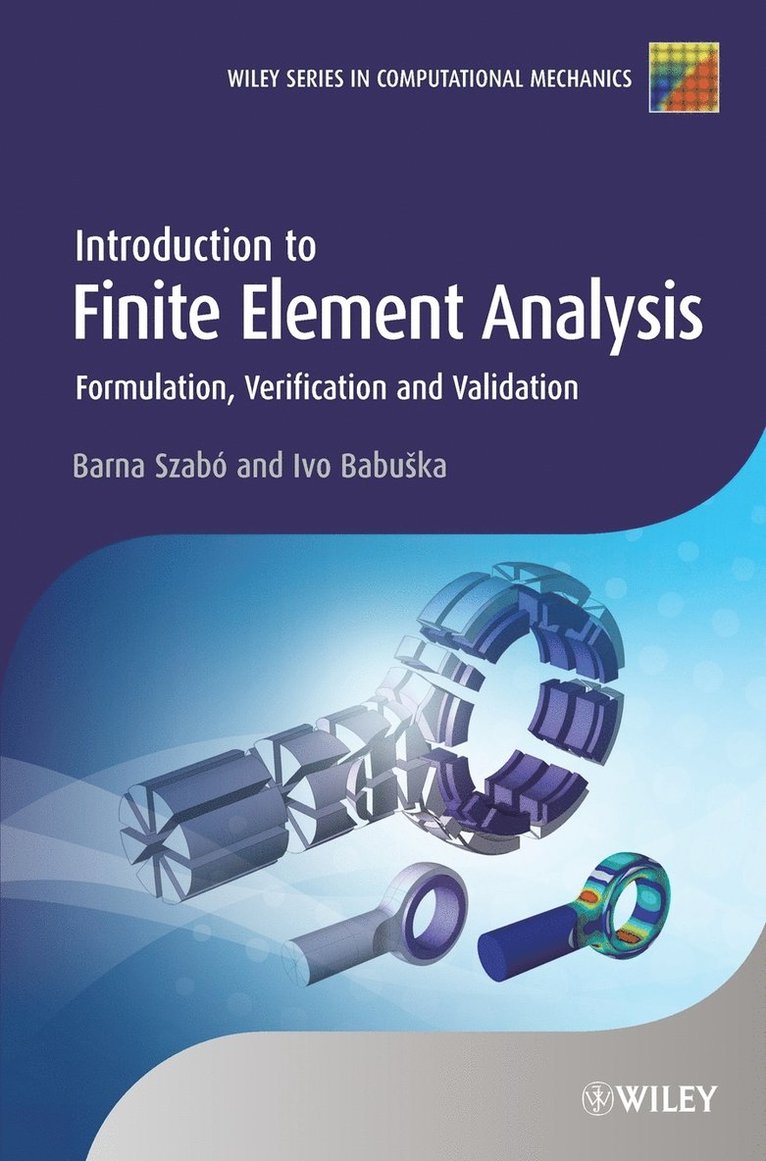
Introduction to Finite Element Analysis
Formulation, Verification and Validation
Inbunden, Engelska, 2011
1 169 kr
Skickas inom 7-10 vardagar
When using numerical simulation to make a decision, how can its reliability be determined? What are the common pitfalls and mistakes when assessing the trustworthiness of computed information, and how can they be avoided? Whenever numerical simulation is employed in connection with engineering decision-making, there is an implied expectation of reliability: one cannot base decisions on computed information without believing that information is reliable enough to support those decisions. Using mathematical models to show the reliability of computer-generated information is an essential part of any modelling effort.Giving users of finite element analysis (FEA) software an introduction to verification and validation procedures, this book thoroughly covers the fundamentals of assuring reliability in numerical simulation. The renowned authors systematically guide readers through the basic theory and algorithmic structure of the finite element method, using helpful examples and exercises throughout. Delivers the tools needed to have a working knowledge of the finite element methodIllustrates the concepts and procedures of verification and validation Explains the process of conceptualization supported by virtual experimentationDescribes the convergence characteristics of the h-, p- and hp-methods Covers the hierarchic view of mathematical models and finite element spaces Uses examples and exercises which illustrate the techniques and procedures of quality assurance Ideal for mechanical and structural engineering students, practicing engineers and applied mathematiciansIncludes parameter-controlled examples of solved problems in a companion website (www.wiley.com/go/szabo)
1 275 kr
Skickas inom 7-10 vardagar
Finite Element AnalysisAn updated and comprehensive review of the theoretical foundation of the finite element methodThe revised and updated second edition of Finite Element Analysis: Method, Verification, and Validation offers a comprehensive review of the theoretical foundations of the finite element method and highlights the fundamentals of solution verification, validation, and uncertainty quantification. Written by noted experts on the topic, the book covers the theoretical fundamentals as well as the algorithmic structure of the finite element method. The text contains numerous examples and helpful exercises that clearly illustrate the techniques and procedures needed for accurate estimation of the quantities of interest. In addition, the authors describe the technical requirements for the formulation and application of design rules.Designed as an accessible resource, the book has a companion website that contains a solutions manual, PowerPoint slides for instructors, and a link to finite element software. This important text: Offers a comprehensive review of the theoretical foundations of the finite element methodPuts the focus on the fundamentals of solution verification, validation, and uncertainty quantificationPresents the techniques and procedures of quality assurance in numerical solutions of mathematical problemsContains numerous examples and exercisesWritten for students in mechanical and civil engineering, analysts seeking professional certification, and applied mathematicians, Finite Element Analysis: Method, Verification, and Validation, Second Edition includes the tools, concepts, techniques, and procedures that help with an understanding of finite element analysis.
Del 75 - IMA Volumes in Mathematics and its Applications
Modeling, Mesh Generation, and Adaptive Numerical Methods for Partial Differential Equations
Häftad, Engelska, 2011
2 636 kr
Skickas inom 10-15 vardagar
This IMA Volume in Mathematics and its Applications MODELING, MESH GENERATION, AND ADAPTIVE NUMERICAL METHODS FOR PARTIAL DIFFERENTIAL EQUATIONS is based on the proceedings of the 1993 IMA Summer Program "Modeling, Mesh Generation, and Adaptive Numerical Methods for Partial Differential Equations." We thank Ivo Babuska, Joseph E. Flaherty, William D. Hen- shaw, John E. Hopcroft, Joseph E. Oliger, and Tayfun Tezduyar for orga- nizing the workshop and editing the proceedings. We also take this oppor- tunity to thank those agencies whose financial support made the summer program possible: the National Science Foundation (NSF), the Army Re- search Office (ARO) the Department of Energy (DOE), the Minnesota Su- percomputer Institute (MSI), and the Army High Performance Computing Research Center (AHPCRC). A vner Friedman Willard Miller, Jr. xiii PREFACE Mesh generation is one of the most time consuming aspects of com- putational solutions of problems involving partial differential equations. It is, furthermore, no longer acceptable to compute solutions without proper verification that specified accuracy criteria are being satisfied.Mesh gen- eration must be related to the solution through computable estimates of discretization errors. Thus, an iterative process of alternate mesh and so- lution generation evolves in an adaptive manner with the end result that the solution is computed to prescribed specifications in an optimal, or at least efficient, manner. While mesh generation and adaptive strategies are becoming available, major computational challenges remain. One, in particular, involves moving boundaries and interfaces, such as free-surface flows and fluid-structure interactions.
1 781 kr
Skickas inom 7-10 vardagar
Del 19 - Lecture Notes in Computational Science and Engineering
Mathematical Modeling and Numerical Simulation in Continuum Mechanics
Proceedings of the International Symposium on Mathematical Modeling and Numerical Simulation in Continuum Mechanics, September 29 – October 3, 2000 Yamaguchi, Japan
Häftad, Engelska, 2001
1 069 kr
Skickas inom 10-15 vardagar
This book shows the latest frontiers of the research by the most active researchers in the field of numerical mathematics. The papers in the book were presented at a symposium held in Yamaguchi, Japan. The subject of the symposium was mathematical modeling and numerical simulation in continuum mechanics. The topics of the lectures ranged from solids to fluids and included both mathematical and computational analysis of phenomena and algorithms. The reader can study the latest results on shells, plates, flows in various situations, fracture of solids, new ways of exact error estimates and many other topics.