• Fri frakt över 249 kr
  • •
  • Snabba leveranser
  • •
  • Billiga böcker
Kundservice

Du är på sajten för privatpersoner.

Företag, bibliotek eller offentlig verksamhet?

Du handlar på classic.bokus.com, där alla dina funktioner finns intakta.
Till classic.bokus.com
Bokus logotyp. Gå till startsidan.
  • Erbjudanden
  • Nyheter
  • Student
  • Topplistor
  • Barn & ungdom
  • Bokus Play
  • E-böcker
  • Pocketböcker
  • Spel & pussel

10% rabatt på allt med kod: NYSTART10 →

Sidfot

Mina sidor

    Hjälp

    • Kundservice
    • Vanliga frågor och svar
    • Frakt och leverans
    • Retur vid ångerrätt
    • Reklamera vara
    • Betalning
    • Köpvillkor
    • Allmänna villkor
    • Information om webbplatsens tillgänglighet

    Om Bokus

    • Om oss
    • Pressrum
    • För studenter
    • För företag
    • För bibliotek och offentlig verksamhet
    • För leverantörer
    • Hållbarhet

    Populärt

    • Aktuella erbjudanden
    • Presentkort
    • Studentlitteratur
    • Nya böcker
    • Topplistor
    • Signerade böcker
    • Engelska böcker

    Inspiration

    • Boktips
    • BookTok
    • Populära bokserier
    • Barnbokskaraktärer
    • Populära författare
    Logotyp för Bokus
    Följ oss på Facebook (extern länk)Följ oss på Instagram (extern länk)Följ oss på YouTube (extern länk)Följ oss på TikTok (extern länk)
    bokus @ CookiesAnpassa cookiesIntegritetspolicyKöpvillkor
    Till Citymail hemsida (extern länk)Till Budbee hemsida (extern länk)Till Postnord hemsida (extern länk)Till Schenker hemsida (extern länk)Till Early Bird hemsida (extern länk)Till Walleys hemsida (extern länk)
    1. Naturvetenskap och teknik
    2. Matematik och naturvetenskap
    3. Fysik
    4. Klassisk mekanik

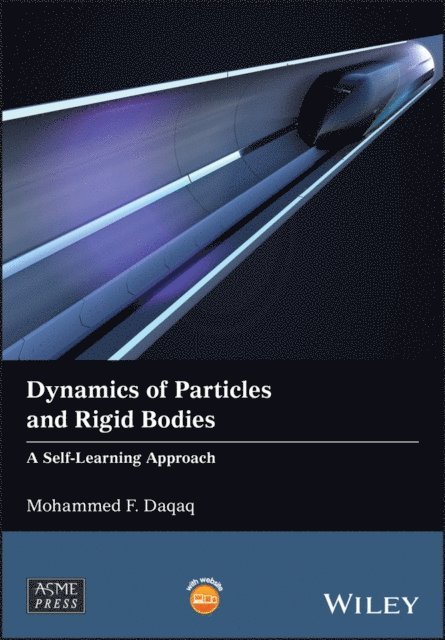
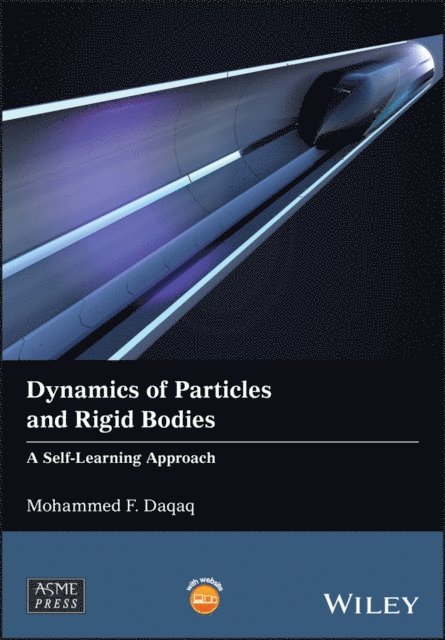
    Dynamics of Particles and Rigid Bodies

    A Self-Learning Approach

    AvMohammed F. Daqaq

    Häftad, Engelska, 2018

    Del i serien Wiley-ASME Press Series

    1 306 kr

    Beställningsvara. Skickas inom 5-8 vardagar. Fri frakt över 249 kr.

    Fler format och utgåvor

    E-bok

    1 499 kr

    E-bok

    1 499 kr

    Beskrivning

    A unique approach to teaching particle and rigid body dynamics using solved illustrative examples and exercises to encourage self-learningThe study of particle and rigid body dynamics is a fundamental part of curricula for students pursuing graduate degrees in areas involving dynamics and control of systems. These include physics, robotics, nonlinear dynamics, aerospace, celestial mechanics and automotive engineering, among others. While the field of particle and rigid body dynamics has not evolved significantly over the past seven decades, neither have approaches to teaching this complex subject. This book fills the void in the academic literature by providing a uniquely stimulating, “flipped classroom” approach to teaching particle and rigid body dynamics which was developed, tested and refined by the author and his colleagues over the course of many years of instruction at both the graduate and undergraduate levels. Complete with numerous solved illustrative examples and exercises to encourage self-learning in a flipped-classroom environment, Dynamics of Particles and Rigid Bodies: A Self-Learning Approach: Provides detailed, easy-to-understand explanations of concepts and mathematical derivationsIncludes numerous flipped-classroom exercises carefully designed to help students comprehend the material covered without actually solving the problem for themFeatures an extensive chapter on electromechanical modelling of systems involving particle and rigid body motionProvides examples from the state-of-the-art research on sensing, actuation, and energy harvesting mechanismsOffers access to a companion website featuring additional exercises, worked problems, diagrams and a solutions manualIdeal as a textbook for classes in dynamics and controls courses, Dynamics of Particles and Rigid Bodies: A Self-Learning Approach is a godsend for students pursuing advanced engineering degrees who need to master this complex subject. It will also serve as a handy reference for professional engineers across an array of industrial domains.

    Produktinformation

    • Utgivningsdatum:2018-08-10
    • Mått:170 x 241 x 23 mm
    • Vikt:703 g
    • Format:Häftad
    • Språk:Engelska
    • Serie:Wiley-ASME Press Series
    • Antal sidor:376
    • Förlag:John Wiley & Sons Inc
    • ISBN:9781119463146

    Utforska kategorier

    • Klassisk mekanik inom Naturvetenskap och teknik
    • Maskinteknik och material inom Naturvetenskap och teknik

    Mer om författaren

    Mohammed F. Daqaq, PhD, is a Global Network Associate Professor of Mechanical Engineering at New York University, Abu Dhabi. His research focuses on the application of various nonlinear phenomena to improve the performance of micro-power generation systems, micro-electromechanical systems, and vibration assisted manufacturing processes. He serves as an Associate Editor of the ASME Journal of Vibration and Acoustics and as a Subject Editor of the Journal Nonlinear Dynamics.

    Innehållsförteckning

    • List of Figures xiiiPreface xxiiiAcknowledgement xxviiIntroduction xxixAbout the Companion Website xliii1 Kinematics of Particles 11.1 Inertial Frames 11.2 Rotating Frames 21.3 Rotation Matrices 41.4 Velocity of a Particle in a Three-dimensional Space 81.5 Acceleration of a Particle in a Three-dimensional Space 14Exercises 212 Dynamics of Particles: Vectorial Approach 272.1 Newton’s Second Law of Dynamics 272.2 Stiffness and Viscous Damping 372.3 Dry Friction 402.4 Dynamics of a System of Particles 432.5 Newton’s Law of Gravitation 47Exercises 50Reference 543 Dynamics of Rigid Bodies: Vectorial Approach 553.1 Center of Mass 553.2 Mass Moment of Inertia 573.3 Parallel Axis Theorem 613.4 Rotation of the Inertia Matrix 653.4.1 The Principal Axes 663.5 Planar Motion of Rigid Bodies 693.5.1 Moment about an Inertial Point 723.5.2 Moment about a Moving Point on the Body 733.5.3 Moment about the Center of Mass or a Fixed Point on the Body 733.6 Non-planar Rigid-body Motion 833.6.1 Euler Rotational Equations 85Exercises 94Reference 1014 System Constraints and Virtual Displacement 1034.1 Constraints 1034.1.1 Classification of Constraints 1044.2 Actual and Virtual Displacements 1104.3 Virtual Work 113Exercises 115Reference 1165 Dynamics of Particles: Analytical Approach 1175.1 The Brachistochrone Problem 1175.2 Lagrange’s Equation for a Conservative System 1235.3 Lagrange’s Equation for Non-conservative Systems 1315.3.1 Viscous Damping 1345.4 Lagrange’s Equations with Constraints 1415.4.1 Physical Interpretation of Lagrange Multipliers 1465.5 Cyclic Coordinates 1515.6 Advantages and Disadvantages of the Analytical Approach 154Exercises 155References 1596 Dynamics of Rigid Bodies: Analytical Approach 1616.1 Kinetic Energy of a Rigid Body 1616.2 Lagrange’s Equation Applied to Rigid Bodies 166Exercises 1767 Momentum 1837.1 Linear Momentum 1837.2 Collision 1867.3 Angular Momentum of Particles 1927.3.1 Angular Impulse 1957.4 Angular Momentum of Rigid Bodies (Planar Motion) 1997.4.1 Angular Momentum about an Axis Passing through the Center of Mass 1997.4.2 Angular Momentum about an Axis Passing through a Fixed Point on the Body 2017.4.3 Angular Momentum about an Axis Passing through an Arbitrary Inertial Point 2017.5 Angular Momentum of Rigid Bodies (Non-planar Motion) 2057.5.1 Angular Momentum about a Set of Axes Located at the Center of Mass 2057.5.2 Angular Momentum about a Set of Axes Located at a Fixed Point 2067.5.3 Angular Momentum about a Set of Axes Located at an Arbitrary Inertial Point 2067.5.4 Conservation of Angular Momentum for Rigid Bodies 2067.6 Generalized Momenta 213Exercises 2198 Motion of Charged Bodies in an Electric Field 2278.1 Electrostatics 2278.1.1 Electrostatic Forces 2278.1.2 Electric Field 2298.1.3 Electric Flux 2328.1.4 Electrostatic Potential Energy 2348.1.5 Electric Potential (Voltage) 2358.1.6 Capacitance 2378.1.7 Motion in an Electric Field 2398.2 Electromagnetism 2478.2.1 Electromagnetic Force 2478.2.2 Forces on a Current-carrying Conductor 2538.2.3 Electromagnetic Coupling 2558.2.4 Ampere’s Law 2578.2.5 Faraday’s Law of Induction 2628.3 Lagrangian Formulation for Electrical Elements 2688.3.1 Capacitor 2688.3.2 Inductor 2698.3.3 Resistor 2698.4 Maxwell’s Equations 2738.4.1 Maxwell’s First Equation 2738.4.2 Maxwell’s Second Equation 2738.4.3 Maxwell’s Third Equation 2748.4.4 Maxwell’s Fourth Equation 2748.5 Lagrangian Formulation of the Lorentz Force 275Exercises 279References 2849 Introduction to Analysis Tools 2859.1 Basic Definitions 2859.2 Equilibrium Solutions of Dynamical Systems 2879.3 Stability and Classification of Equilibrium Solutions 2889.4 Phase-plane Representation of the Dynamics 2969.4.1 Conservative Systems 2969.4.2 Non-conservative Systems 3039.5 Bifurcation of Equilibrium Solutions 3089.5.1 Static Bifurcations 3089.5.2 Dynamic (Hopf) Bifurcation 3159.6 Basins of Attraction 323Exercises 324References 326Index 327