• Fri frakt över 249 kr
  • •
  • Snabba leveranser
  • •
  • Billiga böcker
Kundservice

Du är på sajten för privatpersoner.

Företag, bibliotek eller offentlig verksamhet?

Du handlar på classic.bokus.com, där alla dina funktioner finns intakta.
Till classic.bokus.com
Bokus logotyp. Gå till startsidan.
  • Erbjudanden
  • Nyheter
  • Student
  • Topplistor
  • Barn & ungdom
  • Bokus Play
  • E-böcker
  • Pocketböcker
  • Spel & pussel

10% rabatt på allt med kod NYSTART10 →

Sidfot

Mina sidor

    Hjälp

    • Kundservice
    • Vanliga frågor och svar
    • Frakt och leverans
    • Retur vid ångerrätt
    • Reklamera vara
    • Betalning
    • Köpvillkor
    • Allmänna villkor
    • Information om webbplatsens tillgänglighet

    Om Bokus

    • Om oss
    • Pressrum
    • För studenter
    • För företag
    • För bibliotek och offentlig verksamhet
    • För leverantörer
    • Hållbarhet

    Populärt

    • Aktuella erbjudanden
    • Presentkort
    • Studentlitteratur
    • Nya böcker
    • Topplistor
    • Signerade böcker
    • Engelska böcker

    Inspiration

    • Boktips
    • BookTok
    • Populära bokserier
    • Barnbokskaraktärer
    • Populära författare
    Logotyp för Bokus
    Följ oss på Facebook (extern länk)Följ oss på Instagram (extern länk)Följ oss på YouTube (extern länk)Följ oss på TikTok (extern länk)
    bokus @ CookiesAnpassa cookiesIntegritetspolicyKöpvillkor
    Till Citymail hemsida (extern länk)Till Budbee hemsida (extern länk)Till Postnord hemsida (extern länk)Till Schenker hemsida (extern länk)Till Early Bird hemsida (extern länk)Till Walleys hemsida (extern länk)
    1. Naturvetenskap och teknik
    2. Teknik och industri
    3. Maskinteknik och material

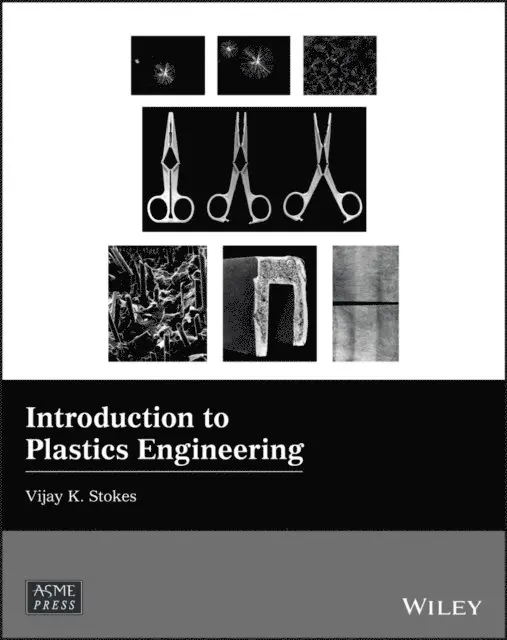
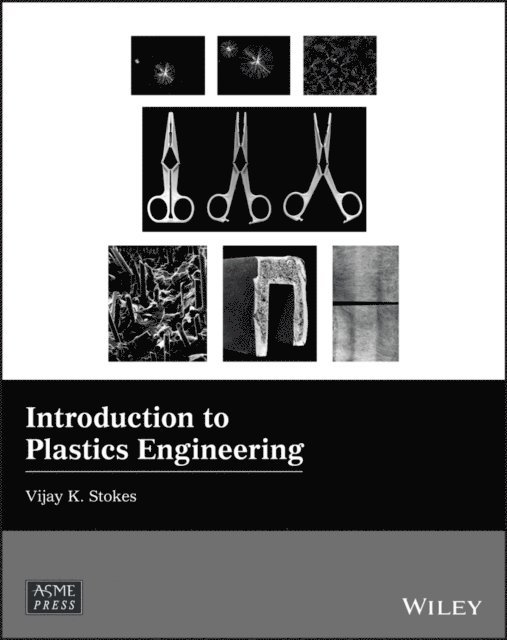
    Introduction to Plastics Engineering

    AvVijay K. Stokes

    Inbunden, Engelska, 2020

    Del i serien Wiley-ASME Press Series

    1 961 kr

    Beställningsvara. Skickas inom 5-8 vardagar. Fri frakt över 249 kr.

    Fler format och utgåvor

    E-bok

    2 272 kr

    E-bok

    2 272 kr

    Beskrivning

    The authoritative introduction to all aspects of plastics engineering — offering both academic and industry perspectives in one complete volume. Introduction to Plastics Engineering provides a self-contained introduction to plastics engineering. A unique synergistic approach explores all aspects of material use — concepts, mechanics, materials, part design, part fabrication, and assembly — required for converting plastic materials, mainly in the form of small pellets, into useful products. Thermoplastics, thermosets, elastomers, and advanced composites, the four disparate application areas of polymers normally treated as separate subjects, are covered together.Divided into five parts — Concepts, Mechanics, Materials, Part Processing and Assembly, and Material Systems — this inclusive volume enables readers to gain a well-rounded, foundational knowledge of plastics engineering. Chapters cover topics including the structure of polymers, how concepts from polymer physics explain the macro behavior of plastics, evolving concepts for plastics use, simple mechanics principles and their role in plastics engineering, models for the behavior of solids and fluids, and the mechanisms underlying the stiffening of plastics by embedded fibers. Drawing from his over fifty years in both academia and industry, Author Vijay Stokes uses the synergy between fundamentals and applications to provide a more meaningful introduction to plastics. Examines every facet of plastics engineering from materials and fabrication methods to advanced compositesProvides accurate, up-to-date information for students and engineers both new to plastics and highly experienced with themOffers a practical guide to large number of materials and their applicationsAddresses current issues for mechanical design, part performance, and part fabrication Introduction to Plastics Engineering is an ideal text for practicing engineers, researchers, and students in mechanical and plastics engineering and related industries.

    Produktinformation

    • Utgivningsdatum:2020-05-07
    • Mått:201 x 239 x 61 mm
    • Vikt:2 041 g
    • Format:Inbunden
    • Språk:Engelska
    • Serie:Wiley-ASME Press Series
    • Antal sidor:1 072
    • Förlag:John Wiley & Sons Inc
    • ISBN:9781119536574

    Utforska kategorier

    • Maskinteknik och material inom Naturvetenskap och teknik

    Mer om författaren

    Vijay Kumar Stokes, PhD (Princeton), joined IIT Kanpur in 1964, where he served as the Head of the Mechanical Engineering Department (1974-1977) and as the Convener of the Nuclear Engineering and Technology Program (1977-1978). In 1978, he joined GE Corporate Research & Development, where for 15 years he worked on plastics. Professor Stokes is a Fellow of the American Society of Mechanical Engineers, the Institution of Engineers (India), and the Society of Plastics Engineers.

    Recensioner i media

    "Although Author Dr. Vijay Stokes humbly includes 'introduction' in the book title, the treatment in this book is quite extensive and inclusive, with 25 chapters and over 1000 pages. This volume essentially contains every facet of plastics engineering from materials and fabrication methods to advanced composites. It endorses a unique synergistic approach to implementing the ideas of mechanistic principles and polymer physics to practical applications of polymers and composites. Engineers are natural readers of this book. In this book, concepts from polymer physics explain the macro behavior of plastics, including deformation, flow and rheology, which are of vital importance in design and fabrication with plastics. Engineers would therefore learn the new tool sets to tailor plastics in various engineering applications. Materials scientists who have an interest in applications of polymers would greatly benefit from this book as well. The book also contains detailed derivations and design analysis and may be used as a textbook for college seniors or students at an introductory graduate level."—Professor Donggang Yao, Journal of Manufacturing Science and Engineering"The book, Introduction of Plastics Engineering, is a great resource both for students beginning to learn about plastics, and for practicing engineers trying to clarify concepts unique to polymers. The author writes that he started working on plastics in mid career; the learning process he went through is reflected in how he has organized the material in the over 1000 pages in this book. It works. As a reviewer who has worked with polymers for almost four decades, I give this book high marks."—Professor Tim A. Osswald, International Polymer Processing"Overall, this is an important addition to the plastics engineering series available in the market. While most books on plastics engineering emphasize materials' aspects and most design books are based on mechanical engineering concepts, this book uses mechanics based engineering principles to understand plastics engineering. Hence, the book covers the existing gap. The principles are discussed with basic knowledge of mathematics and easy to follow."—Professor Anil K. Bhowmick, AIChE Journal"This expansive 1000-page book authored by Professor Stokes is certainly a great addition to the bookshelves of both practicing plastics engineers and academics.... Each chapter of the book has been put together meticulously and thoughtfully with informative illustrations, mechanics-based models, and empirical data. With many chapters of the book containing author's own works besides others, the monograph is very authentic and I strongly recommend it as a textbook and research monograph."—Professor Hareesh Tippur, Journal of Engineering Materials and Technology

    Innehållsförteckning

    • Series Preface xxixPreface xxxiPart I Introduction 1Outlines for Chapters 1 and 21 Introductory Survey 31.1 Background 31.2 Synergy Between Materials Science and Engineering 41.3 Plastics Engineering as a Process (the Plastics Engineering Process) 71.4 Types of Plastics 91.5 Material Characteristics Determine Part Shapes 111.6 Part Fabrication (Part Processing) 271.7 Part Performance 281.8 Assembly 321.9 Concluding Remarks 332 Evolving Applications of Plastics 352.1 Introduction 352.2 Consumer Applications 362.3 Medical Applications 672.4 Automotive Applications 702.5 Infrastructure Applications 772.6 Wind Energy 882.7 Airline Applications 902.8 Oil Extraction 912.9 Mining 922.10 Concluding Remarks 93Part II Mechanics 95Outlines for Chapters 3 through 83 Introduction to Stress and Deformation 973.1 Introduction 973.2 Simple Measures for Load Transfer and Deformation 973.3 *Strains as Displacement Gradients 993.4 *Coupling Between Normal and Shear Stresses 1013.5 *Coupling Between Normal and Shear Strains 1023.6 **Two-Dimensional Stress 1033.7 Concluding Remarks 1054 Models for Solid Materials 1074.1 Introduction 1074.2 Simple Models for the Mechanical Behavior of Solids 1074.3 Elastic Materials 1084.4 *Anisotropic Materials 1094.5 Thermoelastic Effects 1114.6 Plasticity 1134.7 Concluding Remarks 1165 Simple Structural Elements 1195.1 Introduction 1195.2 Bending of Beams 1195.3 Deflection of Prismatic Beams 1235.4 Torsion of Thin-Walled Circular Tubes 1275.5 Torsion of Thin Rectangular Bars and Open Sections 1295.6 Torsion of Thin-Walled Tubes 1305.7 *Torsion of Multicellular Sections 1315.8 Introduction to Elastic Stability 1335.9 *Elastic Stability of an Axially Loaded Column 1385.10 Twist-Bend Buckling of a Cantilever 1425.11 Stress Concentration 1425.12 The Role of Numerical Methods 1455.13 Concluding Remarks 1456 Models for Liquids 1476.1 Introduction 1476.2 Simple Models for Heat Conduction 1476.3 Kinematics of Fluid Flow 1496.4 Equations Governing One-Dimensional Fluid Flow 1516.5 Simple Models for the Mechanical Behavior of Liquids 1576.6 Simple One-Dimensional Flows 1596.7 Polymer Rheology 1716.8 Concluding Remarks 1737 Linear Viscoelasticity 1757.1 Introduction 1757.2 Phenomenology of Viscoelasticity 1767.3 Linear Viscoelasticity 1797.4 Simple Models for Stress Relaxation and Creep 1827.5 Response for Constant Strain Rates 1897.6 *Sinusoidal Shearing 1907.6.1 Dynamic Mechanical Analysis (DMA) 1917.6.1.1 DMA Curves for Three-Parameter Model 1927.6.2 *Energy Storage and Loss 1927.7 Isothermal Temperature Effects 1937.7.1 Thermorheologically Simple Materials 1947.7.2 Physical Interpretation for Time-Temperature Shift 1957.8 *Variable Temperature Histories 1957.9 *Cooling of a Constrained Bar 1967.10 Concluding Remarks 1968 Stiffening Mechanisms 1998.1 Introduction 1998.2 Continuous Fiber Reinforcement 1998.3 Discontinuous Fiber Reinforcement 2038.4 The Halpin–Tsai Equations 2118.5 Reinforcing Materials 2118.6 Concluding Remarks 213Further Reading 213Part III Materials 215Outlines for Chapters 9 through 159 Introduction to Polymers 2179.1 Introduction 2179.2 Thermoplastics 2179.3 Molecular Weight Distributions 2269.4 Thermosets 2279.5 Concluding Remarks 22710 Concepts from Polymer Physics 22910.1 Introduction 22910.2 Chain Conformations 22910.3 Amorphous Polymers 23410.4 Semicrystalline Polymers 24010.5 Liquid Crystal Polymers 24310.6 Concluding Remarks 24511 Structure, Properties, and Applications of Plastics 24711.1 Introduction 24711.2 Resin Grades 24811.3 Additives and Modifiers 24811.4 Polyolefins 25111.5 Vinyl Polymers 25411.6 High-Performance Polymers 25811.7 High-Temperature Polymers 26511.8 Cyclic Polymers 27111.9 Thermoplastic Elastomers 27211.10 Historical Notes 27311.11 Concluding Remarks 27412 Blends and Alloys 27712.1 Introduction 27712.2 Blends 27812.3 Historical Notes 28212.4 Concluding Remarks 28213 Thermoset Materials 28513.1 Introduction 28513.2 Thermosetting Resins 28513.3 High-Temperature Thermosets 29613.4 Thermoset Elastomers 30413.5 Historical Notes 30913.6 Concluding Remarks 31114 Polymer Viscoelasticity 31314.1 Introduction 31314.2 Phenomenology of Polymer Viscoelasticity 31314.3 Time-Temperature Superposition 31914.4 Sinusoidal Oscillatory Tests 32314.5 Concluding Remarks 32815 Mechanical Behavior of Plastics 33115.1 Introduction 33115.2 Deformation Phenomenology of Polycarbonate 33215.3 Tensile Characteristics of PEI 36015.4 Deformation Phenomenology of PBT 36315.5 Stress-Deformation Behavior of Several Plastics 37615.6 Phenomenon of Crazing 38715.7 *Multiaxial Yield 39315.8 *Fracture 40115.9 Fatigue 40315.10 Impact Loading 41215.11 Creep 41915.12 Stress-Deformation Behavior of Thermoset Elastomers 41915.13 Concluding Remarks 420Further Reading 420Part IV Part Processing and Assembly 421Outlines for Chapters 16 through 2116 Classification of Part Shaping Methods 42316.1 Introduction 42316.2 Part Fabrication (Processing) Methods for Thermoplastics 42416.3 Evolution of Part Shaping Methods 42916.4 Effects of Processing on Part Performance 43116.5 Bulk Processing Methods for Thermoplastics 43916.6 Part Processing Methods for Thermosets 44016.7 Part Processing Methods Advanced Composites 44216.8 Processing Methods for Rubber Parts 44316.9 Concluding Remarks 44517 Injection Molding and Its Variants 44717.1 Introduction 44717.2 Process Elements 44717.3 Fountain Flow 46217.4 Part Morphology 47317.5 Part Design 47517.6 Large- Versus Small-Part Molding 49317.7 Molding Practice 50417.8 Variants of Injection Molding 52617.8.7 In-Mold Decoration and Lamination 55217.9 Concluding Remarks 553References 55318 Dimensional Stability and Residual Stresses 55518.1 Introduction 55518.2 Problem Complexity 55618.3 Shrinkage Phenomenology 55618.4 Pressure-Temperature Volumetric Data 56318.5 Simple Model for How Processing Affects Shrinkage 56718.6 *Solidification of a Molten Layer 57818.7 **Viscoelastic Solidification Model 58518.8 **Warpage Induced by Differential Mold-Surface Temperatures 60218.9 Concluding Remarks 60919 Alternatives to Injection Molding 61519.1 Introduction 61519.2 Extrusion 61519.3 Blow Molding 62719.4 Rotational Molding 64319.5 Thermoforming 65919.6 Expanded Bead and Extruded Foam 66919.7 3D Printing 67019.8 Concluding Remarks 67220 Fabrication Methods for Thermosets 67520.1 Introduction 67520.2 Gel Point and Curing 67520.3 Compression Molding 67820.4 Transfer Molding 68120.5 Injection Molding 68120.6 Reaction Injection Molding (RIM) 68320.7 Open Mold Forming 68520.8 Fabrication of Advanced Composites 68620.9 Fabrication of Rubber Parts 69820.10 Concluding Remarks 70821 Joining of Plastics 71121.1 Introduction 71121.2 Classification of Joining Methods 71221.3 Mechanical Fastening 71321.4 Adhesive Bonding 72121.5 Welding 72221.6 Thermal Bonding 72321.7 Friction Welding 74121.8 Electromagnetic Bonding 76221.9 Concluding Remarks 770Part V Material Systems 771Outlines for Chapters 22 through 2522 Fiber-Filled Material Materials – Materials with Microstructure 77322.1 Introduction 77322.2 Fiber Types 77322.3 Processing Issues 77422.4 Material Complexity 77422.5 Tensile and Flexural Moduli 78022.6 Short-Fiber-Filled Systems 78422.7 Long-Fiber Filled Systems 81722.8 *Fiber Orientation 83322.9 Concluding Remarks 85123 Structural Foams –Materials with Millistructure 85323.1 Introduction 85323.2 Material Complexity 85523.3 Foams as Nonhomogeneous Continua 85623.4 Effective Bending Modulus for Thin-Walled Prismatic Beams 86023.5 Skin-Core Models for Structural Foams 86323.6 Stiffness and Strength of Structural Foams 86623.7 The Average Density and the Effective Tensile and Flexural Moduli of Foams 87923.8 Density and Modulus Variation Correlations 88423.9 Flexural Modulus 88723.10 **Torsion of Nonhomogeneous Bars 89023.11 Implications for Mechanical Design 89823.12 Concluding Remarks 89924 Random Glass Mat Composites –Materials with Macrostructure 90124.1 Introduction 90124.2 GMT Processing 90124.3 Problem Complexity 90424.4 Effective Tensile and Flexural Moduli of Nonhomogeneous Materials 90624.5 Insights from Model Materials 90924.6 Characterization of the Tensile Modulus 92124.7 Characterization of the Tensile Strength 92424.8 Statistical Characterization of the Tensile Modulus Experimental Data 93424.9 Statistical Properties of Tensile Modulus Data Sets 94324.10 Gauge-Length Effects and Large-Scale Material Stiffness 94624.11 Methodology for Predicting the Stiffness of Parts 95124.12 *Statistical Approach to Strength 96224.13 Implications for Mechanical Design 96924.14 Concluding Remarks 96925 Advanced Composites –Materials with Well-Defined Reinforcement Architectures 97325.1 Introduction 97325.2 Resins, Fibers, and Fabrics 97425.3 Advanced Composites 97725.4 Rubber-Based Composites 99025.5 Concluding Remarks 1008Index 1011