• Fri frakt över 249 kr
  • •
  • Snabba leveranser
  • •
  • Billiga böcker
Kundservice

Du är på sajten för privatpersoner.

Företag, bibliotek eller offentlig verksamhet?

Du handlar på classic.bokus.com, där alla dina funktioner finns intakta.
Till classic.bokus.com
Bokus logotyp. Gå till startsidan.
  • Erbjudanden
  • Nyheter
  • Student
  • Topplistor
  • Barn & ungdom
  • Bokus Play
  • E-böcker
  • Pocketböcker
  • Spel & pussel

10% rabatt på allt med kod NYSTART10 →

Sidfot

Mina sidor

    Hjälp

    • Kundservice
    • Vanliga frågor och svar
    • Frakt och leverans
    • Retur vid ångerrätt
    • Reklamera vara
    • Betalning
    • Köpvillkor
    • Allmänna villkor
    • Information om webbplatsens tillgänglighet

    Om Bokus

    • Om oss
    • Pressrum
    • För studenter
    • För företag
    • För bibliotek och offentlig verksamhet
    • För leverantörer
    • Hållbarhet

    Populärt

    • Aktuella erbjudanden
    • Presentkort
    • Studentlitteratur
    • Nya böcker
    • Topplistor
    • Signerade böcker
    • Engelska böcker

    Inspiration

    • Boktips
    • BookTok
    • Populära bokserier
    • Barnbokskaraktärer
    • Populära författare
    Logotyp för Bokus
    Följ oss på Facebook (extern länk)Följ oss på Instagram (extern länk)Följ oss på YouTube (extern länk)Följ oss på TikTok (extern länk)
    bokus @ CookiesAnpassa cookiesIntegritetspolicyKöpvillkor
    Till Citymail hemsida (extern länk)Till Budbee hemsida (extern länk)Till Postnord hemsida (extern länk)Till Schenker hemsida (extern länk)Till Early Bird hemsida (extern länk)Till Walleys hemsida (extern länk)
    1. Naturvetenskap och teknik
    2. Teknik och industri
    3. Elektronik och kommunikationer

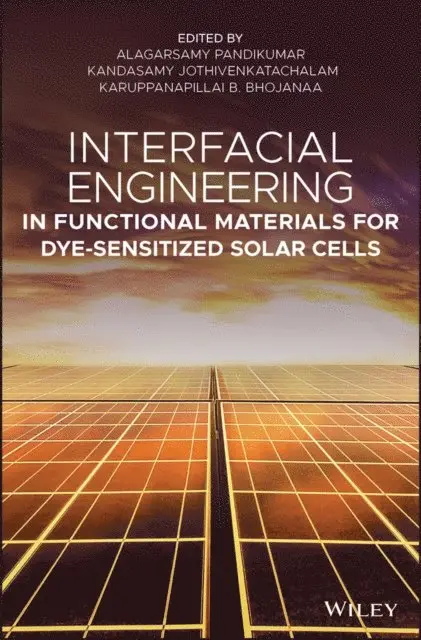
    Interfacial Engineering in Functional Materials for Dye-Sensitized Solar Cells

    AvAlagarsamy Pandikumar,Kandasamy Jothivenkatachalam

    Inbunden, Engelska, 2020

    1 690 kr

    Beställningsvara. Skickas inom 5-8 vardagar. Fri frakt över 249 kr.

    Beskrivning

    Offers an Interdisciplinary approach to the engineering of functional materials for efficient solar cell technologyWritten by a collection of experts in the field of solar cell technology, this book focuses on the engineering of a variety of functional materials for improving photoanode efficiency of dye-sensitized solar cells (DSSC). The first two chapters describe operation principles of DSSC, charge transfer dynamics, as well as challenges and solutions for improving DSSCs. The remaining chapters focus on interfacial engineering of functional materials at the photoanode surface to create greater output efficiency.Interfacial Engineering in Functional Materials for Dye-Sensitized Solar Cells begins by introducing readers to the history, configuration, components, and working principles of DSSC It then goes on to cover both nanoarchitectures and light scattering materials as photoanode. Function of compact (blocking) layer in the photoanode and of TiCl4 post-treatment in the photoanode are examined at next. Next two chapters look at photoanode function of doped semiconductors and binary semiconductor metal oxides. Other chapters consider nanocomposites, namely, plasmonic nanocomposites, carbon nanotube based nanocomposites, graphene based nanocomposites, and graphite carbon nitride based nanocompositesas photoanodes. The book: Provides comprehensive coverage of the fundamentals through the applications of DSSCEncompasses topics on various functional materials for DSSC technologyFocuses on the novel design and application of materials in DSSC, to develop more efficient renewable energy sourcesIs useful for material scientists, engineers, physicists, and chemists interested in functional materials for the design of efficient solar cellsInterfacial Engineering in Functional Materials for Dye-Sensitized Solar Cells will be of great benefit to graduate students, researchers and engineers, who work in the multi-disciplinary areas of material science, engineering, physics, and chemistry.

    Produktinformation

    • Utgivningsdatum:2020-02-10
    • Mått:185 x 257 x 20 mm
    • Vikt:748 g
    • Format:Inbunden
    • Språk:Engelska
    • Antal sidor:288
    • Förlag:John Wiley & Sons Inc
    • ISBN:9781119557333

    Utforska kategorier

    • Elektronik och kommunikationer inom Naturvetenskap och teknik
    • Maskinteknik och material inom Naturvetenskap och teknik

    Mer om författaren

    ALAGARSAMY PANDIKUMAR, PHD, is Scientist at CSIR-Central Electrochemical Research Institute, Karaikudi, India. His research includes development of novel materials involving graphene, graphitic carbon nitrides, and transition metal chalcogenides in combination with metals, metal oxides, polymers and carbon nanotubes for applications in photocatalysis, photoelectrocatalysis, dye-sensitized solar cells and electrochemical sensor. KANDASAMY JOTHIVENKATACHALAM, PHD, is Professor of Chemistry at Anna University, BIT campus, Tiruchirappalli, India. His research interests include photocatalysis, photoelectrochemistry, photoelectrocatalysis, and chemically modified electrodes. KARUPPANAPILLAI B. BHOJANAA, MSc, is DST-INSPIRE Research Fellow at Functional Materials Division, CSIR-Central Electrochemical Research Institute, Karaikudi, India.

    Innehållsförteckning

    • List of Contributors xiPreface xv1 Dye-Sensitized Solar Cells: History, Components, Configuration, and Working Principle 1S.N. Karthick, K.V. Hemalatha, Suresh Kannan Balasingam, F. Manik Clinton, S. Akshaya, and Hee-Je Kim1.1 Introduction 11.2 History of Dye-sensitized Solar Cells 31.3 Components of DSSCs 41.3.1 Conductive Glass Substrate 41.3.2 Photoanode 41.3.3 Counter Electrode 41.3.4 Electrolytes 61.3.4.1 Types of Solvents Used in Electrolytes 61.3.4.2 Alternative Redox Mediators 71.3.5 Dyes 81.4 Configuration of DSSCs 81.4.1 Metal Substrates for Photoanode and Glass/TCO for Counter Electrode 81.4.2 Metal Substrates for Counter Electrode and Glass/TCO for Photoanode 101.4.3 Metal Substrate for Photoanode and Polymer Substrate for Counter Electrode 101.4.4 Polymer Substrates for Flexible DSSCs 101.4.5 Glass/TCO-Free Metal Substrates for Flexible DSSCs 111.4.6 Glass/TCO-Free Metal Wire Substrates for Flexible DSSCs 111.5 Working Principle of DSSCs 111.5.1 Electron Transfer Mechanism in DSSCs 141.5.2 Photoelectric Performance 14Acknowledgments 15References 152 Function of Photoanode: Charge Transfer Dynamics, Challenges, and Alternative Strategies 17A. Dennyson Savariraj and R.V. Mangalaraja2.1 Introduction 172.2 The General Composition of DSSC 182.3 Selection of Substrate for DSSCs 182.4 Photoanode 192.4.1 Coating Procedure 202.4.2 Significance of Using Mesoporous Structure 202.5 Sensitizer 202.6 Charge Transfer Mechanism 212.7 Interfaces 212.8 Significance of Dye/Metal Oxide Interface 222.9 Factors That Influence Efficiency in DSSC 232.9.1 Dye Aggregation 232.9.2 Effect of Metal Oxide on the Performance of Metal Oxide/Dye Interface 242.9.3 Role of Electronic Structure of Metal Oxides 252.10 Kinetics of Operation in DSSCs 262.11 Strategies to Improve the Photoanode Performance 282.11.1 TiCl4 Treatment 282.11.2 Composites 282.11.3 Light Scattering 292.11.4 Nanoarchitectures 292.11.5 Doping 302.11.6 Interfacial Engineering 302.12 Conclusion 30Acknowledgments 31References 313 Nanoarchitectures as Photoanodes 35Hari Murthy3.1 Introduction 353.2 DSSC Operation 363.3 Nanoarchitectures for Improved Device Performance of Photoanodes 393.3.1 TiO2 393.3.2 ZnO 513.3.3 SnO2 533.3.4 Nb2O5 553.3.5 Graphene 553.3.6 Other Photoanode Materials 563.4 Future Outlook and Challenges 653.5 Conclusion 66References 664 Light Scattering Materials as Photoanodes 79Rajkumar C and A. Arulraj4.1 Introduction 794.2 Introduction to Light Scattering 794.3 Materials for Light Scattering in DSSCs 804.4 Early Theoretical Predictions of Light Scattering in DSSCs 824.5 Different Light Scattering Materials 854.5.1 Mixing of Large Particles into Small Particles 854.5.2 Voids as Light Scatters 874.5.3 Nano-Composites for Light Scattering 874.5.3.1 Nanowire–Nanoparticle Composite 874.5.3.2 Nanofiber–Nanoparticle Composite 874.5.3.3 SrTiO3 Nanocubes–ZnO Nanoparticle Composite 884.5.3.4 Silica Nanosphere–ZnO Nanoparticle Composite 884.5.3.5 SnO2 Aggregate–SnO2 Nanosheet Composite 884.5.3.6 Ag (4,4′-Dicyanamidobiphenyl) Complex–TiO2 NP Composite 884.6 Light Scattering Layers 884.6.1 Surface Modified TiO2 Particles in Scattering Layer 884.6.2 Dual Functional Materials in DSSC 894.6.3 Double-Light Scattering Layer 894.6.4 Large Particles as Scattering Layers 894.6.4.1 TiO2 Nanotubes 904.6.4.2 TiO2 Nanowires 904.6.4.3 TiO2 Nanospindles 904.6.4.4 TiO2 Nanofibers 904.6.4.5 TiO2 Rice Grain Nanostructures 904.6.4.6 Nest-Shaped TiO2 Structures 914.6.4.7 Nano-Embossed Hollow Spherical TiO2 914.6.4.8 Hexagonal TiO2 Plates 914.6.4.9 TiO2 Photonic Crystals 914.6.4.10 Cubic CeO2 Nanoparticles 944.6.4.11 Spherical TiO2 Aggregates 944.6.4.12 Hierarchical TiO2 Submicroflowers 944.6.4.13 SnO2 Aggregates 944.6.4.14 ZnO Nanoflowers 954.6.5 Core–Shell Nanoparticles for Light Scattering in DSSCs 954.6.6 Double-Layer Photoanode 954.6.6.1 TiO2 Aggregates 964.6.6.2 Morphology-Controlled 1D–3D Bilayer TiO2 Nanostructures 964.6.6.3 Quintuple-Shelled SnO2 Hollow Microspheres 964.6.6.4 Carbon-Based Materials for Light Scattering 964.6.6.5 3D N-Doped TiO2 Microspheres Used as Scattering Layers 964.6.6.6 ZnO Hollow Spheres and Urchin-like TiO2 Microspheres 964.6.6.7 SnO2 as Light-Scattering Layer 974.6.7 Three-Layer Photoanode 974.6.8 Four-Layer Photoanode 974.6.9 Surface Plasmon Effect in DSSC 974.7 Conclusion 99References 995 Function of Compact (Blocking) Layer in Photoanode 107Su Pei Lim5.1 Introduction 1075.2 Titanium Dioxide (TiO2) and Titanium (Ti)-Based Material as a Compact Layer 1075.3 Zinc Oxide (ZnO) as a Compact Layer 1125.4 Less Common Metal Oxide as a Compact Layer 1175.5 Conclusion 118References 1216 Function of TiCl4 Posttreatment in Photoanode 125T.S. Senthil and C.R. Kalaiselvi6.1 Introduction 1256.2 Role of TiCl4 Posttreatment in Photo-Anode 1266.3 Effect of Posttreatment of TiCl4 on Various Perspectives 1266.3.1 TiO2 Morphology, Porosity, and Surface Area 1266.3.2 Dye Adsorption and Photocurrent Generation 1296.3.3 Electron Transport and Diffusion Coefficient 1326.3.4 Recombination Losses at Short Circuit 1346.3.5 Concentration and Dipping Time of TiCl4 1356.4 Conclusion 136References 1377 Doped Semiconductor as Photoanode 139K. S. Rajni and T. Raguram7.1 Introduction 1397.2 Photoanode 1407.3 Characterization 1417.4 Doped TiO2 Photoanodes 1417.4.1 Alkali Earth Metals-doped TiO2 1417.4.1.1 Lithium-doped TiO2 1417.4.1.2 Magnesium-doped TiO2 1437.4.1.3 Calcium-doped TiO2 1437.4.2 Metalloids-doped TiO2 1437.4.2.1 Boron-doped TiO2 1457.4.2.2 Silicon-doped TiO2 1457.4.2.3 Germanium-doped TiO2 1457.4.2.4 Antimony-doped TiO2 1467.4.3 Nonmetals-doped TiO2 1467.4.3.1 Carbon-doped TiO2 1467.4.3.2 Nitrogen-doped TiO2 1477.4.3.3 Fluorine-doped TiO2 1477.4.3.4 Sulfur-doped TiO2 1477.4.3.5 Iodine-doped TiO2 1487.4.4 Transition Metals-doped TiO2 1487.4.4.1 Scandium-doped TiO2 1487.4.4.2 Vanadium, Niobium, and Tantalum-doped TiO2 1487.4.4.3 Chromium-doped TiO2 1487.4.4.4 Manganese and Cobalt-doped TiO2 1507.4.4.5 Iron-doped TiO2 1507.4.4.6 Nickel-doped TiO2 1517.4.4.7 Copper-doped TiO2 1527.4.4.8 Zinc-doped TiO2 1537.4.4.9 Yttrium-doped TiO2 1537.4.4.10 Zirconium-doped TiO2 1547.4.4.11 Molybdenum-doped TiO2 1547.4.4.12 Silver-doped TiO2 1557.4.5 Post-Transition Metals 1557.4.5.1 Aluminum-doped TiO2 1557.4.5.2 Gallium-doped TiO2 1557.4.5.3 Indium-doped TiO2 1557.4.5.4 Tin-doped TiO2 1567.4.6 Lanthanides-doped TiO2 1567.4.6.1 Lanthanum-doped TiO2 1567.4.6.2 Cerium-doped TiO2 1567.4.6.3 Neodymium-doped TiO2 1577.4.6.4 Samarium-doped TiO2 1577.4.6.5 Europium-doped TiO2 1577.4.7 Co-doped TiO2 1587.4.8 Tri-doped TiO2 1587.5 Conclusion 158References 1598 Binary Semiconductor Metal Oxide as Photoanodes 163S.S. Kanmani, I. John Peter, A. Muthu Kumar, P. Nithiananthi, C. Raja Mohan, and K. Ramachandran8.1 Why Metal Oxide Semiconductors? 1638.2 Development of MOS-Based DSSC 1648.2.1 TiO2/ZnO Core/Shell Configuration 1658.2.2 Preparation of TiO2/ZnO Core/Shell Nanomaterials 1658.2.3 TiO2/ZnO Core/Shell Nanomaterials 1658.2.4 DSSC Performance of TiO2/ZnO Core/Shell Configuration 1678.3 Importance of Heterostructures 1708.4 I–V Characteristics 1718.5 Matching of Bandgaps 1718.6 Conclusion 189References 1899 Plasmonic Nanocomposite as Photoanode 193Su Pei Lim9.1 Introduction 1939.2 Plasmonic Nanocomposite Modified TiO2 as Photoanode 1939.3 Plasmonic Nanocomposite Modified ZnO as Photoanode 1979.4 Plasmonic Nanocomposite Modified with Less Common Metal Oxide as Photoanode 2039.5 Conclusion 206References 20610 Carbon Nanotubes-Based Nanocomposite as Photoanode 213Giovana R. Cagnani, Nirav Joshi, and Flavio M. Shimizu10.1 Introduction 21310.2 Recent Advances on DSSC Photoanodes 21510.3 Structure and Properties of Carbon Nanotubes 21610.4 CNT-Based Photoanode Material 21810.5 Effect of the Morphology and Interface of the CNT Photoanodes on the Efficiency of the DSSC 22110.6 Summary and Future Prospect 223Acknowledgment 223References 22311 Graphene-Based Nanocomposite as Photoanode 231Subhendu K. Panda, G. Murugadoss, and R. Thangamuthu11.1 Introduction 23111.2 Graphene–TiO2 Nanocomposite for Photoanode 23211.3 Conclusion and Remarks 241References 24212 Graphitic Carbon Nitride Based Nanocomposites as Photoanodes 247T.S. Shyju, S. Anandhi, P. Vengatesh, C. Karthik Kumar, and M. Paulraj12.1 Introduction 24712.2 Importance of Graphitic Carbon Nitride 24812.3 Photoanodes for DSSC 25012.4 Preparation of Graphitic Carbon Nitride 25212.4.1 Bulk Graphitic Carbon Nitride 25312.4.2 Mesoporous Graphitic Carbon Nitrides 25312.4.3 Doping in Graphitic Carbon Nitride 25412.4.4 Ag Deposited g-C3N4 25412.4.5 Chemical Doping 25412.5 Operation Principles of DSSC 25512.5.1 Nanostructured Graphitic Carbon Nitride in DSSC 25712.6 Graphitic Carbon Nitride in Polymer Films Solar Cell 25912.7 Preparation of Carbon Nitride Counter Electrode 25912.8 Quantum Dot Graphitic Carbon Nitride 26012.9 Porous Graphitic Carbon Nitride 26012.10 Summary 260Acknowledgment 261References 261Index 265