Alagarsamy Pandikumar - Böcker
Visar alla böcker från författaren Alagarsamy Pandikumar. Handla med fri frakt och snabb leverans.
10 produkter
10 produkter
2 051 kr
Skickas inom 7-10 vardagar
An interdisciplinary guide to the newest solar cell technology for efficient renewable energyRational Design of Solar Cells for Efficient Solar Energy Conversion explores the development of the most recent solar technology and materials used to manufacture solar cells in order to achieve higher solar energy conversion efficiency. The text offers an interdisciplinary approach and combines information on dye-sensitized solar cells, organic solar cells, polymer solar cells, perovskite solar cells, and quantum dot solar cells.The text contains contributions from noted experts in the fields of chemistry, physics, materials science, and engineering. The authors review the development of components such as photoanodes, sensitizers, electrolytes, and photocathodes for high performance dye-sensitized solar cells. In addition, the text puts the focus on the design of material assemblies to achieve higher solar energy conversion. This important resource: Offers a comprehensive review of recent developments in solar cell technologyIncludes information on a variety of solar cell materials and devices, focusing on dye-sensitized solar cellsContains a thorough approach beginning with the fundamental material characterization and concluding with real-world device application.Presents content from researchers in multiple fields of study such as physicists, engineers, and material scientistsWritten for researchers, scientists, and engineers in university and industry laboratories, Rational Design of Solar Cells for Efficient Solar Energy Conversion offers a comprehensive review of the newest developments and applications of solar cells with contributions from a range of experts in various disciplines.
1 838 kr
Skickas inom 7-10 vardagar
A comprehensive volume on photocatalytic functional materials for environmental remediationAs the need for removing large amounts of pollution and contamination in air, soil, and water grows, emerging technologies in the field of environmental remediation are of increasing importance. The use of photocatalysis—a green technology with enormous potential to resolve the issues related to environmental pollution—breaks down toxic organic compounds to mineralized products such as carbon dioxide and water. Due to their high performance, ease of fabrication, long-term stability, and low manufacturing costs, photofunctional materials constructed from nanocomposite materials hold great potential for environmental remediation.Photocatalytic Functional Materials for Environmental Remediation examines the development of high performance photofunctional materials for the treatment of environmental pollutants.This timely volume assembles and reviews a broad range of ideas from leading experts in fields of chemistry, physics, nanotechnology, materials science, and engineering. Precise, up-to-date chapters cover both the fundamentals and applications of photocatalytic functional materials. Semiconductor-metal nanocomposites, layered double hydroxides, metal-organic frameworks, polymer nanocomposites, and other photofunctional materials are examined in applications such as carbon dioxide reduction and organic pollutant degradation. Providing interdisciplinary focus to green technology materials for the treatment of environmental pollutants, this important work: Provides comprehensive coverage of various photocatalytic materials for environmental remediation useful for researchers and developersEncompasses both fundamental concepts and applied technology in the fieldFocuses on novel design and application of photocatalytic materials used for the removal of environmental contaminates and pollutionOffers in-depth examination of highly topical green-technology solutionsPresents an interdisciplinary approach to environmental remediationPhotocatalytic Functional Materials for Environmental Remediation is a vital resource for researchers, engineers, and graduate students in the multi-disciplinary areas of chemistry, physics, nanotechnology, environmental science, materials science, and engineering related to photocatalytic environmental remediation.
Interfacial Engineering in Functional Materials for Dye-Sensitized Solar Cells
Inbunden, Engelska, 2020
1 576 kr
Skickas inom 7-10 vardagar
Offers an Interdisciplinary approach to the engineering of functional materials for efficient solar cell technologyWritten by a collection of experts in the field of solar cell technology, this book focuses on the engineering of a variety of functional materials for improving photoanode efficiency of dye-sensitized solar cells (DSSC). The first two chapters describe operation principles of DSSC, charge transfer dynamics, as well as challenges and solutions for improving DSSCs. The remaining chapters focus on interfacial engineering of functional materials at the photoanode surface to create greater output efficiency.Interfacial Engineering in Functional Materials for Dye-Sensitized Solar Cells begins by introducing readers to the history, configuration, components, and working principles of DSSC It then goes on to cover both nanoarchitectures and light scattering materials as photoanode. Function of compact (blocking) layer in the photoanode and of TiCl4 post-treatment in the photoanode are examined at next. Next two chapters look at photoanode function of doped semiconductors and binary semiconductor metal oxides. Other chapters consider nanocomposites, namely, plasmonic nanocomposites, carbon nanotube based nanocomposites, graphene based nanocomposites, and graphite carbon nitride based nanocompositesas photoanodes. The book: Provides comprehensive coverage of the fundamentals through the applications of DSSCEncompasses topics on various functional materials for DSSC technologyFocuses on the novel design and application of materials in DSSC, to develop more efficient renewable energy sourcesIs useful for material scientists, engineers, physicists, and chemists interested in functional materials for the design of efficient solar cellsInterfacial Engineering in Functional Materials for Dye-Sensitized Solar Cells will be of great benefit to graduate students, researchers and engineers, who work in the multi-disciplinary areas of material science, engineering, physics, and chemistry.
Del 82 - Materials Research Foundations
Graphene-Based Electrochemical Sensors for Toxic Chemicals
Häftad, Engelska, 2020
1 438 kr
Skickas inom 5-8 vardagar
Del 111 - Materials Research Foundations
Bioinspired Nanomaterials
Synthesis and Emerging Applications
Häftad, Engelska, 2021
1 302 kr
Skickas inom 5-8 vardagar
Del 121 - Materials Research Foundations
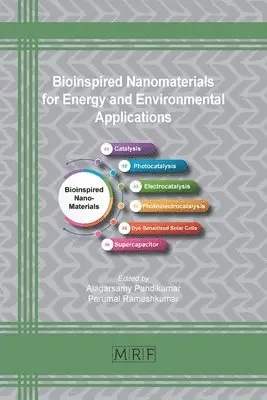
Bioinspired Nanomaterials for Energy and Environmental Applications
Häftad, Engelska, 2022
1 045 kr
Skickas inom 5-8 vardagar
Del 163 - Materials Research Foundations
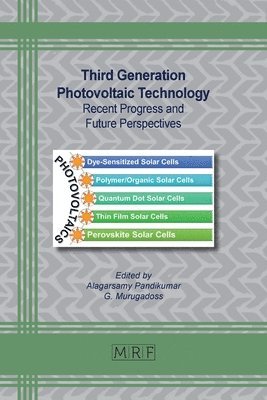
Third Generation Photovoltaic Technology
Recent Progress and Future Perspectives
Häftad, Engelska, 2024
1 099 kr
Skickas inom 5-8 vardagar
Del 170 - Materials Research Foundations
Emerging Materials for Next Frontier Energy and Environment Applications
Häftad, Engelska, 2024
1 062 kr
Skickas inom 5-8 vardagar
2 127 kr
Skickas inom 3-6 vardagar
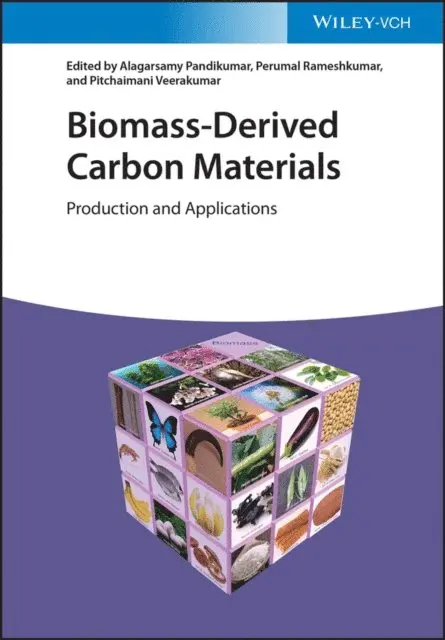
Explores the sustainable production of carbon materials and their applications Of increasing interest to practitioners and researchers in a variety of areas, biomass-derived carbon materials can be easily produced and possess the large surface areas and porosities that enable many applications in materials science, biochemistry, chemistry, and energy research. In Biomass-Derived Carbon Materials: Production and Applications, a team of accomplished researchers delivers a thorough and up-to-date exploration of the preparation and activation processes of biomass-derived carbon materials, the fabrication of composites, and assorted and multidisciplinary applications of the technology. The book also covers future opportunities for research and application. Introductory chapters provide information about the production, functionalization, and characterization of biomass-derived carbon materials, while the latter parts of this edited volume discuss the applications of biomass-derived carbon materials such as catalysis, sensors, microbicidal activity, toxic chemicals removal, drug delivery, and energy conversion and storage applications. The book also includes: A thorough introduction to the production of biomass-derived carbon materials, as well as their characterizationComprehensive explorations of biomass-derived carbon-based materials for microbicidal applications and carbon-based nanomaterials prepared from biomass for catalysisPractical discussions of biomass-derived carbon quantum dots for fluorescence sensors and mesoporous carbon nanomaterials for drug delivery and imaging applicationsIn-depth examinations of biomass-derived carbon as electrode materials for batteries and porous carbon synthesized from biomass for fuel cellsIdeal for materials scientists as well as industrial chemists and biochemists, Biomass-Derived Carbon Materials: Production and Applications also belongs in the libraries of electrochemists and sensor developers.
1 572 kr
Skickas inom 10-15 vardagar
Renewable energies have become an attractive option to overcome the energy demands in sustainable and affordable ways. It has been estimated that one-third of the total renewable energies would be generated from photovoltaics (PVs). A solar or PV cell is a device that directly converts sunlight into electricity by taking benefit of the photoelectric effect. In the third-generation solar PVs, dye-sensitized solar cells (DSSCs) are believed to be the most promising and have attracted wide attention. The optimization of a DSSC is focused on four main components: (i) metal oxide semiconductor, (ii) photosensitizer, (iii) redox couple electrolyte, and (iv) counter electrode. Among these, the counter electrode undertakes three functions: (i) as a catalyst, (ii) as a positive electrode of primary cells, and (iii) as a mirror. To obey these functions, the electrode material should have high catalytic activity, high conductivity, high reflectivity, high surface area, and electrochemical and mechanical stability. To improve the performance of DSSCs, many scientists have developed new counter electrodes made of platinum, carbon materials, transition metals, conductive polymers, and composites. This book converses the various aspects of materials for the fabrication of counter electrodes especially for the DSSCs.