• Fri frakt över 249 kr
  • •
  • Snabba leveranser
  • •
  • Billiga böcker
Kundservice

Du är på sajten för privatpersoner.

Företag, bibliotek eller offentlig verksamhet?

Du handlar på classic.bokus.com, där alla dina funktioner finns intakta.
Till classic.bokus.com
Bokus logotyp. Gå till startsidan.
  • Erbjudanden
  • Nyheter
  • Student
  • Topplistor
  • Barn & ungdom
  • Bokus Play
  • E-böcker
  • Pocketböcker
  • Spel & pussel

10% rabatt på allt med kod NYSTART10 →

Sidfot

Mina sidor

    Hjälp

    • Kundservice
    • Vanliga frågor och svar
    • Frakt och leverans
    • Retur vid ångerrätt
    • Reklamera vara
    • Betalning
    • Köpvillkor
    • Allmänna villkor
    • Information om webbplatsens tillgänglighet

    Om Bokus

    • Om oss
    • Pressrum
    • För studenter
    • För företag
    • För bibliotek och offentlig verksamhet
    • För leverantörer
    • Hållbarhet

    Populärt

    • Aktuella erbjudanden
    • Presentkort
    • Studentlitteratur
    • Nya böcker
    • Topplistor
    • Signerade böcker
    • Engelska böcker

    Inspiration

    • Boktips
    • BookTok
    • Populära bokserier
    • Barnbokskaraktärer
    • Populära författare
    Logotyp för Bokus
    Följ oss på Facebook (extern länk)Följ oss på Instagram (extern länk)Följ oss på YouTube (extern länk)Följ oss på TikTok (extern länk)
    bokus @ CookiesAnpassa cookiesIntegritetspolicyKöpvillkor
    Till Citymail hemsida (extern länk)Till Budbee hemsida (extern länk)Till Postnord hemsida (extern länk)Till Schenker hemsida (extern länk)Till Early Bird hemsida (extern länk)Till Walleys hemsida (extern länk)
    1. Ekonomi och Ledarskap
    2. Företagsekonomi
    3. Entreprenörskap

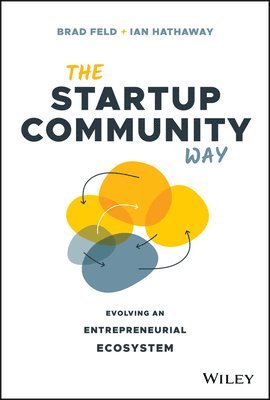
    Startup Community Way

    Evolving an Entrepreneurial Ecosystem

    AvBrad Feld,Ian Hathaway

    Inbunden, Engelska, 2020

    223 kr

    Beställningsvara. Skickas inom 5-8 vardagar. Fri frakt över 249 kr.

    Beskrivning

    The Way Forward for Entrepreneurship Around the WorldWe are in the midst of a startup revolution. The growth and proliferation of innovation-driven startup activity is profound, unprecedented, and global in scope. Today, it is understood that communities of support and knowledge-sharing go along with other resources. The importance of collaboration and a long-term commitment has gained wider acceptance. These principles are adopted in many startup communities throughout the world.And yet, much more work is needed. Startup activity is highly concentrated in large cities. Governments and other actors such as large corporations and universities are not collaborating with each other nor with entrepreneurs as well as they could. Too often, these actors try to control activity or impose their view from the top-down, rather than supporting an environment that is led from the bottom-up. We continue to see a disconnect between an entrepreneurial mindset and that of many actors who wish to engage with and support entrepreneurship. There are structural reasons for this, but we can overcome many of these obstacles with appropriate focus and sustained practice.No one tells this story better than Brad Feld and Ian Hathaway. The Startup Community Way: Evolving an Entrepreneurial Ecosystem explores what makes startup communities thrive and how to improve collaboration in these rapidly evolving, complex environments.The Startup Community Way is an explanatory guide for startup communities. Rooted in the theory of complex systems, this book establishes the systemic properties of entrepreneurial ecosystems and explains why their complex nature leads people to make predictable mistakes. As complex systems, value creation occurs in startup communities primarily through the interaction of the "parts" - the people, organizations, resources, and conditions involved - not the parts themselves. This continual process of bottom-up interactions unfolds naturally, producing value in novel and unexpected ways. Through these complex, emergent processes, the whole becomes greater and substantially different than what the parts alone could produce.Because of this, participants must take a fundamentally different approach than is common in much of our civic and professional lives. Participants must take a whole-system view, rather than simply trying to optimize their individual part. They must prioritize experimentation and learning over planning and execution. Complex systems are uncertain and unpredictable. They cannot be controlled, only guided and influenced. Each startup community is unique. Replication is enticing but impossible. The race to become "The Next Silicon Valley" is futile - even Silicon Valley couldn't recreate itself.This book: Offers practical advice for entrepreneurs, community builders, government officials, and other stakeholders who want to harness the power of entrepreneurship in their cityDescribes the core components of startup communities and entrepreneurial ecosystems, as well as an explanation of the differences between these two related, but distinct conceptsAdvances a new framework for effective startup community building based on the theory of complex systems and insights from systems thinkingIncludes contributions from leading entrepreneurial voicesIs a must-have resource for entrepreneurs, venture capitalists, executives, business and community leaders, economic development authorities, policymakers, university officials, and anyone wishing to understand how startup communities work anywhere in the world

    Produktinformation

    • Utgivningsdatum:2020-09-07
    • Mått:152 x 231 x 28 mm
    • Vikt:568 g
    • Format:Inbunden
    • Språk:Engelska
    • Antal sidor:368
    • Förlag:John Wiley & Sons Inc
    • ISBN:9781119613602

    Utforska kategorier

    • Entreprenörskap inom Ekonomi och Ledarskap

    Mer om författaren

    BRAD FELD has been an early-stage investor and entrepreneur for over 30 years. He is currently a partner at Foundry Group and is a co-founder of Techstars. In addition to his investing efforts, Brad runs the Anchor Point Foundation with his wife Amy Batchelor. Brad is a nationally recognized speaker on the topics of venture capital investing and entrepreneurship. IAN HATHAWAY is an analyst, strategist, and writer. He has been an advisor and executive for leaders in technology, media, and finance on a range of innovation, strategy, and policy initiatives. He is a leading thinker and writer in the areas of entrepreneurship, innovation, cities, and the economy. Ian also advises and invests in startups in the United States and Europe.

    Innehållsförteckning

    • Foreword xiiiPreface xviiChapter One Introduction 1The Next Generation 2Our Approach 3A Deeper Motivation 5The Boulder Thesis 7Startup Communities are Complex Adaptive Systems 8Where We Were in 2012 10Where We are Now in 2020 12Using Complexity Theory to Explain Startup Communities 14Evolving the Boulder Thesis to the Startup Community Way 17Part I Introduction to Startup Communities 21Chapter Two Why Startup Communities Exist 23What Entrepreneurs Do 23The External Environment 25Networks over Hierarchies 27Networks of Trust 29Density and Agglomeration 33Quality of Place 35Chapter Three The Actors 41Leaders, Feeders, and Instigators 42Actors 45Chapter Four The Factors 59The Seven Capitals 60Factors 62Chapter Five Startup Communitiesversus Entrepreneurial Ecosystems 75Entrepreneurial Ecosystems 77Alignment of Actors 78Different, but Mutually Reinforcing, Purpose 80Systems within Systems 81Entrepreneurial Success 84Community/Ecosystem Fit 85Part II Startup Communities as Complex Systems 93Chapter Six Putting the System Back into Ecosystem 95Introduction to Systems 96The Whole System 97Simple, Complicated, and Complex Activities 103Moving from Activities to Systems 107Chapter Seven Unpredictable Creativity 115Emergence 117Synergies and Nonlinearity 118Self-Organization 120Dynamism 121The Study of Interactions 125Chapter Eight The Myth of Quantity 133More of Everything 134Outliers, Not Averages 136Entrepreneurial Recycling 138Leaders as Supernodes 140Chapter Nine The Illusion of Control 151Not Controllable 152Not Fully Knowable 154Feedbacks and Contagion 156Getting Unstuck 158Letting Go 160Chapter Ten The Absence of a Blueprint 165Initial Conditions and Basins of Attraction 168The Narrative Fallacy 170Building on Strengths and Learning from Failures 172Cultivating Topophilia 174Chapter Eleven The Measurement Trap 183The Fundamental Measurement Problem 184Actor and Factor Models: A Categorical Approach 186Standardized Metrics Models: A Comparative Approach 188Network Models: A Relational Approach 190Dynamic Models: An Evolutionary Approach 192Cultural-Social Models: A Behavioral Approach 194Logic Models: A Causal Approach 195Agent-Based Models: A Simulation Approach 198Applying the Different Models 199Part III From the Boulder Thesis to the Startup Community Way 207Chapter Twelve Simplifying Complexity 209The Boulder Thesis 210The Rainforest 212Applying Systems Thinking 214Looking Deeply 216Leverage Points 219Chapter Thirteen Leadership is Key 231Be a Mentor 234Entrepreneurs as Role Models 235Key Leadership Characteristics 237Chapter Fourteen Think in Generations 243Progress is Uneven and Often Feels Slow 245The Endless Long-Term Game 247Chapter Fifteen Diversity is a Feature, Not a Bug 255Cultivate Diversity 256Embracing Diversity 259Think Broadly about Entrepreneurship 260Chapter Sixteen Be Active, Not Passive 267Self-Similarity and Replication 268Don’t Wait or Ask Permission 269Play a Positive-Sum Game 270Continuously and Actively Engage 275Part IV Conclusion 281Chapter Seventeen Conclusion 283Reflections 283Summary of the Book 285Final Thoughts 291About the Authors 295Acknowledgments 297Notes 301Index 325