• Fri frakt över 249 kr
  • •
  • Snabba leveranser
  • •
  • Billiga böcker
Kundservice

Du är på sajten för privatpersoner.

Företag, bibliotek eller offentlig verksamhet?

Du handlar på classic.bokus.com, där alla dina funktioner finns intakta.
Till classic.bokus.com
Bokus logotyp. Gå till startsidan.
  • Erbjudanden
  • Nyheter
  • Student
  • Topplistor
  • Barn & ungdom
  • Bokus Play
  • E-böcker
  • Pocketböcker
  • Spel & pussel

10% studentrabatt med kod TERM26

Sidfot

Mina sidor

    Hjälp

    • Kundservice
    • Vanliga frågor och svar
    • Frakt och leverans
    • Retur vid ångerrätt
    • Reklamera vara
    • Betalning
    • Köpvillkor
    • Allmänna villkor
    • Information om webbplatsens tillgänglighet

    Om Bokus

    • Om oss
    • Pressrum
    • För studenter
    • För företag
    • För bibliotek och offentlig verksamhet
    • För leverantörer
    • Hållbarhet

    Populärt

    • Aktuella erbjudanden
    • Presentkort
    • Studentlitteratur
    • Nya böcker
    • Topplistor
    • Signerade böcker
    • Engelska böcker

    Inspiration

    • Boktips
    • BookTok
    • Populära bokserier
    • Barnbokskaraktärer
    • Populära författare
    Logotyp för Bokus
    Följ oss på Facebook (extern länk)Följ oss på Instagram (extern länk)Följ oss på YouTube (extern länk)Följ oss på TikTok (extern länk)
    bokus @ CookiesAnpassa cookiesIntegritetspolicyKöpvillkor
    Till Citymail hemsida (extern länk)Till Budbee hemsida (extern länk)Till Postnord hemsida (extern länk)Till Schenker hemsida (extern länk)Till Early Bird hemsida (extern länk)Till Walleys hemsida (extern länk)
    1. Språk och ordböcker
    2. Språkvetenskap och lingvistik

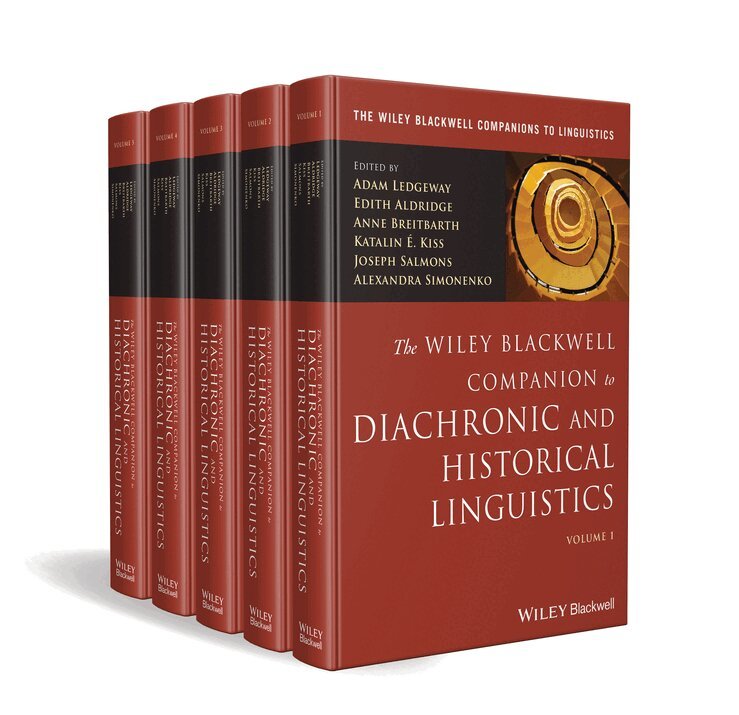
    Wiley Blackwell Companion to Diachronic and Historical Linguistics, 5 Volume Set

    AvAdam Ledgeway,Edith Aldridge

    Inbunden, Engelska, 2026

    Del i serien Wiley Companions to Linguistics

    10 680 kr

    Beställningsvara. Skickas inom 5-8 vardagar. Fri frakt över 249 kr.

    Beskrivning

    The first multi-volume reference work dedicated entirely to the field of diachronic linguistics The Wiley Blackwell Companion to Diachronic and Historical Linguistics is a state-of-the-art resource that explores the mechanisms underlying linguistic evolution. Bridging the gap between theoretical models and empirical research, this comprehensive work connects linguistics with allied disciplines such as psychology, anthropology, sociology, and biology, and provides an enriched understanding of how language interacts with human society and cognition. Contributions from more than 150 leading scholars cover an unparalleled range of key topics, from phonetics and syntax to semantics, pragmatics, and beyond. Spanning five volumes, the Companion combines cutting-edge theoretical perspectives with detailed case studies from a variety of language families, including underrepresented and non-verbal languages, such as sign languages. By examining the interaction of linguistic systems with societal and environmental factors, this landmark work offers a robust framework for investigating the dynamics of language variation and historical development. Synthesizing decades of groundbreaking research while paving the way for new discoveries, The Wiley Blackwell Companion to Diachronic and Historical Linguistics: Presents insights from diverse theoretical frameworks and methodologies in one comprehensive collectionFeatures in-depth analyses of diverse languages and language families, including lesser-studied languagesExplores the dynamics of language change within and across speakers, communities, and societiesHighlights the role of computational tools and statistical methods in advancing diachronic researchEstablishes connections with related fields to foster interdisciplinary collaborationThe Wiley Blackwell Companion to Diachronic and Historical Linguistics is ideal for advanced undergraduate, graduate, and postgraduate students in linguistics, particularly those taking courses on diachronic linguistics, historical linguistics, and language change. It is an indispensable reference for researchers and practitioners in fields intersecting with language evolution, including academic and professional linguists, philologists, and anthropologists engaged in exploring the complexities of language development and change.

    Produktinformation

    • Utgivningsdatum:2026-04-09
    • Mått:10 x 10 x 10 mm
    • Vikt:454 g
    • Format:Inbunden
    • Språk:Engelska
    • Serie:Wiley Companions to Linguistics
    • Antal sidor:3 536
    • Förlag:John Wiley & Sons Inc
    • ISBN:9781119898016

    Utforska kategorier

    • Språkvetenskap och lingvistik inom Språk och ordböcker

    Mer om författaren

    Adam Ledgeway is a Fellow of the British Academy and a Member of the Academia Europaea. Formerly Professor of Italian and Romance Linguistics at the University of Cambridge and now Professor of Italian Linguistics at the University of Bergamo, his research focuses on the historical development and morphosyntax of Romance languages, language change, and contact linguistics. Edith Aldridge is a Research Fellow at Academia Sinica and a former Associate Professor at the University of Washington. Her expertise lies in diachronic and comparative syntax, focusing on Austronesian languages, Chinese, and Japanese. Anne Breitbarth is an Associate Professor at Ghent University, specializing in historical German linguistics, morphosyntactic change, and formal corpus linguistics. She has led major research projects and serves as an editor for Taal & Tongval. Katalin É. Kiss is Professor Emeritus at the Hungarian Research Centre for Linguistics and a member of the Hungarian Academy of Sciences. Her research focuses on Uralic languages, syntactic theory, and diachronic syntax. She has authored over 250 scholarly works. Joseph Salmons is the Lester W.J. "Smoky" Seifert Professor of Language Sciences at the University of Wisconsin–Madison. An expert in sound change and historical linguistics, he edited Diachronica for nearly two decades. Alexandra Simonenko is an Associate Professor in the Department of Linguistics at Ghent University. She is currently the Principal Investigator for the ERC-funded project CAUSALITY, aimed at modeling potential cause-effect relations in language change.

    Innehållsförteckning

    • Thematic List of Contents xiiiEditors xviiContributors xixPreface xxixVolume IDiachronic Linguistics: An Overview 1Joseph SalmonsAbruptness in Language Change 19Graeme TrousdaleAcoustic-Perceptual Factors in the Actuation of Sound Change 37James Kirby and Jonathan HarringtonAcquisition and Learnability 75Ailis CournaneAlignment Change 95Edith AldridgeAnalogy and Extension 123David FertigApproaches to the Comparative Linguistics of Sign Languages 143Justin M. Power and Keiko SagaraArgument Structure 165Leonid KulikovAspectual Changes: Aktionsart versus Perfectivity 199Amalia MoserAssimilation and Dissimilation Processes in Sound Change 225Joachim Kokkelmans and Eirini ApostolopoulouAt the Interfaces: Indigenous and Non-Indigenous Sources of Phonological Change 251Holly Kennard and Aditi LahiriAutonomy of Morphology: Paradigmatic Structure in Diachrony 275Borja Herce(Basic) Word Order 293Lieven DanckaertBorrowing of Linguistic Rules 317Metin Ba˘grıacıkCausality at the Interfaces: Non-Syntactic Triggers of Syntactic Change 343Tara StruikChain Shifts 369Monica Nesbitt and Samson LotvenChange in Contrastive Hierarchies 391Will OxfordChanges across the Lifespan 409Isabelle Buchstaller and James GramaChanges from Below and from Above 437Lauren Hall-LewChanging Patterns of Deixis in the Nominal Domain 455Alexandra SimonenkoChanging Patterns of Deixis in the Verbal Domain 485Mario SquartiniCode-Switching 505Ad BackusComparative Method and Comparative Reconstruction 527Koen Bostoen and Martine RobbeetsComplex Predicate Formation 551Veronika Heged˝usCompounding 571Angela RalliComputational Models of Semantic Change 595Nina Tahmasebi, Andrey Kutuzov, Haim Dubossarsky, and Mario GiulianelliConditioning 629Pavel IosadVolume IIConfigurationality: Changing Patterns of Morphology and Syntax 657Adam LedgewayContact and Borrowing 691Anthony GrantConvergence and Linguistic Areas 713Victor A. Friedman and Brian D. JosephCounting Systems 729Brigitte L.M. BauerCyclicity 755John W.W. Powell and Elly van Gelderen(De)Grammaticalization 783Muriel NordeDeletion (aphaeresis, syncope, apocope) 813Daniel RecasensDerivation 835Carola Trips and Charles YangDiachronic Creole Syntax: Lessons from Cabo Verdean, Haitian, and Sranan 863Marlyse Baptista and Ariana BancuDiachronic Patterns of Affixation 889Judith MeinschaeferDiachronic Typological Universals 917Shelece EasterdayDiachrony and the Bases of Synchronic Regularity 953Stephen R. AndersonDiachrony of Morphological Strategies 973Ivan IgartuaDialectology 1001Tommaso Balsemin, Emanuela Sanfelici, and Cecilia PolettoDirectionality 1033Katalin E. KissEconomy 1061Anna RoussouEllipsis 1083Remus Gergel and Sonia CyrinoThe Emergence of Determiners across Time 1115Anne CarlierEndogeny and Exogeny 1169Marianne MithunEvolution of the Structural Encoding of Discourse Functions 1195Augustin SpeyerExaptation and Related Processes of Language Change 1223Ilse WischerFamily Tree Model 1245Thomas Pellard, Robin J. Ryder, and Guillaume JacquesFolk Etymology and Contamination 1279Martin MaidenFrequency 1299Dirk Pijpops and Eva ZehentnerGenre Variation and Change across Registers of Writing 1327Irma Taavitsainen, Matylda Włodarczyk, and Jukka TyrkkoGrammar Competition and Variational Learning 1355Joel Wallenberg, Henri Kauhanen, George Walkden, and Caroline HeycockVolume IIIHypothetical Routes from Parataxis to Hypotaxis 1387Katrin Axel-Tober and Helmut WeisIllocutionary Force: Encoding Utterance Meaning and Function through Time 1415Roland Hinterholzl and Nicola MunaroIndirect Language Contact and Pragmatic Borrowing 1443Elizabeth PetersonInertia and Anti-Inertia Theories of Syntactic Change 1461Chris H. ReintgesInflectional Change and Morphological Theory 1493Nigel VincentInformation Structure in Diachronic Change 1511Marco Coniglio and Esther RinkeInsertion (prosthesis, epenthesis) 1541Nancy HallOn Language Acquisition as the Locus of Reanalysis 1567Esther Rinke, Jurgen M. Meisel, and Georg A. KaiserLanguage Shift, Obsolescence, and Death 1591Joshua R. Brown and Michael T. PutnamLenition and Fortition: Environments, Processes, and Representations 1609Andras CserLexical Change and Stability 1631Steven N. Dworkin and Philip DurkinLexical Frequency and Diffusion 1649Vsevolod KapatsinskiLexicalization 1673Alain PeyraubeLife Cycle of Phonological Processes 1693Michael RamsammyLoss and Leveling 1717Joshua BousquetteMarkedness, Naturalness, and Complexity 1739Nikolaus RittMechanisms of Change in Lexical Semantics 1761Karlien FrancoMergers and Splits 1781Sarah BabinskiMetathesis 1803Ander EgurtzegiMixed Languages 1827Jesse StewartModality and Mood 1855Francesca Dell’OroMorphing Creole Languages 1887Fabiola Henri and Jose Carlos Antonio Perez VargasMorphological Agreement 1913Paolo MiliziaMorphological Reanalysis: Recycling Old Form to New Function 1939Laura A. JandaMorphological Universals and Tendencies 1963Dunstan BrownMorphologization (from phonology and syntax) and Demorphologization 1991Livio GaetaMorphology and Syntax in Competition: The Place of Inflectional Periphrasis 2021Andrew Spencer and Gergana PopovaNegation: Diachronic Developments 2045M.Teresa Espinal and Susagna TubauNon-Morphological Sources and Triggers of Morphological Change 2077Ekaterina Georgieva and Irina BurukinaVolume IVOnomasiological Variation: How We Name Extralinguistic Reality 2095Jesus Fernandez DominguezThe Penthouse Principle Revisited 2115Sam WolfePeriodization 2147John Charles SmithPhonological Constraints and Conditioning in Diachronic Morphology 2167Yuni Kim and Mary PasterPhonological Universals in Sound Change 2189David NatvigPragmatic Strengthening and Conventionalized Implicature 2211Regine EckardtProcessing Efficiency 2231Richard FutrellProductivity 2265Johanna Barðdal, Renata Enghels, Quentin Feltgen, Sven Van Hulle, and Peter LauwersPropagation of Change: Computational Models 2293Henri KauhanenProsodic Changes and Metrical Restructuring: Syllables, Feet, and Prosodic Templates 2317Laura Catharine SmithProto-Languages 2351Gerd Carling and Filip LarssonQuantification 2379Tamas HalmReanalysis and Restructuring 2417Helmut WeisReconstruction without Broad Comparison: Internal Reconstruction 2437Jose Ignacio HualdeRegularity and Exceptions 2459Peter RebrusRelative Clauses 2489Eva DekanyRevisiting the Five Foundational Problems of Weinreich, Labov, and Herzog (1968) 2523Anne BreitbarthRise and Fall of Case: When Syntax Meets Morphology 2549Nikolaos Lavidas and Eleni PlakoutsiSalience 2589Peter RaczSemantic Universals 2605Chiara GianolloSemasiological Variation 2629Dirk GeeraertsSocial Conditioning, Differentiation, and Linguistic Valuation 2645Jon ForrestSociocultural Drivers of Lexical Innovation 2667Terttu Nevalainen and Tanja SailySociolinguistic Typology: Complexification and Simplification 2687Christian Bentz and Annemarie VerkerkSources of Nominal Number Markers 2717Patricia Cabredo HofherrVolume VStandardization 2755Gijsbert RuttenSubgrouping 2777Daniel KaufmanSubjectification and Intersubjectification 2813Elizabeth Closs Traugott, Katsunobu Izutsu, and Mitsuko Narita IzutsuSuppletion 2837Ljuba VeselinovaSyncretism 2889Louise EsherSyntactic Changes in Nominal Agreement 2913Giampaolo SalviSyntactic Changes in Verbal Agreement 2945Charlotte Hemmings, Hannah Gibson, and Lutz MartenSyntactic Methods for Language Phylogenies 2971Cristina Guardiano and Giuseppe LongobardiSyntactic Reanalysis 3011Marieke MeelenSyntagmatic and Paradigmatic Changes in Meaning 3037Josh Phillips and Martin FuchsTense, Aspect, and Mood Systems 3059Barbara MeisterernstTonogenesis and the Evolution of Tone Systems 3093Marc Brunelle and James KirbyTransmission and Diffusion of Syntactic Change 3129David WillisTransparency 3157Eric HaeberliTypology of Prosodic Organization 3177Martin KummelUniformitarianism 3195Claire BowernVariation and Change in Language Revitalization 3217Itxaso Rodriguez-Ordonez and Jonathan R. KasstanVoice Alternations in Diachrony 3239Laura Grestenberger and Iris Tanza-KamilWave Model 3289Jamin Pelkey and Siva KalyanWord-Order Universals: A Formal Approach 3315Ian RobertsWorking with Dead Languages 3337James Clackson and Nathan W. HillWorking with Language Isolates 3353Patience Epps and Hein van der VoortWriting Systems 3377William G. BoltzIndex 3401