• Fri frakt över 249 kr
  • •
  • Snabba leveranser
  • •
  • Billiga böcker
Kundservice

Du är på sajten för privatpersoner.

Företag, bibliotek eller offentlig verksamhet?

Du handlar på classic.bokus.com, där alla dina funktioner finns intakta.
Till classic.bokus.com
Bokus logotyp. Gå till startsidan.
  • Erbjudanden
  • Nyheter
  • Student
  • Topplistor
  • Barn & ungdom
  • Bokus Play
  • E-böcker
  • Pocketböcker
  • Spel & pussel

10% rabatt på allt med kod: NYSTART10 →

Sidfot

Mina sidor

    Hjälp

    • Kundservice
    • Vanliga frågor och svar
    • Frakt och leverans
    • Retur vid ångerrätt
    • Reklamera vara
    • Betalning
    • Köpvillkor
    • Allmänna villkor
    • Information om webbplatsens tillgänglighet

    Om Bokus

    • Om oss
    • Pressrum
    • För studenter
    • För företag
    • För bibliotek och offentlig verksamhet
    • För leverantörer
    • Hållbarhet

    Populärt

    • Aktuella erbjudanden
    • Presentkort
    • Studentlitteratur
    • Nya böcker
    • Topplistor
    • Signerade böcker
    • Engelska böcker

    Inspiration

    • Boktips
    • BookTok
    • Populära bokserier
    • Barnbokskaraktärer
    • Populära författare
    Logotyp för Bokus
    Följ oss på Facebook (extern länk)Följ oss på Instagram (extern länk)Följ oss på YouTube (extern länk)Följ oss på TikTok (extern länk)
    bokus @ CookiesAnpassa cookiesIntegritetspolicyKöpvillkor
    Till Citymail hemsida (extern länk)Till Budbee hemsida (extern länk)Till Postnord hemsida (extern länk)Till Schenker hemsida (extern länk)Till Early Bird hemsida (extern länk)Till Walleys hemsida (extern länk)
    1. Samhälle och politik
    2. Samhälle och kultur
    3. Kultur och medier
    4. Referensverk och tvärvetenskap

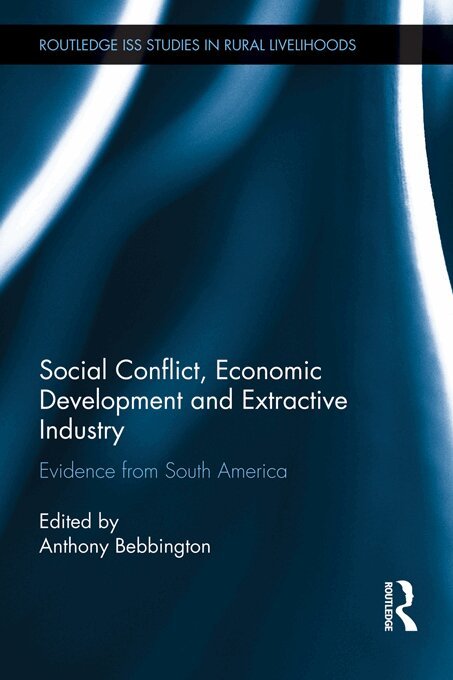
    Social Conflict, Economic Development and the Extractive Industry

    Evidence from South America

    AvAnthony Bebbington

    E-bok
    Engelska, 2011

    Del i serien Routledge ISS Studies in Rural Livelihoods

    1 043 kr

    Läs direkt i Bokus Reader – eller ladda ned till din enhet

    Beskrivning

    The extraction of minerals, oil and gas has a long and ambiguous history in development processes – in North America, Europe, Latin America and Australasia. Extraction has yielded wealth, regional identities and in some cases capital for industrialization. In other cases its main heritages have been social conflict, environmental damage and underperforming national economies. As the extractive economy has entered another boom period over the last decade, not least in Latin America, the countries in which this boom is occurring are challenged to interpret this ambiguity. Will the extractive industry yield, for them, economic development, or will its main gifts be ones of conflict, degradation and unequal forms of growth. This book speaks directly to this question and to the different ways in which Latin American countries are responding to the challenge of extractive industry. The contributors are a mixture of geographers, economists, political scientists, development experts and anthropologists, who all draw on sustained field work in the region. By digging deep into both national and local experiences with extractive industry they demonstrate the ways in which it transforms economies, societies, polities and environments. They pay particular attention to the social conflict that extraction consistently produces, and they ask how far this conflict might usher in political and institutional changes that could lead to a more productive relationship between extraction and development. They also ask whether the existence of left-of-centre governments in the region changes the relationships between extractive industry and development. The book makes clear the immense difficulties that countries and regional societies face in harnessing extractive industry for the collective good. For the most part the findings question the wisdom of the development model that many countries in the region have taken up and which emphasises the productive roles of mining and hydrocarbon industries. The book should be of interest to students and researchers of Development Studies, Geography, Politics and Political Economy, as well as Anthropology.

    Produktinformation

    • Utgivningsdatum:2011-09-27
    • Språk:Engelska
    • Filformat:EPUB
    • Kopieringsskydd:LCP
    • ISBN:9781136620218
    • Förlag:Taylor & Francis Ltd
    • Serie:Routledge ISS Studies in Rural Livelihoods

    Utforska kategorier

    • Referensverk och tvärvetenskap inom Samhälle och politik
    • Etnicitet inom Samhälle och politik
    • Internationell ekonomi inom Ekonomi och Ledarskap

    Mer om författaren

    Anthony Bebbington is Higgins Professor of Environment and Society and Director of the Graduate School of Geography at Clark University, USA. He is also a Professorial Research Fellow in the School of Environment and Development at the University of Manchester, UK, and Research Associate of the Centro Peruano de Estudios Sociales, Lima.

    Recensioner i media

    ‘This book has a subtle combination of dealing with practical social problems of development and rich academic insights. The complex development and welfare challenges in the emerging and underdeveloped economies of Latin America, that have implications for institutional changes, are well presented. In the process, it exemplifies the case of social conflict in South America showing that the same research work can be replicated for other developing and emerging economies of the world.’ - Rupamanjari Sinha Ray, Area Chairperson, Economics Management Development Institute, India, Vision (16:1) 2012

    Innehållsförteckning

    • Part 1: Political Economies of Extraction 1. Extractive industries, socio-environmental conflicts and political economic transformations in Andean America Anthony Bebbington 2. The political economy of managing extractives in Bolivia, Ecuador and Peru Jose Carlos Orihuela and Rosemary Thorp 3 The politics of extractive industries in the Central Andes John Crabtree and Isabel Crabtree-Condor Part 2: Conflicts, Transformations and Institutional Change 4. Social conflict and emergent institutions: hypotheses from Piura, Peru Anthony Bebbington 5. Mining and conflict in Peru: sowing the minerals, reaping a hail of stones Javier Arellano-Yanguas 6. Sovereignty negotiated: anti-mining movements, the state and multinational mining companies under ‘Correa's Twenty-First Century Socialism’ Jennifer Moore and Teresa VelÁsquez 7. State-indigenous tensions over hydrocarbon expansion in the Bolivian Chaco Denise Humphreys Bebbington 8. Planning development futures in the Ecuadorian Amazon: the expanding oil frontier and the Yasuní-ITT initiative Laura Rival 9. The Camisea gas project: indigenous social movements and international NGOs in the Peruvian Amazon Brian Pratt 10. Household and community responses to mining-related river contamination in the upper Pilcomayo basin, Bolivia David Preston Part 3: Conclusions and Comparisons 11.Afterward: Mining conflict in Bolivia, Ecuador and Peru Stuart Kirsch 12. Conclusions Anthony Bebbington