• Fri frakt över 249 kr
  • •
  • Snabba leveranser
  • •
  • Billiga böcker
Kundservice

Du är på sajten för privatpersoner.

Företag, bibliotek eller offentlig verksamhet?

Du handlar på classic.bokus.com, där alla dina funktioner finns intakta.
Till classic.bokus.com
Bokus logotyp. Gå till startsidan.
  • Erbjudanden
  • Nyheter
  • Student
  • Topplistor
  • Barn & ungdom
  • Bokus Play
  • E-böcker
  • Pocketböcker
  • Spel & pussel

Må bättre, för mindre! Upp till 50% rabatt på hälsoböcker

Sidfot

Mina sidor

    Hjälp

    • Kundservice
    • Vanliga frågor och svar
    • Frakt och leverans
    • Retur vid ångerrätt
    • Reklamera vara
    • Betalning
    • Köpvillkor
    • Allmänna villkor
    • Information om webbplatsens tillgänglighet

    Om Bokus

    • Om oss
    • Pressrum
    • För studenter
    • För företag
    • För bibliotek och offentlig verksamhet
    • För leverantörer
    • Hållbarhet

    Populärt

    • Aktuella erbjudanden
    • Presentkort
    • Studentlitteratur
    • Nya böcker
    • Topplistor
    • Signerade böcker
    • Engelska böcker

    Inspiration

    • Boktips
    • BookTok
    • Populära bokserier
    • Barnbokskaraktärer
    • Populära författare
    Logotyp för Bokus
    Följ oss på Facebook (extern länk)Följ oss på Instagram (extern länk)Följ oss på YouTube (extern länk)Följ oss på TikTok (extern länk)
    bokus @ CookiesAnpassa cookiesIntegritetspolicyKöpvillkor
    Till Citymail hemsida (extern länk)Till Budbee hemsida (extern länk)Till Postnord hemsida (extern länk)Till Schenker hemsida (extern länk)Till Early Bird hemsida (extern länk)Till Walleys hemsida (extern länk)
    1. Ekonomi och Ledarskap
    2. Nationalekonomi
    3. Mikroekonomi

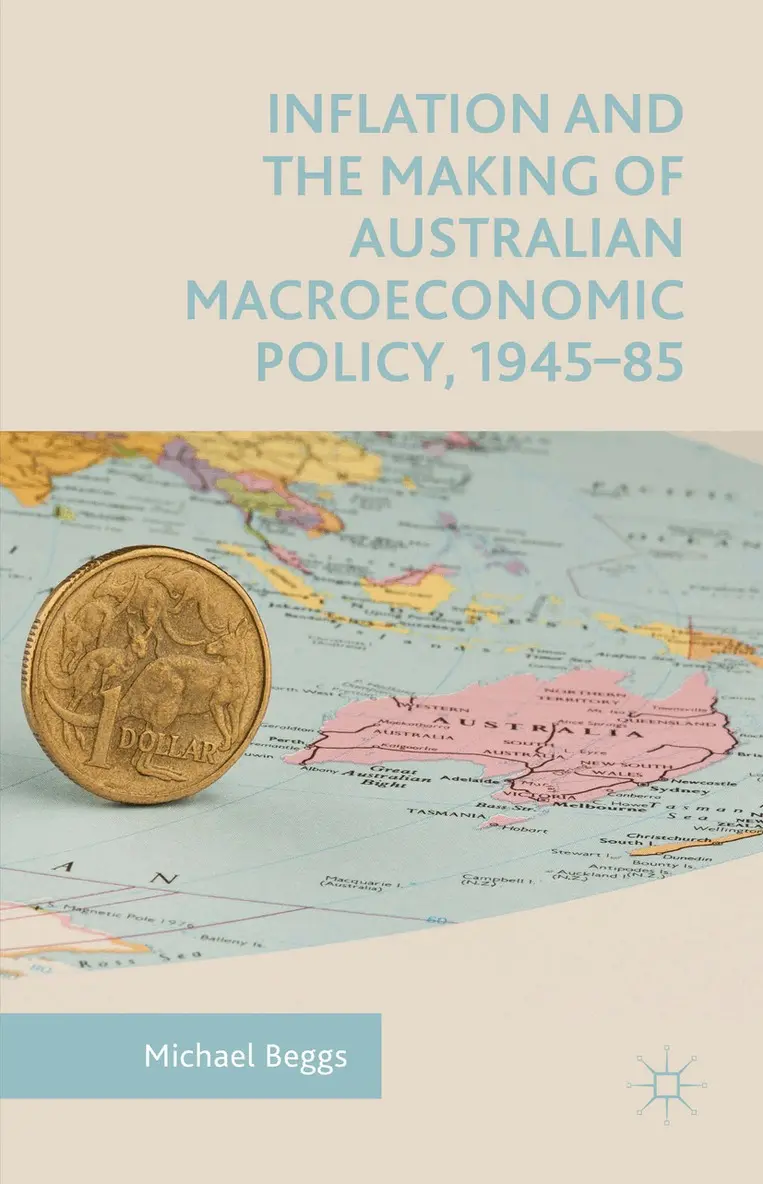
    Inflation and the Making of Australian Macroeconomic Policy, 1945–85

    AvMichael Beggs

    Inbunden, Engelska, 2015

    1 119 kr

    Beställningsvara. Skickas inom 10-15 vardagar. Fri frakt över 249 kr.

    Fler format och utgåvor

    E-bok

    1 501 kr

    Beskrivning

    In the decades after World War II, inflation undermined the aspiration for full employment in Australia. This book tells the story of how the Australian state was shaped by the confrontation with monetary instability: a pre-history of neoliberalism.

    Produktinformation

    • Utgivningsdatum:2015-09-02
    • Mått:140 x 216 x 21 mm
    • Vikt:542 g
    • Format:Inbunden
    • Språk:Engelska
    • Antal sidor:325
    • Upplaga:2015
    • Förlag:Palgrave Macmillan
    • ISBN:9781137265968

    Utforska kategorier

    • Mikroekonomi inom Ekonomi och Ledarskap
    • Ekonomisk historia inom Ekonomi och Ledarskap
    • Makroekonomi inom Ekonomi och Ledarskap

    Mer om författaren

    Michael Beggs is a Lecturer in Political Economy at the University of Sydney, Australia, where he works on the history of monetary thought and policy.

    Recensioner i media

    "This is a scholarly and in many respects impressive book, derived from the author's doctoral thesis. ... Read as a set of essays on the relationship between contemporary economic ideas and macroeconomic policy-making in Australia between the 1940s and the 1980s, this book makes a strong contribution to historical literature." (John Singleton, Australian Historical Studies, Vol. 48 (1), February, 2017)

    Innehållsförteckning

    • Contents1. Inflation, The State And Economic Policy 1.1. Fighting Inflation First 1.1.1. The Origin Myth Of The ''New Macroeconomic Consensus'' 1.1.2. From ''Keynesianism'' To ''Neoliberalism'' 1.2. Explaining Policy 1.2.1. Economic Policy As An Emergent Strategic Agent1.2.2. Thinking Like A State About Political-Economic Tensions 1.2.3. Inflation As A Policy Problem 1.3. The Structure Of This Book 1.3.1. The Long 1950s 1.3.2. The Long 1970s Part I: The Long 1950s 2. ''External Balance'' And The Counter-Inflationary Imperative 2.1. Internalising External Balance 2.1.1. A Conflict Foretold 2.1.2. ''A Balance Of Hopes And Desires'': Bretton Woods Shapes The Constraint 2.1.3. Swan''s Way: A Contemporary Model Of Policy Coherence 2.2. Beyond Swan 2.2.1. The Stylised Facts 2.2.2. The Period As A Whole 2.2.3. Breaking Down The Period 2.2.4. Capital Inflow And Wool Boom: To 1950/51 2.2.5. Recurring Crisis: 1951/52-1960/61 2.2.6. The Reprieve: 1961/62-64/65 2.3. Rules And Strategies Of The Game 3. Inflation And The Keynesianism Of Restraint 3.1. In Everybody''s Interest 3.2. The Making Of Fiscal Policy 3.2.1. To The ''Horror Budget'' 3.2.2. Fiscal Policy In The Fifties The ''Horror Budget'' In Perspective Another Round Of Restraint: Mid-1950s Credit Squeeze And Aftermath: Early 1960s 3.3. Inflation Theory In The 1950s 3.3.1. Towards Dynamics 3.3.2. Cost-Push, Demand-Pull, Wages And Distributional Struggle 3.4. Targeting Wages 3.5. Phillips In Melbourne 3.6. A Period Of Calm 4. From The ''Battle For The Banks'' To The ''Credit Sqeeze'': Monetary Policy In The Long 1950s ?4.1. An Unusual History 4.2. Boundaries And Strategies 4.2.1. The Mystery Element In Monetary Policy 4.2.2. Banks And Markets 4.3. Strengthening The Chain 4.3.1. Lessons Of The Wool Boom 4.3.2. Pursuing A Liquidity Norm 4.4. Beyond The Banks 4.4.1. The Finance Companies And The Birth Of The Money Market 4.4.2. The ''Credit Squeeze'' And New Strategy 4.5. Concusion Part II: The Long 1970s 5. From Bretton Woods To The Float 5.1. Constraint Changes Form 5.2. From ''The Balance-Of-Payments Constraint'' To ''Imported Inflation'' 5.2.1. Footnotes To Swan 5.2.2. The Constraint Relaxes 5.2.3. ''Imported Inflation'' 5.3. Capital Flows And Macroeconomic Policy 5.3.1. The Canadian Contribution To Balance-Of-Payments Theory 5.3.2. The Monetary Approach To The Balance Of Payments 5.3.3. Capital Flows And Monetary Policy In The Early 1970s 5.4. Flexible Exchange Rates 5.4.1. High-Dollar Discipline And Its Enemies: January 1973-November 1976 5.4.2. Towards The Float: November 1976-December 1983 5.5. The Float In Retrospect 6. Inflation And Macroeconomic Policy In The Long 1970s 6.1. Introduction 6.2. Demand Policy, Inflation And Unemployment 6.2.1. An Overview Of Fiscal Policy In The Long 1970s 6.3. Augmenting The Phillips Curve 6.3.1. Australian Natural-Rate Expectations-Augmented Phillips Curve Studies ?6.4. Distributional Conflict And ''Fighting Inflation First'' 6.4.1. Incomes Policy 6.5 Conclusion 7. Stengthening The Central Bank 7.1. Introduction 7.2. Banks, Markets And Monetary Policy Into The 1970s 7.2.1. Policy, Banks And Markets 7.2.2. Market Development In The 1960s And 1970s 7.2.3. Policy Eclecticism 7.3. ''Through Fire Or Over Ground Which Moves'': Monetarism In Australia 7.3.1. Long And Variable Lags: Monetarism And The Econometricians 7.3.2. Implementing The Targets 7.4. Towards Deregulation Conclusion 8.1. A Long View 8.1.1. Managed Money 8.1.2. A ''Labour Standard''? 8.1.3. Mutations Of ''Mnaged Money'' In Australia 8.2. The Accord Alternative? 8.2.1. The Accord In Action 8.2.2. The Accord As Qualitative Policy 8.3. Conclusion Bibliography