• Fri frakt över 249 kr
  • •
  • Snabba leveranser
  • •
  • Billiga böcker
Kundservice

Du är på sajten för privatpersoner.

Företag, bibliotek eller offentlig verksamhet?

Du handlar på classic.bokus.com, där alla dina funktioner finns intakta.
Till classic.bokus.com
Bokus logotyp. Gå till startsidan.
  • Erbjudanden
  • Student
  • Topplistor
  • Barn & ungdom
  • Bokus Play
  • E-böcker
  • Ljudböcker
  • Pocketböcker
  • Spel och pussel

5% studentrabatt – använd koden KURSBOK27 →

Sidfot

Mina sidor

    Hjälp

    • Kundservice
    • Vanliga frågor och svar
    • Frakt och leverans
    • Retur vid ångerrätt
    • Reklamera vara
    • Betalning
    • Köpvillkor
    • Allmänna villkor
    • Information om webbplatsens tillgänglighet

    Om Bokus

    • Om oss
    • Pressrum
    • För studenter
    • För företag
    • För bibliotek och offentlig verksamhet
    • För leverantörer
    • Hållbarhet

    Populärt

    • Aktuella erbjudanden
    • Presentkort
    • Studentlitteratur
    • Nya böcker
    • Topplistor
    • Signerade böcker
    • Engelska böcker

    Inspiration

    • Boktips
    • BookTok
    • Barnbokskaraktärer
    • Populära författare
    Logotyp för Bokus
    Följ oss på Facebook (extern länk)Följ oss på Instagram (extern länk)Följ oss på YouTube (extern länk)Följ oss på TikTok (extern länk)
    bokus @ CookiesAnpassa cookiesIntegritetspolicyKöpvillkor
    Till Citymail hemsida (extern länk)Till Budbee hemsida (extern länk)Till Postnord hemsida (extern länk)Till Schenker hemsida (extern länk)Till Early Bird hemsida (extern länk)Till Walleys hemsida (extern länk)
    1. Psykologi och pedagogik
    2. Pedagogik
    3. Pedagogisk teori och filosofi

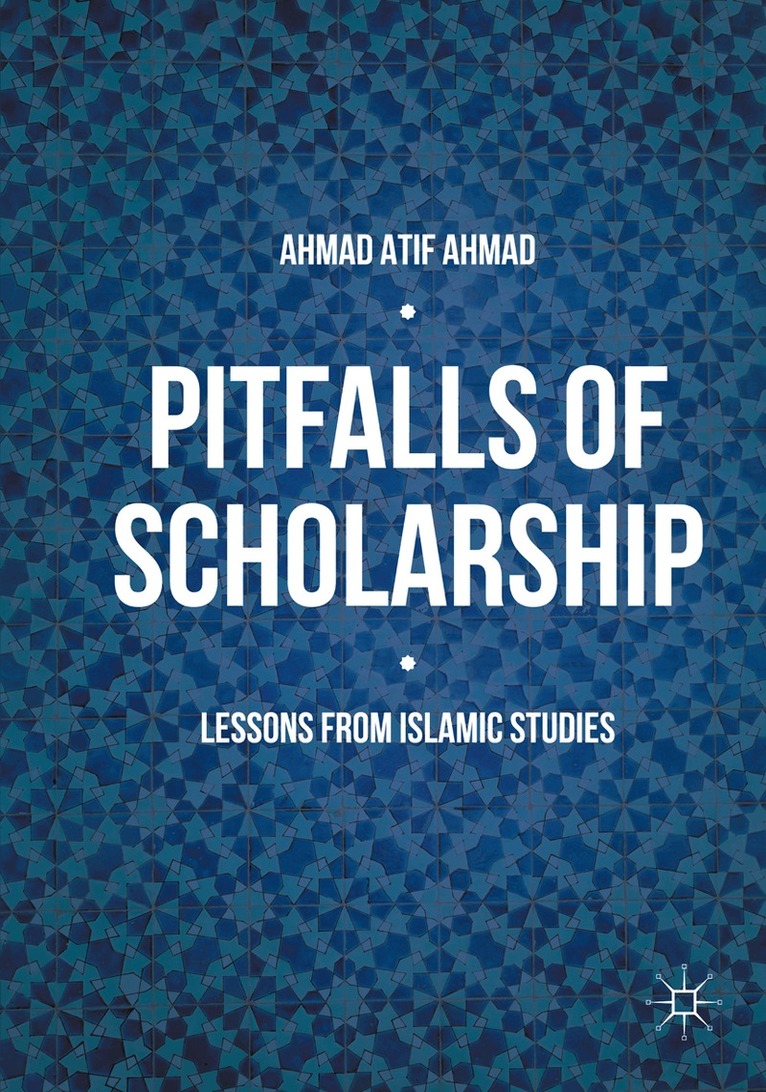
    Pitfalls of Scholarship

    Lessons from Islamic Studies

    AvAhmad Atif Ahmad

    Inbunden, Engelska, 2016

    1 110 kr

    Beställningsvara. Skickas inom 10-15 vardagar. Fri frakt över 249 kr.

    Fler format och utgåvor

    E-bok

    1 459 kr

    Häftad

    1 078 kr

    Beskrivning

    Pitfalls of Scholarship offers an array of reflections on higher education, its entanglements with humanity's pursuit of natural and social knowledge, and the impact national environments have upon it. This book considers the humanities, vocational, and scientific/technological sides of the university from the vantage-point of an Islamic studies scholar in twenty-first century American academia. Four discussions and a personal note make up the parts of these pages. The first discussion sets the stage with a description of the irregularities of our age of late modernity and the limits of scholarship in it. The second focuses on clashes of personal and academic knowledge with social assumptions and convictions. Guiding the discussion is an unlikely narrative from an old era where academic freedom did not exist. The third discussion points to the surprisingly negative impacts of obsession with research methods in the modern academy. "Scholarships of negation" are identified as the mainillness of the age, next to popular exaggerations of the value of standard assumptions and excellent academic institutions. The fourth and final section deals with modern education's aspiration toward acquiring democratic quality, and the implications of further democratization of education.

    Produktinformation

    • Utgivningsdatum:2016-02-05
    • Mått:140 x 216 x 20 mm
    • Vikt:410 g
    • Format:Inbunden
    • Språk:Engelska
    • Antal sidor:188
    • Upplaga:16001
    • Förlag:Palgrave Macmillan
    • ISBN:9781137565358

    Utforska kategorier

    • Pedagogisk teori och filosofi inom Psykologi och pedagogik
    • Högskola och universitet inom Psykologi och pedagogik
    • Historia inom Historia och arkeologi

    Mer om författaren

    Ahmad Atif Ahmad is Professor of Religious Studies at the University of California, Santa Barbara, USA. He also served as Chair of Middle East Studies at the College of William and Mary, USA, and Associate Academic Director of the University of California, Washington Center, USA. He is the author of The Fatigue of the Shari'a.

    Recensioner i media

    Reader Response to LIMITS: Scholarship in an Age of Ends This manuscript is replete with brilliant insights, unconventional analysis and great overall promise. Yet, I find myself unable to endorse its publication as is. To begin with, the manuscript simply did not read very well. It lacked flow, often seemed to fizzle out on the brink of making its actual point (or at least making it fully), and routinely seemed to dart in and out of topics, eras and ideational universes without sufficient warning, transition or glue to hold its disparate strands together. I guess the overall problem here might be described as one of genre: it is simply not clear what kind of text the author is attempting to produce. At times, one gets the impression that the text is headed in the direction of a series of long, sophisticated aphorisms; at other times, one senses a clear autobiographical commitment; still at other times, one finds oneself get stuck in the interstices of the writer's indecision as to whether he is writing intellectual history, continuing in the tradition of Islamic studies or doing modern philosophy (among other things). There was also a tendency to use humor or sarcasm as a rhetorical device; but as often as not, this came off as more sophomoric, flippant or even unduly dismissive; it did little to advance the clarity or communicative effectiveness of the text. This is unfortunate, because much of the material adduced and the insights offered are rich, sophisticated and thought-provoking. I think the author needs to re-think his overall strategy and framework and decide in explicit terms what kind of text he wants to write. This is clearly not a research project; so the author need not necessarily go back to the library. Indeed, I suspect that there is enough substantive material here for him to make his case. I just think he has to be a bit more explicit and forthcoming about what this case is and how his materials can be marshaled to drive it home. This takes us, of course, to the matter of organization. I suppose the inclusion of the topics the author includes could be successfully brought together in a single volume. But his sort of stream-of-consciousness style leaves one with no real sense of direction. Often, upon completing a chapter, one is gratified by the many individual (and often isolate insights) one has picked up along the way; but one is left with no real sense of the overall point or of how these disparate insights necessarily relate to it. This is further compounded by the question of whom the intended audience for this text might be. Robert J. Richards, Eric Davis and Carl Linnaeus are not names with which those trained or interested in Islam or Islamic studies are likely to be readily familiar. And Ghazali, Ibn Rushd and Taha Husayn are not likely to be known among scholars and students outside the field of Islamic studies. Of course, my point is not to suggest that these disparate universes cannot or should not be brought together or into conversation with each other, especially in the post-9/11 moment in which we live (where the distance between East and West is shrinking as we speak). But I think the author may be simply assuming too much in trusting the reader to make the kinds of connections he leaves him or her to make. I am not sure what I would suggest here, other than perhaps 'slowing down' a bit and providing more grounding (and perhaps less substantive material) to the end of leaving the reader a bit more empowered and with a sense of discovery and intellectual victory. Or perhaps the author might consider arranging his materials more chronologically, where he works from the Islamic past into the Islamic and Western present in a manner that allows for the tracing and assessment of continuities and discontinuities that provides the reader the benefit of a thicker context. Again, I am not sure that any of this would amount to a successful strategy. But it seems to me that the one the author has chosen is simply does not work. There are also a number of thematic issues. The most important and outstanding of these relate to the author's use of 'ends.' This is clearly a major trope in the work, around which the bulk of the author's 'argument' revolves. But, it is not always clear to me what exactly was meant by 'ends.' For about a third of the book, I assumed (and there seemed to be nothing to suggest otherwise) that he was using 'ends' in the sense of 'goals' or 'objectives.' It was not until around p. 48, however, that I finally became aware that s/he was using it in the sense of 'terminus' or 'conclusion,' as F. Fukuyama used it in his important book, The End of History. This changed the mental prism through I read from that point on. But it left me wondering if I had actually understood what the author was trying to get at up to that point. My marginal note on p. 48 read: 'clearly, this meaning of 'ends' needs to be stated explicitly up front.' I was probably influenced by the fact that in the early part of the manuscript, the author spoke of such challenges as a 'crisis of purposes.' Perhaps, he is using 'ends' in an intentionally multivalent fashion. But this, it seems to me, comes at great cost in terms of the overall coherency of the work. One more general observation has to do with the overall quality of writing. The English is a bit clunky at times; and there are several places where it seems overly apparent that the author is not a native speaker. The work as such will require significant editing. These are my basic criticisms of the manuscript. (There are more substantive questions, e.g., whether the Qur'?n 5:4 actually bans friendship with Jews and Christians (p. 114) or why al-Ghaz?l?'s al-Munqidh min al-?al?l should not be considered a 'confession such as those of Augustine or Rousseau' (p.124).) But these are better left perhaps to the market of scholarship. Having registered these criticisms, however, I must rush to add that I truly hope that the author will find the structure, language and flow that will make this project work. For, again, the text is simply chock full of brilliant insights, which could contribute mightily to modern discourses on religion, philosophy, education, reason, Islam, democracy, the West and a host of other important topics. Tropes such as 'clash of educations,' Egypt as Religion' or 'the tyranny of the arbitrary' are simply priceless - and unprecedented. It would be a shame to see all of this (and more!) go to waste. In conclusion, I would strongly urge the author to reconsider the issues laid out in this review and attempt to restructure the book accordingly. I am sure that even a modicum of success in this regard will result in a truly meaningful and important piece of work. The author of Limts is clearly a first-rate mind, well-read, mature and driven. He has produced a bold, courageous, insightful and provocative text. It very much deserves (in modified form) a public hearing.

    Innehållsförteckning

    • Acknowledgements Introduction 1. Defending the Defenseless: The Humanities and Islamic Studies from an Oblique Angle 2. The First Person Singular: Personal and Social Knowledge in Conflict 3. Method, Discovery, and Knowledge 4. Democracy, National Religions, Disorder 5. Curriculum Vitae Conclusion BibliographyIndex