• Fri frakt över 249 kr
  • •
  • Snabba leveranser
  • •
  • Billiga böcker
Kundservice

Du är på sajten för privatpersoner.

Företag, bibliotek eller offentlig verksamhet?

Du handlar på classic.bokus.com, där alla dina funktioner finns intakta.
Till classic.bokus.com
Bokus logotyp. Gå till startsidan.
  • Erbjudanden
  • Nyheter
  • Student
  • Topplistor
  • Barn & ungdom
  • Bokus Play
  • E-böcker
  • Pocketböcker
  • Spel & pussel

Upp till 20% på populära nyheter →

Sidfot

Mina sidor

    Hjälp

    • Kundservice
    • Vanliga frågor och svar
    • Frakt och leverans
    • Retur vid ångerrätt
    • Reklamera vara
    • Betalning
    • Köpvillkor
    • Allmänna villkor
    • Information om webbplatsens tillgänglighet

    Om Bokus

    • Om oss
    • Pressrum
    • För studenter
    • För företag
    • För bibliotek och offentlig verksamhet
    • För leverantörer
    • Hållbarhet

    Populärt

    • Aktuella erbjudanden
    • Presentkort
    • Studentlitteratur
    • Nya böcker
    • Topplistor
    • Signerade böcker
    • Engelska böcker

    Inspiration

    • Boktips
    • BookTok
    • Populära bokserier
    • Barnbokskaraktärer
    • Populära författare

    Mina sidor

      Hjälp

      • Kundservice
      • Vanliga frågor och svar
      • Frakt och leverans
      • Retur vid ångerrätt
      • Reklamera vara
      • Betalning
      • Köpvillkor
      • Allmänna villkor
      • Information om webbplatsens tillgänglighet

      Om Bokus

      • Om oss
      • Pressrum
      • För studenter
      • För företag
      • För bibliotek och offentlig verksamhet
      • För leverantörer
      • Hållbarhet

      Populärt

      • Aktuella erbjudanden
      • Presentkort
      • Studentlitteratur
      • Nya böcker
      • Topplistor
      • Signerade böcker
      • Engelska böcker

      Inspiration

      • Boktips
      • BookTok
      • Populära bokserier
      • Barnbokskaraktärer
      • Populära författare
      Logotyp för Bokus
      Följ oss på Facebook (extern länk)Följ oss på Instagram (extern länk)Följ oss på YouTube (extern länk)Följ oss på TikTok (extern länk)
      bokus @ CookiesIntegritetspolicyKöpvillkor
      Till Citymail hemsida (extern länk)Till Budbee hemsida (extern länk)Till Postnord hemsida (extern länk)Till Schenker hemsida (extern länk)Till Early Bird hemsida (extern länk)Till Walleys hemsida (extern länk)
      1. Samhälle och politik
      2. Samhälle och kultur
      3. Kultur och medier
      4. Kulturvetenskap

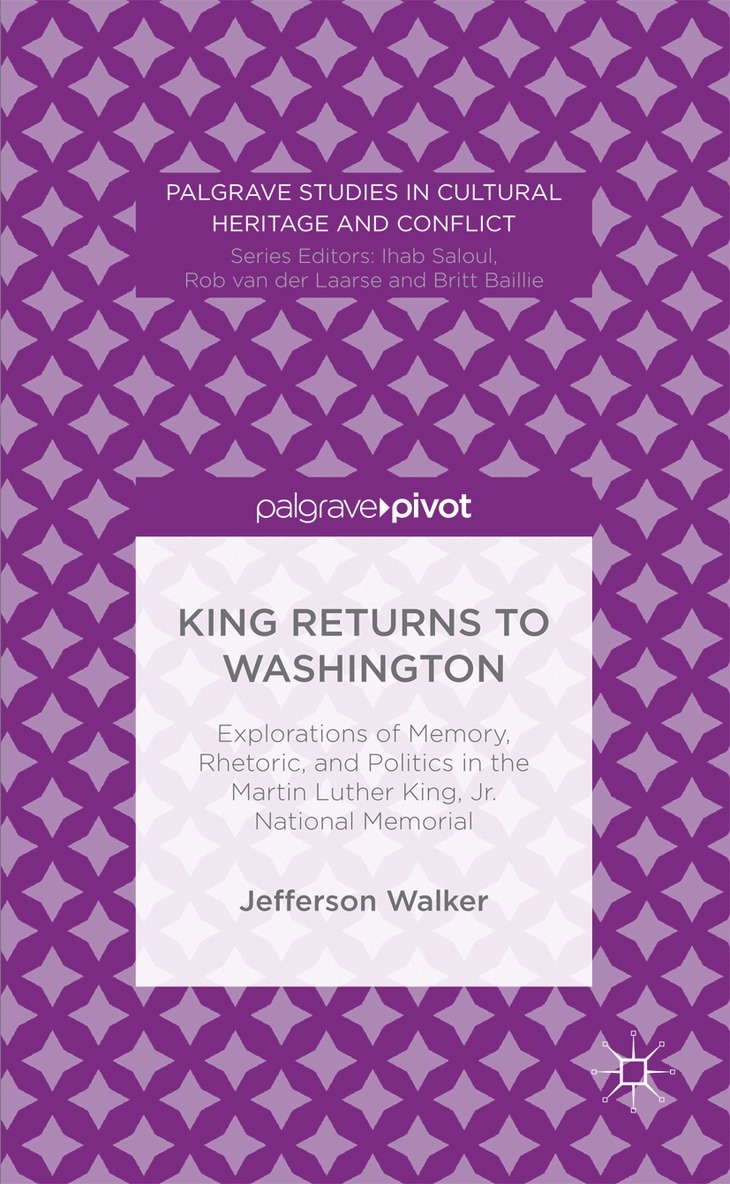
      King Returns to Washington

      Explorations of Memory, Rhetoric, and Politics in the Martin Luther King, Jr. National Memorial

      AvJefferson Walker

      Inbunden, Engelska, 2015

      Del i serien Palgrave Studies in Cultural Heritage and Conflict

      558 kr

      Beställningsvara. Skickas inom 10-15 vardagar. Fri frakt över 249 kr.

      Fler format och utgåvor

      E-bok

      785 kr

      Beskrivning

      Exploring the Dr. Martin Luther King, Jr. National Memorial (King Memorial) in Washington, DC through a multi-faceted rhetorical analysis of the site's visual and textual components, Jefferson Walker reveals multiple critical, popular, privileged, and vernacular interpretations of the site and Dr. Martin Luther King's memory. Walker argues that the King Memorial and its related texts help to universalize and institutionalize King's ethos - creating a contentious rhetorical battleground where various people and organizations contest the "ownership" and use of King's memory. Walker uses these analyses to uncover how the site contributes to the public memory of Dr. Martin Luther King, Jr.

      Produktinformation

      • Utgivningsdatum:2015-12-03
      • Mått:140 x 216 x 11 mm
      • Vikt:280 g
      • Format:Inbunden
      • Språk:Engelska
      • Serie:Palgrave Studies in Cultural Heritage and Conflict
      • Antal sidor:95
      • Upplaga:15001
      • Förlag:Palgrave Macmillan
      • ISBN:9781137590336

      Utforska kategorier

      • Kulturvetenskap inom Samhälle och politik
      • Etnicitet inom Samhälle och politik

      Mer om författaren

      Jefferson Walker is Assistant Professor of Communication at Louisiana Tech University, USA. His research and teaching interests are in public memory, political communication, and the rhetoric of social movements. His work has been published in Alabama Review and the Journal of Contemporary Rhetoric. He earned his PhD in Communication and Information Sciences from the University of Alabama, USA.

      Recensioner i media

      Reader Report Richard Leeman Professor of Communication Studies University of North Carolina at Charlotte, USA 1. Recommendation I would recommend that the work be published with some minor revisions. The work is publishable as is, but I think two revisions would strengthen the work. They are detailed under #2 below. 2. General assessment of the proposal The manuscript is well researched and well written. The topic is timely and the author is well versed in the scholarship on memorializing. In a few places, the dissertation practice of explicitly outlining all the arguments that will ensue should be stylistically softened, but in general the author has done a nice revision that makes the manuscript read like a book, rather than a dissertation. There are two substantive revisions I would recommend, although the manuscript is, I believe, publishable as is: a. Include some accounts of how the public has reacted to the memorial (attendance figures, newspaper accounts, blogs, etc.) The author's account of reactions and interpretations of the memorial focuses on leaders, as opposed to the public. I think that is appropriate for much of the work, but postmodern criticism emphasizes the role of the audience in creating the message, and I think an analysis of a wider, public response to the memorial would enhance the analysis. b. Realign slightly the analysis in Chapters 3 and 4. In Chapter 3, the author appears to be criticizing the memorial for emphasizing universal themes. In Chapter 4, the author appears to be criticizing those who particularize the memorial in order to advance their specific agendas. Although these are not mutually exclusive stances, the result is a reading that appears to criticize anything about the memorial. I think some fine-tuning of the language and clearer explication of the author's critical stance would help mitigate this sense. 3. This project contributes to our scholarship in two important ways. First, it examines an important new memorial in American culture, one that will take on added significance with the recent events in Ferguson, New York, Baltimore and Charleston, and as the Obama presidency comes to a close. This memorial will be a major focus of race relations and racial dialogue in America. Second, it stands as an exemplar of a book length study of a single, significant memorial. 4. This project adequately engages the scholarship on memorializing and the scholarship on Martin Luther King, Jr. The level and quality of scholarship in the manuscript is excellent. 5. The strengths of the proposal: a. the structure, organization and coherence of the arguments is excellent. I would not change those. b. the quality of the writing is very good. I consider myself a detail-oriented editor, and I found very few changes that I would make to the writing. c. the timeliness is excellent. The memorial is still relatively new and un-commented upon and, as suggested above, the national discussion on race is particularly timely. Because the analysis takes a post-modern approach, the shelf life of the research is excellent. Even if interpretations of the memorial evolve, this book provides an apt analysis of the origins of that evolution. d. there are no portions of the manuscript that require substantial re-working. 6. This is already a well-qualified manuscript. The author is eminently qualified to produce high quality revisions to the work. 7. This project seems an ideal fit for the Pivot Series. It is a substantial scholarly work that works very well in the 25,000-50,000 word range. 8. The manuscript is written very professionally and well. This is a well-edited, polished manuscript. 9. The main readers will be students of communication, history and Africana studies who are interested in Martin Luther King, Jr., the Civil Rights Movement, contemporary memorializing and race relations, and/or contemporary memorializing. There would certainly be interdisciplinary interest in this work, and given Martin Luther King, Jr.'s stature on the international stage, there would be international interest in it as well. I would imagine that library sales around the world would be especially robust. 10. I am not aware of any volumes that serve as direct competition. There are, for example, no book length studies on any of the civil rights museums or the King memorial in Atlanta, and certainly not the newly completed King National Memorial in Washington, D.C. 11. I know of no portion of this manuscript that has been previously published. Specific comments by page Stylistic note: I would not put authors' middle initials in the manuscript when citing them. It interrupts the flow of the reading and, since some authors do not use middle initials, the citations read inconsistently. p. 6: stylistic note: some of the first person singulars should be removed. The author needs them in Chapter 3 that describes his personal visits to the Memorial, but not when making claims such as 'By studying the King national Memorial, I am able to examine...' This kind of claim could be made without inserting the : 'I.' p. 16: 'But many felt': this should be cited, perhaps substantiated by a quotation. The claim of 'many' needs substantiation. p. 25: 'Many protested the use of Chinese granite and some even questioned the choice of white granite' - this claim needs substantiation. p. 51: The author might productively note that the paraphrase from the book of Amos that is contextualized by the quotation from Montgomery will also call to the mind of many the very similar paraphrase in 'I Have a Dream.' There is a dual context here - the explicit one of Montgomery, and the implicit one of the March on Washington. p. 57: 'By promoting King as a non-partisan and uncontroversial hero, the Memorial risks misleadingly inspiring everyone or failing to inspire anyone.' Here is where I think the author is overstating the case, since in Chapter 4 he discusses how the various speakers at the dedication 'use' King to inspire, justify, etc. I think the observation that the Memorial does much to de-contextualize King and thereby render multivalent readings is apt. But don't most memorials do the same thing? I think the notion of epideictic here, as well as a stronger attention to post-modernism, would be helpful. Epideictic rhetoric unifies communities because it allows multivalent readings around core values. I think the author could usefully draw on Perelman and Olbrechts-Tyteca's discussion of epideictic (The New Rhetoric) as well as Hauser's 1999 RSQ article. Further, using a postmodern lens, Blair, et al argue that the Vietnam Veterans Memorial is rhetorically powerful in part because of the range of interpretations available to visitors. I think the author has a valid and important point that, on the surface, the King Memorial decontextualizes him from race relations in the U.S. But a post-modern stance argues that we also DO contextualize, and so how does audience understanding and attitudes about race inform their reading(s) of the memorial? p. 58: 'The Stone of Hope carved from white granite also whitewashes many of the leader's beliefs' - again, multivalent readings would say that this could be one message that is constructed, but others are possible. The author's series of questions on the bottom of page 57 is suggestive - many readings are possible. p. 58: subtly endorses one individual (Obama) as the heir and steward: again, a post-modern lens argues that such ownership will evolve. It may, in Obama's post-presidency, increase, or it may decrease. pp 58-59 - the author returns to the idea of 'plural readings' - but I would like to see that foundational assumption carried through the chapter's analysis. What is needed is more an articulation that the readings presented here are the way the Memorial could be read; that the quotations emphasize the universal; and that it allows a broader range of readings than had it been constructed differently. It is intended to serve an epideictic function, and the placement, quotations, gift shops, etc. all work to further that goal. Chapter Four: and then in chapter 4 the author can emphasize that the Memorial does indeed work as intended - the multivalent readings that are presented here are representative of epideictic discourse that applies timeless values to the causes of the day. Here is where I would be particularly interested in whether the messages resonated with audiences or not. Did they inspire? p. 66: the dedicator's broad interpretation: who? Who was the 'dedicator'? p. 66: 'But while King did take a stance on this particular issue during his lifetime, other speakers associated King's call for justice with issues that originated, more or less, after King's death.' - as phrased, there is an implied criticism here, but why? Isn't this what epideictic discourse always does? I think the point that it was politicized is good, but I would avoid comments that suggest King's 'meaning' is somehow set by the positions he took in his lifetime. Again, that critical stance goes directly against the postmodern lens that the author is using for so much of the analysis. p. 68: I do not read Marian Wright Edelman's quotation the same as the author. To say 'We're it' is indeed to say that King's legacy now falls to all of us, but it does not say that one cannot say what King's 'legacy' is. Similarly, Bond's quotation seems to support using King's mantle of legitimacy for the Occupy movement; he does not seem to argue against it. I do not see from these quotations that they were putting King's 'political positions to rest.' They may have somewhere else in their speeches, but these quotations do not support the author's claim. p. 67: I would disagree with Condit that epideictic discourse is uncontroversial and universal. Epideictic discourse speaks to the values of the community and, within that community, may be uncontroversial. Much epideictic discourse, however, makes demands - sometimes controversial - upon its audience. Indeed, all the speeches studied here are epideictic - and notice the range that is here. pp. 70-71 - I like the parallels the author draws between Obama's description of King and Obama himself. p. 76: may have signaled to some that 'some day' was today: Certainly. But it would be worth noting that many probably interpreted it as in 'some day' is still in the future and there is work to do. That is how all the speakers interpreted it. What might those in the audience have thought? Again - it would be good to hear some alternative voices. E.g., how did the black press handle it? What did letter writers to the black press say? To the mainstream (white) press? Interviews with attendees? I would very much like to hear about the responses of the audience - present and extended - to the ceremony and the Memorial. p. 77: the author notes the variety of causes advanced in the name of King - it would be good to cover more of these specifically and with quotations in the section on Politicization, so that the discussion there goes beyond the Occupy movement. p. 77: 'and even to invent King's thoughts on issues as they pleased' - again, this is implicitly critical, and yet I am not sure it should be. Isn't that what all epideictic discourse does? Invent how the Declaration of Independence might apply to woman suffrage, or how the Constitutional right to a militia applies to the ownership of AK-47s, or how Gandhi's teachings apply to segregation in the U.S.? Unless one is speaking from one's own authority, epideictic discourse is uniformly some variation of WWJD?. To say that the Memorial wants to be inclusive, universal and belong to the world does not contradict the attempts to politicize the message or even a one-sided political forum. I think it is fine to argue that the ceremony was arranged so that there was little contestation, but that does not mean that the meaning of the Memorial will be uncontested. Universal values have a way of being applied to contested meanings. How many opponents of affirmative action have employed King's phrase about being judged 'not by the color of their skin, but by the content of their character'? I think a different tenor to the criticism, and greater attention to the point that there will be multivalent, ever evolving meanings drawn from the Memorial would be warranted in this chapter. Series Editor Recommendation Ihab Saloul Assistant Professor of Cultural Studies University of Amsterdam, Netherlands I confirm that this book examines important aspects of heritage, conflict, and memorial cultures so it's certainly relevant and a good fit for us. The review is also very clear and the author agrees to implement the necessary changes. Let's include it in the series.

      Innehållsförteckning

      • 1. Introduction2. "Building the Dream": A Historical-Contextual Analysis of the King Memorial3. The Rhetorical Form and Force of the King Memorial4. Interpretation, Politicization, and Institutionalization: A Rhetorical Analysis of the King Memorial's Dedication Ceremony5. Conclusion
      Hoppa över listan

      Mer från samma serie

      Katherine O. Stafford - Narrating War in Peace, Inbunden

      Narrating War in Peace

      Katherine O. Stafford

      Inbunden, 2015

      574 kr

      C. Weber - Social Memory and War Narratives, Inbunden

      Social Memory and War Narratives

      C. Weber

      Inbunden, 2015

      574 kr

      Felix Lang - Lebanese Post-Civil War Novel, Inbunden

      Lebanese Post-Civil War Novel

      Felix Lang

      Inbunden, 2015

      641 kr

      Leila Kamali - Cultural Memory of Africa in African American and Black British Fiction, 1970-2000, Inbunden

      Cultural Memory of Africa in African American and Black British Fiction, 1970-2000

      Leila Kamali

      Inbunden, 2016

      1 655 kr

      C. Weber - Social Memory and War Narratives, Häftad

      Social Memory and War Narratives

      C. Weber

      Häftad, 2015

      574 kr

      Leila Kamali - Cultural Memory of Africa in African American and Black British Fiction, 1970-2000, Häftad

      Cultural Memory of Africa in African American and Black British Fiction, 1970-2000

      Leila Kamali

      Häftad, 2020

      1 655 kr

      David Clarke - Constructions of Victimhood, Inbunden

      Constructions of Victimhood

      David Clarke

      Inbunden, 2019

      1 028 kr

      Jeroen Rodenberg, Pieter Wagenaar - Cultural Contestation, Häftad

      Cultural Contestation

      Jeroen Rodenberg, Pieter Wagenaar

      Häftad, 2018

      1 549 kr

      Joanna Bocheńska - Rediscovering Kurdistan’s Cultures and Identities, Häftad

      Rediscovering Kurdistan’s Cultures and Identities

      Joanna Bocheńska

      Häftad, 2018

      1 093 kr

      Kathryn N. McDaniel - Virtual Dark Tourism, Häftad

      Virtual Dark Tourism

      Kathryn N. McDaniel

      Häftad, 2018

      1 709 kr

      Hoppa över listan

      Du kanske också är intresserad av

      Jefferson Walker - King Returns to Washington, E-bok

      King Returns to Washington

      Jefferson Walker

      E-bok
      2017

      785 kr

      Måns Petter Zelmerlöw - När allt faller, Inbunden
      • -12%

      När allt faller

      Måns Petter Zelmerlöw

      Inbunden, 2026

      229 kr259 kr

      Peter Englund - Om att misslyckas, Inbunden
      • -17%

      Om att misslyckas

      Peter Englund

      Inbunden, 2026

      4,0 utav 5 stjärnor. Totalt antal röster:(9)

      199 kr239 kr

      Roland Paulsen - Avbegåvad : en essäberättelse om arv och miljö, Inbunden
      • -15%

      Avbegåvad : en essäberättelse om arv och miljö

      Roland Paulsen

      Inbunden, 2026

      225 kr265 kr

      Klara Peters Bastin - SIGNERAD - Om julens wälgång, Inbunden
      • Signerad!

      SIGNERAD - Om julens wälgång

      Klara Peters Bastin

      Inbunden, 2026

      249 kr

      Vendela Blomström, Jeanna Wennerberg - Akademiskt läsande och skrivande, Häftad

      Akademiskt läsande och skrivande

      Vendela Blomström, Jeanna Wennerberg

      Häftad, 2026

      421 kr

      Åsa Jonsson - Helt orimligt : en hemmasittares berättelse, Kartonnage
      • Nyhet

      Helt orimligt : en hemmasittares berättelse

      Åsa Jonsson

      Kartonnage, 2026

      249 kr

      Anna Meeuwisse, Hans Swärd, Sune Sunesson, Marcus Knutagård - Socialt arbete : en grundbok, Inbunden

      Socialt arbete : en grundbok

      Anna Meeuwisse, Hans Swärd, Sune Sunesson, Marcus Knutagård

      Inbunden, 2024

      4,0 utav 5 stjärnor. Totalt antal röster:(1)

      581 kr

      Harlan Coben - Se dig inte om, Pocket
      • -30%

      Se dig inte om

      Harlan Coben

      Pocket, 2026

      69 kr99 kr

      Rebecca Yarros - Threshing Day (Limited Deluxe Edition), Inbunden
      • Nyhet

      Threshing Day (Limited Deluxe Edition)

      Rebecca Yarros

      Inbunden, 2026

      259 kr