• Fri frakt över 249 kr
  • •
  • Snabba leveranser
  • •
  • Billiga böcker
Kundservice

Du är på sajten för privatpersoner.

Företag, bibliotek eller offentlig verksamhet?

Du handlar på classic.bokus.com, där alla dina funktioner finns intakta.
Till classic.bokus.com
Bokus logotyp. Gå till startsidan.
  • Erbjudanden
  • Nyheter
  • Student
  • Topplistor
  • Barn & ungdom
  • Bokus Play
  • E-böcker
  • Pocketböcker
  • Spel & pussel

10% rabatt på allt med kod: NYSTART10 →

Sidfot

Mina sidor

    Hjälp

    • Kundservice
    • Vanliga frågor och svar
    • Frakt och leverans
    • Retur vid ångerrätt
    • Reklamera vara
    • Betalning
    • Köpvillkor
    • Allmänna villkor
    • Information om webbplatsens tillgänglighet

    Om Bokus

    • Om oss
    • Pressrum
    • För studenter
    • För företag
    • För bibliotek och offentlig verksamhet
    • För leverantörer
    • Hållbarhet

    Populärt

    • Aktuella erbjudanden
    • Presentkort
    • Studentlitteratur
    • Nya böcker
    • Topplistor
    • Signerade böcker
    • Engelska böcker

    Inspiration

    • Boktips
    • BookTok
    • Populära bokserier
    • Barnbokskaraktärer
    • Populära författare
    Logotyp för Bokus
    Följ oss på Facebook (extern länk)Följ oss på Instagram (extern länk)Följ oss på YouTube (extern länk)Följ oss på TikTok (extern länk)
    bokus @ CookiesAnpassa cookiesIntegritetspolicyKöpvillkor
    Till Citymail hemsida (extern länk)Till Budbee hemsida (extern länk)Till Postnord hemsida (extern länk)Till Schenker hemsida (extern länk)Till Early Bird hemsida (extern länk)Till Walleys hemsida (extern länk)
    1. Språk och ordböcker
    2. Språkvetenskap och lingvistik

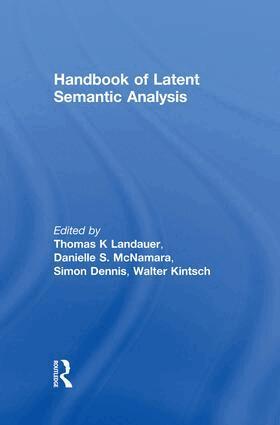
    Handbook of Latent Semantic Analysis

    AvThomas K. Landauer,Danielle S. McNamara

    Häftad, Engelska, 2014

    Del i serien University of Colorado Institute of Cognitive Science Series

    852 kr

    Beställningsvara. Skickas inom 10-15 vardagar. Fri frakt över 249 kr.

    Beskrivning

    The Handbook of Latent Semantic Analysis is the authoritative reference for the theory behind Latent Semantic Analysis (LSA), a burgeoning mathematical method used to analyze how words make meaning, with the desired outcome to program machines to understand human commands via natural language rather than strict programming protocols. The first book of its kind to deliver such a comprehensive analysis, this volume explores every area of the method and combines theoretical implications as well as practical matters of LSA.Readers are introduced to a powerful new way of understanding language phenomena, as well as innovative ways to perform tasks that depend on language or other complex systems. The Handbook clarifies misunderstandings and pre-formed objections to LSA, and provides examples of exciting new educational technologies made possible by LSA and similar techniques. It raises issues in philosophy, artificial intelligence, and linguistics, while describing how LSA has underwritten a range of educational technologies and information systems. Alternate approaches to language understanding are addressed and compared to LSA. This work is essential reading for anyone—newcomers to this area and experts alike—interested in how human language works or interested in computational analysis and uses of text. Educational technologists, cognitive scientists, philosophers, and information technologists in particular will consider this volume especially useful.

    Produktinformation

    • Utgivningsdatum:2014-06-09
    • Mått:152 x 229 x 29 mm
    • Vikt:725 g
    • Format:Häftad
    • Språk:Engelska
    • Serie:University of Colorado Institute of Cognitive Science Series
    • Antal sidor:544
    • Förlag:Taylor & Francis Ltd
    • ISBN:9781138004191

    Utforska kategorier

    • Språkvetenskap och lingvistik inom Språk och ordböcker
    • Material och digital teknik i undervisningen inom Psykologi och pedagogik
    • Systemvetenskap och AI inom Data och IT

    Mer om författaren

    Thomas K. Landauer, Danielle S. McNamara, Simon Dennis, Walter Kintsch

    Innehållsförteckning

    • Contents: Part I: Introduction to LSA: Theory and Methods. T.K. Landauer, LSA as a Theory of Meaning. D. Martin, M. Berry, Mathematical Foundations Behind Latent Semantic Analysis. S. Dennis, How to Use the LSA Website. J. Quesada, Creating Your Own LSA Spaces. Part II: LSA in Cognitive Theory. W. Kintsch , Meaning in Context. M. Louwerse, Symbolic or Embodied Representations: A Case for Symbol Interdependency. M.W. Howard, K. Addis, B. Jing, M.K. Kahana, Semantic Structure and Episodic Memory. G. DenhiŠre, B. Lemaire, C. Bellissens, S. Jhean-Larose, A Semantic Space for Modeling Children's Semantic Memory. P. Foltz, Discourse Coherence and LSA. J. Quesada, Spaces for Problem Solving. Part III: LSA in Educational Applications. K. Millis, J. Magliano, K. Wiemer-Hastings, S. Todaro, D.S. McNamara, Assessing and Improving Comprehension With Latent Semantic Analysis. D.S. McNamara, C. Boonthum, I. Levinstein, K. Millis, Evaluating Self-Explanations in iSTART: Comparing Word-Based and LSA Algorithms. A. Graesser, P. Penumatsa, M. Ventura, Z. Cai, X. Hu, Using LSA in AutoTutor: Learning Through Mixed-Initiative Dialog in Natural Language. E. Kintsch, D. Caccamise, M. Franzke, N. Johnson, S. Dooley, Summary Streetr: Computer-Guided Summary Writing. L. Streeter, K. Lochbaum, N. LaVoie, J.E. Psotka, Automated Tools for Collaborative Learning Environments. Part IV: Information Retrieval and HCI Applications of LSA. S.T. Dumais, LSA and Information Retrieval: Getting Back to Basics. P.K. Foltz, T.K. Landauer, Helping People Find and Learn From Documents: Exploiting Synergies Between Human and Computer Retrieval With SuperManual. M.H. Blackmon, M. Kitajima, D.R. Mandalia, P.G. Polson, Automating Usability Evaluation Cognitive Walkthrough for the Web Puts LSA to Work on Real-World HCI Design Problems. Part V: Extensions to LSA. D.S. McNamara, Z. Cai, M.M. Louwerse, Optimizing LSA Measures of Cohesion. X. Hu, Z. Cai, P. Wiemer-Hastings, A.C. Graesser, D.S. McNamara, Strength, Weakness, and Extensions of LSA. M. Steyvers, T. Griffiths, Probabilistic Topic Models. S. Dennis, Introducing Word Order: Within the LSA Framework. Part VI: Conclusion. W. Kintsch, D.S. McNamara, S. Dennis, T.K. Landauer, LSA and Meaning: In Theory and Application.