Walter Kintsch - Böcker
Visar alla böcker från författaren Walter Kintsch. Handla med fri frakt och snabb leverans.
6 produkter
6 produkter
1 670 kr
Skickas inom 7-10 vardagar
In this landmark volume, Walter Kintsch presents a theory of human text comprehension that he has refined and developed over the past 20 years. Characterizing the comprehension process as one of constraint satisfaction, this comprehensive theory is concerned with mental processes - not primarily with the analysis of materials to be understood. The author describes comprehension as a two-stage process: first, approximate, inaccurate representations are constructed via context insensitive construction rules, which are then integrated via a process of spreading activation. In Part I, the general theory is presented and an attempt is made to situate it within the current theoretical landscape in cognitive science. In the second part, many of the topics are discussed that are typically found in a cognitive psychology text. The book addresses how relevant knowledge is activated during reading and how readers recognize and recall texts. It then draws the implications of these findings for how people solve word problems, act out verbal instructions and make decisions based on verbal information.
698 kr
Skickas inom 7-10 vardagar
In this landmark volume, Walter Kintsch presents a theory of human text comprehension that he has refined and developed over the past 20 years. Characterizing the comprehension process as one of constraint satisfaction, this comprehensive theory is concerned with mental processes - not primarily with the analysis of materials to be understood. The author describes comprehension as a two-stage process: first, approximate, inaccurate representations are constructed via context insensitive construction rules, which are then integrated via a process of spreading activation. In Part I, the general theory is presented and an attempt is made to situate it within the current theoretical landscape in cognitive science. In the second part, many of the topics are discussed that are typically found in a cognitive psychology text. The book addresses how relevant knowledge is activated during reading and how readers recognize and recall texts. It then draws the implications of these findings for how people solve word problems, act out verbal instructions and make decisions based on verbal information.
3 087 kr
Skickas inom 10-15 vardagar
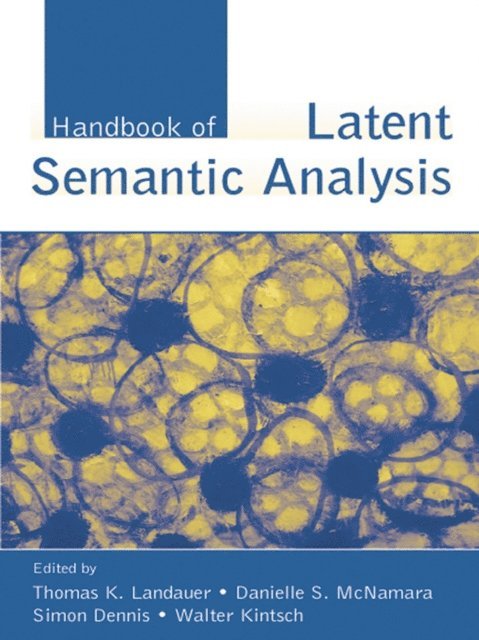
The Handbook of Latent Semantic Analysis is the authoritative reference for the theory behind Latent Semantic Analysis (LSA), a burgeoning mathematical method used to analyze how words make meaning, with the desired outcome to program machines to understand human commands via natural language rather than strict programming protocols. The first book of its kind to deliver such a comprehensive analysis, this volume explores every area of the method and combines theoretical implications as well as practical matters of LSA.Readers are introduced to a powerful new way of understanding language phenomena, as well as innovative ways to perform tasks that depend on language or other complex systems. The Handbook clarifies misunderstandings and pre-formed objections to LSA, and provides examples of exciting new educational technologies made possible by LSA and similar techniques. It raises issues in philosophy, artificial intelligence, and linguistics, while describing how LSA has underwritten a range of educational technologies and information systems. Alternate approaches to language understanding are addressed and compared to LSA. This work is essential reading for anyone—newcomers to this area and experts alike—interested in how human language works or interested in computational analysis and uses of text. Educational technologists, cognitive scientists, philosophers, and information technologists in particular will consider this volume especially useful.
788 kr
Skickas inom 10-15 vardagar
The Handbook of Latent Semantic Analysis is the authoritative reference for the theory behind Latent Semantic Analysis (LSA), a burgeoning mathematical method used to analyze how words make meaning, with the desired outcome to program machines to understand human commands via natural language rather than strict programming protocols. The first book of its kind to deliver such a comprehensive analysis, this volume explores every area of the method and combines theoretical implications as well as practical matters of LSA.Readers are introduced to a powerful new way of understanding language phenomena, as well as innovative ways to perform tasks that depend on language or other complex systems. The Handbook clarifies misunderstandings and pre-formed objections to LSA, and provides examples of exciting new educational technologies made possible by LSA and similar techniques. It raises issues in philosophy, artificial intelligence, and linguistics, while describing how LSA has underwritten a range of educational technologies and information systems. Alternate approaches to language understanding are addressed and compared to LSA. This work is essential reading for anyone—newcomers to this area and experts alike—interested in how human language works or interested in computational analysis and uses of text. Educational technologists, cognitive scientists, philosophers, and information technologists in particular will consider this volume especially useful.
682 kr
Skickas inom 10-15 vardagar
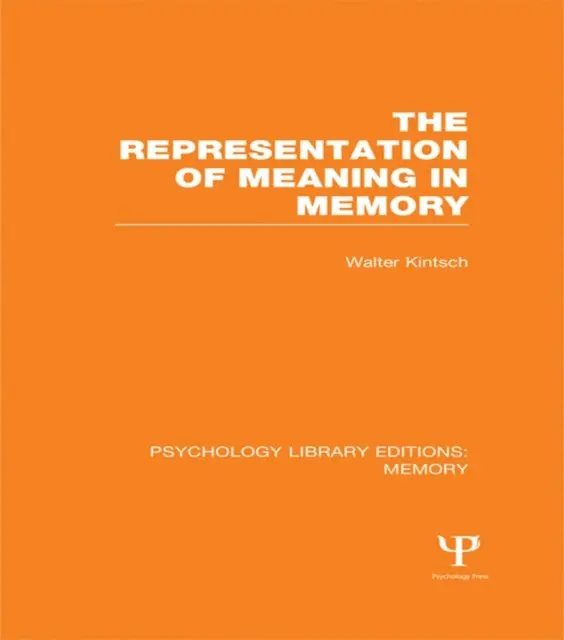
Originally published in 1974, this volume presents empirical and theoretical investigations of the role of meaning in psychological processes. A theory is proposed for the representation of the meaning of texts, employing ordered lists of propositions. The author explores the adequacy of this representation, with respect to the demands made upon such formulations by logicians and linguists. A sufficiently large number of problems are encompassed by the propositional theory to justify its use in psychological research into memory and language comprehension.A number of different experiments are reported on a wide variety of topics, and these test central portions of this theory, and any that purports to deal with how humans represent meaning. Among the topics discussed are the role of lexical decomposition in comprehension and memory, propositions as the units of recall, and the effects of the number of propositions in a text base upon reading rate and recall. New problems are explored, such as inferential processes during reading, differences in levels of memory for text, and retrieval speed for textual information. On the other hand, a study of retrieval from semantic memory focusses on a problem of much current research. The final review chapter relates the present work to other current research in the area at the time.
2 039 kr
Skickas inom 10-15 vardagar
Originally published in 1974, this volume presents empirical and theoretical investigations of the role of meaning in psychological processes. A theory is proposed for the representation of the meaning of texts, employing ordered lists of propositions. The author explores the adequacy of this representation, with respect to the demands made upon such formulations by logicians and linguists. A sufficiently large number of problems are encompassed by the propositional theory to justify its use in psychological research into memory and language comprehension.A number of different experiments are reported on a wide variety of topics, and these test central portions of this theory, and any that purports to deal with how humans represent meaning. Among the topics discussed are the role of lexical decomposition in comprehension and memory, propositions as the units of recall, and the effects of the number of propositions in a text base upon reading rate and recall. New problems are explored, such as inferential processes during reading, differences in levels of memory for text, and retrieval speed for textual information. On the other hand, a study of retrieval from semantic memory focusses on a problem of much current research. The final review chapter relates the present work to other current research in the area at the time.