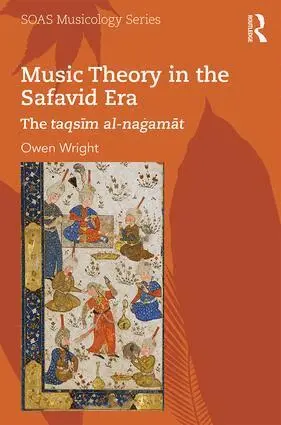
Review from Ethnomusicology 70:1 (Spring 2026)Owen Wright’s Music Theory in the Safavid Era is a significant contribution to the growing body of scholarship on the music theory of the early modern Persianateworld. Centered on the taqsīm al-naġamāt, an anonymous early sixteenth century Persian treatise, this volume provides a critical edition, annotatedtranslation, and exhaustive commentary that together open new pathways for understanding Safavid-era musical thought. Published in 2019, the book helpedestablish a foundation for subsequent studies on Safavid music theory—an area that has received increasing scholarly attention in recent years. In this sense,Wright’s book stands as an important early landmark in a still-developing field. The taqsīm al-naġamāt, copied in Istanbul, is firmly rooted in the Persian theoretical tradition. Its modal and rhythmic vocabulary diverges from contemporaryOttoman works such as Seydī’s musical treatise, suggesting a distinct Safavid lineage. First brought to scholarly attention more than 170 years ago byKiesewetter (1842) and later studied by Salah Eddin Maraqa in Die traditionelle Kunstmusik in Syrien und Ägypten von 1500 bis 1800 (2015), the treatise hadnot been critically edited or thoroughly analyzed until this 2019 publication. Wright’s editorial efforts offer an invaluable resource for scholars interested in thetransmission and transformation of theoretical traditions across the Persianate and Ottoman worlds.The volume is structured around twelve chapters, grouped thematically into three clusters dealing with modes, rhythms, and compositional forms. Eachsection begins with a presentation of the relevant chapters of the taqsīm alnaġamāt, followed by “Retrospect” chapters in which Wright draws comparisonswith earlier and contemporaneous sources. These comparative essays, based on close philological work, offer a detailed historical framework that allowsreaders to trace the continuities and innovations of this Safavid text in relation to the broader theoretical heritage of the region. The Persian text is edited ina precise style at the end of the book and is compared with three anonymous Arabic treatises with which it has a considerable degree of overlap.One of the most striking features of the taqsīm al-naġamāt is its organization of modal entities according to the finger holes of the nay (reed flute). Each modeis mapped diagrammatically onto the layout of the instrument, a gesture that evokes European works such as Sylvestro di Ganassi’s Fontegara (1535). Basedon this, Wright cautiously proposes that the author may have been a nay player and even suggests a possible Sufi affiliation. While intriguing, the latter hypothesismight benefit from further nuancing. The nay in Persian music, though a respected instrument, does not occupy the same symbolic and spiritual role itholds in the Mevlevi Sufi tradition. As such, the use of the nay in this treatise could be read as a reflection of practical musicianship rather than an overt Sufiorientation.Wright’s deep expertise in music theory and philology is evident throughout the book. His linguistic precision is unmatched; three different transliterationsystems are employed for Arabic, Persian, and Turkish, each applied with consistent care. His familiarity with a broad array of primary sources allows for arich contextualization of the taqsīm al-naġamāt, and his commentary is densely informative. At the same time, readers new to the subject or approaching itfrom adjacent disciplines may find the book’s structure somewhat demanding. The introduction, for instance, provides limited orientation regarding methodologicalframework or overall organization. Some key concepts, such as “mode,” are introduced without clear theoretical framing. The term is used to describeentities such as maqām, āvāz, and sho‘ba, but its precise definition, scope, and limitations in performance practice remain largely implicit. As Harold Powershas cautioned, the cross-cultural use of “mode” can lead to conceptual ambiguities, and further clarification might have enhanced the book’s accessibility.Similarly, the use of “time unit” instead of the more commonly used “beat,” as well as the term “systematist theorists” (referring to the lineage of scholarsfollowing Ṣafī al-Dīn al-Urmawī), would benefit from brief clarification. These small omissions, though understandable in a work of this depth, may makenavigation more challenging for nonspecialists.Wright’s analytical style is characteristically thorough. He presents multiple interpretive possibilities, often preferring to explore the complexities of a passagerather than reduce it to a singular reading. Of particular note, the section on rhythm synthesizes some of Wright’s earlier writings—particularly his contributionsto Rhythmic Cycles and Structures in the Art Music of the Middle East (2017)—and places them in productive dialogue with the treatise at hand.In sum, Music Theory in the Safavid Era is a major achievement. It brings to light an important but long-overlooked source and offers a comprehensive scholarlyapparatus for its study. The book’s meticulous analytical approach, broad historical contextualization, and attention to detail make it an indispensableresource for anyone working on Persian music theory, Safavid intellectual history, or the transmission of musical knowledge across cultures. While some sectionsmay prove dense for general readers, specialists will find—and indeed have found—much to admire and build upon. As more studies continue to emergein this area, Wright’s volume will remain a cornerstone of the conversation.ReferencesHelvacı, Zeynep, Jacob Olley, and Rolf Martin Jaeger, eds. 2017. Rhythmic Cycles and Structures in the Art Music of the Middle East. Orient Institute.Kiesewetter, Raphael Georg. 1842. Die Musik der Araber nach Originalquellen dargestellt. Breitkopf und Härtel. Reproduced in facsimile by Dr. Martin Sändig oHG, 1968.Maraqa, Salah Eddin. 2015. Die traditionelle Kunstmusik in Syrien und Ägypten von 1500 bis1800: Eine Untersuchung der musiktheoretischen und historisch-biographischen Quellen. Hans Schneider.Review by Amir Hosein Pourjavady, Independent Scholar