• Fri frakt över 249 kr
  • •
  • Snabba leveranser
  • •
  • Billiga böcker
Kundservice

Du är på sajten för privatpersoner.

Företag, bibliotek eller offentlig verksamhet?

Du handlar på classic.bokus.com, där alla dina funktioner finns intakta.
Till classic.bokus.com
Bokus logotyp. Gå till startsidan.
  • Erbjudanden
  • Nyheter
  • Student
  • Topplistor
  • Barn & ungdom
  • Bokus Play
  • E-böcker
  • Pocketböcker
  • Spel & pussel

10% rabatt på allt med kod: NYSTART10 →

Sidfot

Mina sidor

    Hjälp

    • Kundservice
    • Vanliga frågor och svar
    • Frakt och leverans
    • Retur vid ångerrätt
    • Reklamera vara
    • Betalning
    • Köpvillkor
    • Allmänna villkor
    • Information om webbplatsens tillgänglighet

    Om Bokus

    • Om oss
    • Pressrum
    • För studenter
    • För företag
    • För bibliotek och offentlig verksamhet
    • För leverantörer
    • Hållbarhet

    Populärt

    • Aktuella erbjudanden
    • Presentkort
    • Studentlitteratur
    • Nya böcker
    • Topplistor
    • Signerade böcker
    • Engelska böcker

    Inspiration

    • Boktips
    • BookTok
    • Populära bokserier
    • Barnbokskaraktärer
    • Populära författare
    Logotyp för Bokus
    Följ oss på Facebook (extern länk)Följ oss på Instagram (extern länk)Följ oss på YouTube (extern länk)Följ oss på TikTok (extern länk)
    bokus @ CookiesAnpassa cookiesIntegritetspolicyKöpvillkor
    Till Citymail hemsida (extern länk)Till Budbee hemsida (extern länk)Till Postnord hemsida (extern länk)Till Schenker hemsida (extern länk)Till Early Bird hemsida (extern länk)Till Walleys hemsida (extern länk)
    1. Historia och arkeologi
    2. Arkeologi
    3. Arkeologiska perioder och områden

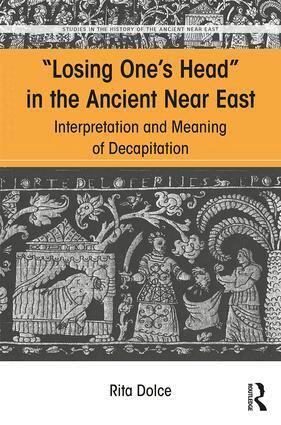
    Losing One's Head in the Ancient Near East

    Interpretation and Meaning of Decapitation

    AvRita Dolce

    Inbunden, Engelska, 2017

    Del i serien Studies in the History of the Ancient Near East

    2 493 kr

    Beställningsvara. Skickas inom 10-15 vardagar. Fri frakt över 249 kr.

    Fler format och utgåvor

    Häftad

    701 kr

    E-bok

    829 kr

    E-bok

    829 kr

    Beskrivning

    In the Ancient Near East, cutting off someone’s head was a unique act, not comparable to other types of mutilation, and therefore charged with a special symbolic and communicative significance. This book examines representations of decapitation in both images and texts, particularly in the context of war, from a trans-chronological perspective that aims to shed light on some of the conditions, relationships and meanings of this specific act. The severed head is a “coveted object” for the many individuals who interact with it and determine its fate, and the act itself appears to take on the hallmarks of a ritual. Drawing mainly on the evidence from Anatolia, Syria and Mesopotamia between the third and first millennia BC, and with reference to examples from prehistory to the Neo-Assyrian Period, this fascinating study will be of interest not only to art historians, but to anyone interested in the dynamics of war in the ancient world.

    Produktinformation

    • Utgivningsdatum:2017-12-19
    • Mått:156 x 234 x 11 mm
    • Vikt:317 g
    • Format:Inbunden
    • Språk:Engelska
    • Serie:Studies in the History of the Ancient Near East
    • Antal sidor:110
    • Förlag:Taylor & Francis Ltd
    • ISBN:9781138067486

    Utforska kategorier

    • Arkeologiska perioder och områden inom Historia och arkeologi
    • Forntida militärhistoria inom Historia och arkeologi
    • Konsthistoria inom Kultur

    Mer om författaren

    Rita Dolce is Associate Professor of Archaeology and History of Near Eastern Cultures and Fine Arts at the Università degli Studi Roma Tre, Italy, and a member of the Italian Archaeological Mission in Syria, where she has excavated for 40 years at the site of Tell Mardikh-Ebla. Her research interests lie mainly in the figurative art, urban topography and architecture of the third millennium BC in Mesopotamia and Syria. She has written numerous books and articles focusing particularly on visual communication as the language of power and a means of dissemination in the societies of the Ancient Near East, and on the urban origins of Ebla, its palatial culture and the structure and significance of cult places in this important Early Syrian kingdom.

    Recensioner i media

    "Building on a vast documentary record that covers the entire Syro-Mesopotamian tradition, Dolce's analysis offers an in-depth study in visual semiotics. She identifies specific 'semantic codes' and an explicit syntactical organization, through which a strong message was conveyed by means of visual imagery. This is iconology at its best: by highlighting the coherence of a representational program, and drawing on parallel written statements, our sensitivity is trained to appreciate the 'intrinsic meaning' of a topos such as the action of beheading – a topos with a valence that goes well beyond that of other types of mutilation precisely because of its ideological import."Giorgio Buccellati, University of California Los Angeles, USA

    Innehållsförteckning

    • List of IllustrationsPrefaceAcknowledgementsImage CreditsAbbreviationsIntroductionChapter II.1. From the Distant Past to the Recent PastI.2. An Unrepeatable ActI.3. The Headless Body: Anonymity/IdentityChapter IIII.1. Exclusivity/MultiplicityII.2. Exhibition/QuantificationChapter IIIIII.1. What Happens to the "Coveted Object"?III.2. Destinations/MotivationsIII.3. Exhibition and MultivalenceChapter IVIV.1. Severed Heads and Birds of PreyIV.2. Eannatum of Lagash and the Birds of PreyIV.3. Mari and the Birds of PreyIV.4. Sargon I of Akkad and the Birds of Prey IV.5. Dadusha of Eshnunna and the Birds of Prey IV.6. The Assyrians and the Birds of Prey Chapter VV.1. Moving Through Space and TimeV.2. How Does the Head Travel?Chapter VIVI.1. "Other" Decapitations in Times of WarVI.2. What Happens to the Severed Heads of Statues?VI.3. Moving Through Space and TimeVI.4. Annihilation/CatharsisBibliographyIndex