• Fri frakt över 249 kr
  • •
  • Snabba leveranser
  • •
  • Billiga böcker
Kundservice

Du är på sajten för privatpersoner.

Företag, bibliotek eller offentlig verksamhet?

Du handlar på classic.bokus.com, där alla dina funktioner finns intakta.
Till classic.bokus.com
Bokus logotyp. Gå till startsidan.
  • Erbjudanden
  • Nyheter
  • Student
  • Topplistor
  • Barn & ungdom
  • Bokus Play
  • E-böcker
  • Pocketböcker
  • Spel & pussel

10% rabatt på allt med kod NYSTART10 →

Sidfot

Mina sidor

    Hjälp

    • Kundservice
    • Vanliga frågor och svar
    • Frakt och leverans
    • Retur vid ångerrätt
    • Reklamera vara
    • Betalning
    • Köpvillkor
    • Allmänna villkor
    • Information om webbplatsens tillgänglighet

    Om Bokus

    • Om oss
    • Pressrum
    • För studenter
    • För företag
    • För bibliotek och offentlig verksamhet
    • För leverantörer
    • Hållbarhet

    Populärt

    • Aktuella erbjudanden
    • Presentkort
    • Studentlitteratur
    • Nya böcker
    • Topplistor
    • Signerade böcker
    • Engelska böcker

    Inspiration

    • Boktips
    • BookTok
    • Populära bokserier
    • Barnbokskaraktärer
    • Populära författare
    Logotyp för Bokus
    Följ oss på Facebook (extern länk)Följ oss på Instagram (extern länk)Följ oss på YouTube (extern länk)Följ oss på TikTok (extern länk)
    bokus @ CookiesAnpassa cookiesIntegritetspolicyKöpvillkor
    Till Citymail hemsida (extern länk)Till Budbee hemsida (extern länk)Till Postnord hemsida (extern länk)Till Schenker hemsida (extern länk)Till Early Bird hemsida (extern länk)Till Walleys hemsida (extern länk)
    1. Psykologi och pedagogik
    2. Pedagogik
    3. Material och digital teknik i undervisningen

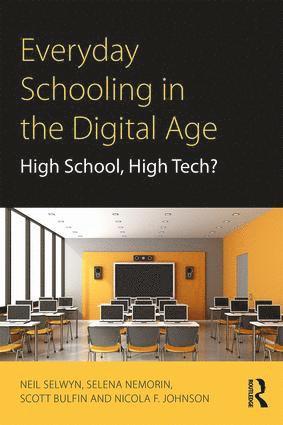
    Everyday Schooling in the Digital Age

    High School, High Tech?

    AvNeil Selwyn,Selena Nemorin

    Häftad, Engelska, 2017

    580 kr

    Beställningsvara. Skickas inom 10-15 vardagar. Fri frakt över 249 kr.

    Fler format och utgåvor

    Inbunden

    2 573 kr

    Beskrivning

    Today’s high schools are increasingly based around the use of digital technologies. Students and teachers are encouraged to ‘Bring Your Own Device’, teaching takes place through ‘learning management systems’ and educators are rushing to implement innovations such as flipped classrooms, personalized learning, analytics and ‘maker’ technologies. Yet despite these developments, the core processes of school appear to have altered little over the past 50 years. As the twenty-first century progresses, concerns are growing that the basic model of ‘school’ is ‘broken’ and no longer ‘fit for purpose’.This book moves beyond the hype and examines the everyday realities of digital technology use in today’s high schools. Based on a major ethnographic study of three contrasting Australian schools, the authors lay bare the reasons underlying the inconsistent impact of digital technologies on day-to-day schooling. The book examines leadership and management of technology in schools, the changing nature of teachers’ work in the digital age, as well as student (mis)uses of technologies in and out of classrooms. In-depth case studies are presented of the adoption of personalized learning apps, social media and 3D printers. These investigations all lead to a detailed understanding of why schools make use of digital technologies in the ways that they do.Everyday Schooling in the Digital Age: High School, High Tech? offers a revealing analysis of the realities of contemporary schools and schooling – drawing on arguments and debates from various academic literatures such as policy studies, sociology of education, social studies of technology, media and communication studies. Over the course of ten wide-ranging chapters, a range of suggestions are developed as to how the full potential of digital technology might be realized within schools. Written in a detailed but accessible manner, this book offers an ambitious critique that is essential reading for anyone interested in the fast-changing nature of contemporary education.

    Produktinformation

    • Utgivningsdatum:2017-11-27
    • Mått:156 x 234 x 12 mm
    • Vikt:320 g
    • Format:Häftad
    • Språk:Engelska
    • Antal sidor:206
    • Förlag:Taylor & Francis Ltd
    • ISBN:9781138069374

    Utforska kategorier

    • Material och digital teknik i undervisningen inom Psykologi och pedagogik
    • Skolan och förskolan inom Psykologi och pedagogik

    Mer om författaren

    Neil Selwyn is a professor in the Faculty of Education, Monash University, Australia. His research and teaching focuses on the place of digital media in everyday life, and the sociology of technology (non)use in educational settings.Selena Nemorin is a post-doctoral research fellow at London School of Economics and Politics (LSE), UK. Her research interests include digital sociology, philosophy of technology, Maker education, surveillance and society, and brain-machine interfaces. Scott Bulfin is a senior lecturer in the Faculty of Education at Monash University, Australia, where he studies young people’s use of digital media and the new innovations in literacy education.Nicola F. Johnson is an associate professor and Deputy Head in the School of Education, at Federation University Australia. Nicola’s research concerns internet over-use, the social phenomena of internet usage, technological expertise, the use of information and communication technologies within teaching and learning, and more recently, interventions with at-risk, regional students.

    Innehållsförteckning

    • List of figuresPreface and acknowledgementsChapter 1.Schools in the digital age... waiting for the great leap forward!Chapter 2. Developing an everyday perspective on schools and technologyChapter 3. Introducing the schoolsChapter 4. Leadership of technologyChapter 5. The realities of ‘one-to-one’ technology provision Chapter 6. New technology meets old classroomsChapter 7. Technology and teachers’ work Chapter 8. Students and technology – ‘getting on’ and ‘getting by’ Chapter 9. Making sense of schools, technology and changeChapter 10. Schools in the digital age: how might things be otherwise?