• Fri frakt över 249 kr
  • •
  • Snabba leveranser
  • •
  • Billiga böcker
Kundservice

Du är på sajten för privatpersoner.

Företag, bibliotek eller offentlig verksamhet?

Du handlar på classic.bokus.com, där alla dina funktioner finns intakta.
Till classic.bokus.com
Bokus logotyp. Gå till startsidan.
  • Erbjudanden
  • Nyheter
  • Student
  • Topplistor
  • Barn & ungdom
  • Bokus Play
  • E-böcker
  • Pocketböcker
  • Spel & pussel

10% rabatt på allt med kod NYSTART10 →

Sidfot

Mina sidor

    Hjälp

    • Kundservice
    • Vanliga frågor och svar
    • Frakt och leverans
    • Retur vid ångerrätt
    • Reklamera vara
    • Betalning
    • Köpvillkor
    • Allmänna villkor
    • Information om webbplatsens tillgänglighet

    Om Bokus

    • Om oss
    • Pressrum
    • För studenter
    • För företag
    • För bibliotek och offentlig verksamhet
    • För leverantörer
    • Hållbarhet

    Populärt

    • Aktuella erbjudanden
    • Presentkort
    • Studentlitteratur
    • Nya böcker
    • Topplistor
    • Signerade böcker
    • Engelska böcker

    Inspiration

    • Boktips
    • BookTok
    • Populära bokserier
    • Barnbokskaraktärer
    • Populära författare
    Logotyp för Bokus
    Följ oss på Facebook (extern länk)Följ oss på Instagram (extern länk)Följ oss på YouTube (extern länk)Följ oss på TikTok (extern länk)
    bokus @ CookiesAnpassa cookiesIntegritetspolicyKöpvillkor
    Till Citymail hemsida (extern länk)Till Budbee hemsida (extern länk)Till Postnord hemsida (extern länk)Till Schenker hemsida (extern länk)Till Early Bird hemsida (extern länk)Till Walleys hemsida (extern länk)
    1. Samhälle och politik
    2. Samhälle och kultur
    3. Kultur och medier
    4. Referensverk och tvärvetenskap

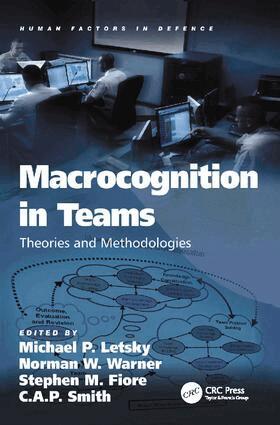
    Macrocognition in Teams

    Theories and Methodologies

    AvMichael P. Letsky,Norman W. Warner

    Häftad, Engelska, 2017

    Del i serien Human Factors in Defence

    867 kr

    Beställningsvara. Skickas inom 10-15 vardagar. Fri frakt över 249 kr.

    Fler format och utgåvor

    Inbunden

    2 647 kr

    Beskrivning

    Team collaboration involves many operational tasks such as team decision-making or course of action selection, developing shared understanding, and intelligence analysis. These operational tasks must be performed in many situations, often under severe time pressure, with information and knowledge uncertainty, large amounts of dynamic information and across different team characteristics. Recent research in this area has focused on various aspects of human collaborative decision-making and the underlying cognitive processes while describing those processes at different levels of detail, making it difficult to compare research results. The theoretical construct of ’macrocognition in teams’ was developed to facilitate cognitive research in team collaboration, which will enable a common level of understanding when defining, measuring and discussing the cognitive processes in team collaboration. Macrocognition is defined as both the internalized and externalized mental processes employed by team members in complex, one-of-a-kind, collaborative problem solving. Macrocognition in Teams provides readers with a greater understanding of the macrocognitive processes which support collaborative team activity, showcasing current research, theories, methodologies and tools. It will be of direct relevance to academics, researchers and practitioners interested in group/team interaction, performance, development and training.

    Produktinformation

    • Utgivningsdatum:2017-03-31
    • Mått:156 x 234 x undefined mm
    • Vikt:453 g
    • Format:Häftad
    • Språk:Engelska
    • Serie:Human Factors in Defence
    • Antal sidor:446
    • Förlag:Taylor & Francis Ltd
    • ISBN:9781138076358

    Utforska kategorier

    • Referensverk och tvärvetenskap inom Samhälle och politik
    • Socialpsykologi och gruppsykologi inom Psykologi och pedagogik
    • Tillämpad datateknik inom Data och IT

    Mer om författaren

    Dr Michael P Letsky is currently Program Officer for the Collaboration and Knowledge Interoperability Program at the Office of Naval Research (ONR), Arlington, Virginia. He manages a research program of academic grants and innovative small business projects seeking to understand team cognition and team performance. He previously worked for the Army Research Institute of the Behavioral and Social Sciences where he developed their long range strategic research plan and also served on the Army Science Board on Highly Maneuverable Forces. Dr. Letsky's education includes a B.S. in Electrical Engineering (Northeastern University), an MBA and DBA in Operations Research (George Washington University). Norman Warner, Ph.D. is a senior scientist at the Naval Air Systems Command, Patuxent River, Maryland. His expertise is in Human Factors Engineering in the areas of automated decision support, human decision-making and team collaboration. Over the past 27 years, he has conducted research with a variety of organizations (i.e. Naval Air Systems Command, Office of Naval Research, Air Force, Army). He was awarded two patents in decision support technology and has published over 25 peer reviewed articles. Currently, his research focus is on understanding team decision-making and the cognitive mechanisms used during asynchronous, distributed team collaboration. Stephen M. Fiore, Ph.D. holds a joint appointment with the University of Central Florida’s Institute for Simulation and Training and the Cognitive Sciences Program in the Department of Philosophy. He earned his Ph.D. degree (2000) in Cognitive Psychology from the University of Pittsburgh, Learning Research and Development Center. He maintains a multidisciplinary research interest that incorporates aspects of cognitive, social, and organizational psychology in the investigation of human behavior in individuals and small groups. Dr. Fiore has co-authored a number of scientific publications in the areas of learning, memor

    Recensioner i media

    'The book Macrocognition in Teams is an innovative, coherent, and focused approach to the cognitive processes of teams solving problems. The chapters of this book demonstrate what happens if the cognitive processes of teams solving problems are taken seriously. The book includes a number of theoretical and empirical contributions. Additionally, technologies are described in several chapters that can be used to transform the cognitive processes of teams so that problems are solved more effectively. The book advances our theoretical and conceptual understanding of macrocognition and presents empirical results and technological demonstrations showing how applications of macrocognition can enhance the cognitive processes of teams solving problems.' Verlin B. Hinsz, North Dakota State University, USA

    Innehållsförteckning

    • Contents: Preface; Macrocognition in teams, Michael Letsky and Norman W. Warner; Empirical model of team collaboration: focus on macrocognition; Norman W. Warner and Michael P. Letsky; Shared mental models and their convergence, Sara A. McComb; Communication as team-level cognitive processing, Nancy J. Cooke, Jamie C. Gorman and Preston A. Kiekel; Collaboration, training and pattern recognition, Steven Haynes and C.A.P. Smith; Towards a conceptual model of common ground in teamwork, John M. Carroll, Gregorio Convertino, Mary Beth Rosson, Craig H. Ganoe; Agents as collaborating team members, Abhijit V. Deshmukh, Sara A. McComb and Christian Wernz; Transferring meaning and developing cognitive similarity in decision making teams: collaboration and meaning analysis process, Joan R. Rentsch, Lisa A. Delise and Scott Hutchison; Processes in complex team problem-solving: parsing and defining the theoretical problem space, Stephen M. Fiore, Michael Rosen, Eduardo Salas, Shawn Burke and Florian Jentsch; Augmenting video to share situation awareness more effectively in a distributed team, David Kirsh; EWall: a computational system for investigating and supporting cognitive and collaborative sense-making processes, Paul Keel, William Porter, Mathew Sither and Patrick Winston; DCODE: a tool for knowledge transfer, conflict resolution and consensus building in teams, Robert A Fleming; Modeling cultural and organizational factors of multinational teams, Holly A.H. Handley and Nancy J Heacox; CENTER: critical thinking in team decision making, Kathleen P. Hess, Jared Freeman and Michael D. Coovert; Measuring situation awareness through automated communication analysis, Peter W. Foltz, Cheryl A. Bolstad, Haydee M. Cuevas, Marita Franzke, Mark Rosenstein and Anthony M. Costello; Converging approaches to automated communications-based assessment of team situation awareness, Shawn A. Weil, Pacey Foster, Jared Freeman, Kathleen Carley, Jana Diesner, Terrill Franz, Nancy J. Cooke, Steve Shope and Jamie C. Gorman; Shared lightweight annotation technology (SLATE) for special operations forces, Mark St. John and Harvey S. Smallman; JIGSAW - joint intelligence graphical situation awareness web for collaborative intelligence analysis, Harvey S. Smallman; The collaboration advizor tool: a tool to diagnose and fix team cognitive problems, David Noble; Collaborative operational and research environment (CORE): a collaborative testbed and tool suite for asynchronous collaboration, Elizabeth M. Wroblewski and Norman W. Warner; Plug-and-play testbed for collaboration in the global information grid, Alex Bordetsky and Susan Hutchins; Naturalistic decision making based collaboration scenarios, Elizabeth Wroblewski and Norman W. Warner; Macrocognition research: challenges and opportunities on the road ahead, Stephen M. Fiore, C.A.P. Smith and Michael P. Letsky; Index.