C.A.P. Smith - Böcker
Visar alla böcker från författaren C.A.P. Smith. Handla med fri frakt och snabb leverans.
4 produkter
4 produkter
2 302 kr
Skickas inom 10-15 vardagar
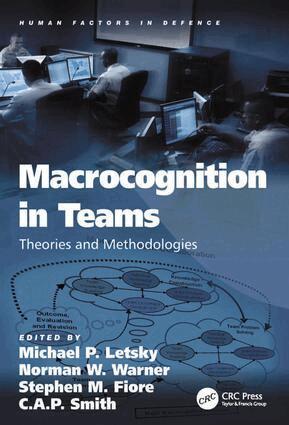
Team collaboration involves many operational tasks such as team decision-making or course of action selection, developing shared understanding, and intelligence analysis. These operational tasks must be performed in many situations, often under severe time pressure, with information and knowledge uncertainty, large amounts of dynamic information and across different team characteristics. Recent research in this area has focused on various aspects of human collaborative decision-making and the underlying cognitive processes while describing those processes at different levels of detail, making it difficult to compare research results. The theoretical construct of ’macrocognition in teams’ was developed to facilitate cognitive research in team collaboration, which will enable a common level of understanding when defining, measuring and discussing the cognitive processes in team collaboration. Macrocognition is defined as both the internalized and externalized mental processes employed by team members in complex, one-of-a-kind, collaborative problem solving. Macrocognition in Teams provides readers with a greater understanding of the macrocognitive processes which support collaborative team activity, showcasing current research, theories, methodologies and tools. It will be of direct relevance to academics, researchers and practitioners interested in group/team interaction, performance, development and training.
2 893 kr
Skickas inom 10-15 vardagar
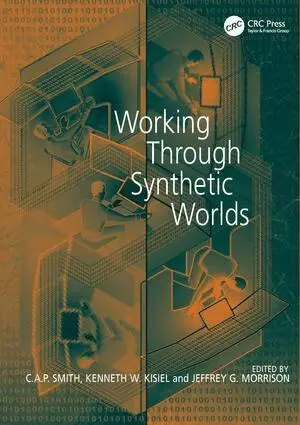
Virtual environments (VE) are human-computer interfaces in which the computer creates a sensory-immersing environment that interactively responds to and is controlled by the behaviour of the user. Since these technologies will continue to become more reliable, more resolute and more affordable, it's important to consider the advantages that VEs may offer to support business processes. The term 'synthetic world' refers to a subset of VEs, having a large virtual landscape and a set of rules that govern the interactions among participants. Currently, the primary motivators for participation in these synthetic worlds appear to be fun and novelty. As the novelty wears off, synthetic worlds will need to demonstrate a favourable value proposition if they are to survive. In particular, non-game-oriented worlds will need to facilitate business processes to a degree that exceeds their substantial costs for development and maintenance. Working Through Synthetic Worlds explores a variety of different tasks that might benefit by being performed within a synthetic world. The editors use a distinctive format for the book, consisting of a set of chapters composed of three parts: ¢ a story or vignette that describes work conducted within a synthetic world based loosely on the question, 'what will work be like in the year 2025?', founded on the expert authors' expectations of plausible future technologies ¢ a scholarly review of the technologies described by the stories and the current theories related to those technologies ¢ a prescription for future research required to bridge the current state-of-the-art with the notional worlds described in the stories. The book will appeal to undergraduate and graduate students, professors, scientists and engineers, managers in high-tech industries and software developers.
817 kr
Skickas inom 10-15 vardagar
Team collaboration involves many operational tasks such as team decision-making or course of action selection, developing shared understanding, and intelligence analysis. These operational tasks must be performed in many situations, often under severe time pressure, with information and knowledge uncertainty, large amounts of dynamic information and across different team characteristics. Recent research in this area has focused on various aspects of human collaborative decision-making and the underlying cognitive processes while describing those processes at different levels of detail, making it difficult to compare research results. The theoretical construct of ’macrocognition in teams’ was developed to facilitate cognitive research in team collaboration, which will enable a common level of understanding when defining, measuring and discussing the cognitive processes in team collaboration. Macrocognition is defined as both the internalized and externalized mental processes employed by team members in complex, one-of-a-kind, collaborative problem solving. Macrocognition in Teams provides readers with a greater understanding of the macrocognitive processes which support collaborative team activity, showcasing current research, theories, methodologies and tools. It will be of direct relevance to academics, researchers and practitioners interested in group/team interaction, performance, development and training.
1 181 kr
Skickas inom 10-15 vardagar
Virtual environments (VE) are human-computer interfaces in which the computer creates a sensory-immersing environment that interactively responds to and is controlled by the behaviour of the user. Since these technologies will continue to become more reliable, more resolute and more affordable, it's important to consider the advantages that VEs may offer to support business processes. The term 'synthetic world' refers to a subset of VEs, having a large virtual landscape and a set of rules that govern the interactions among participants. Currently, the primary motivators for participation in these synthetic worlds appear to be fun and novelty. As the novelty wears off, synthetic worlds will need to demonstrate a favourable value proposition if they are to survive. In particular, non-game-oriented worlds will need to facilitate business processes to a degree that exceeds their substantial costs for development and maintenance. Working Through Synthetic Worlds explores a variety of different tasks that might benefit by being performed within a synthetic world. The editors use a distinctive format for the book, consisting of a set of chapters composed of three parts: ¢ a story or vignette that describes work conducted within a synthetic world based loosely on the question, 'what will work be like in the year 2025?', founded on the expert authors' expectations of plausible future technologies ¢ a scholarly review of the technologies described by the stories and the current theories related to those technologies ¢ a prescription for future research required to bridge the current state-of-the-art with the notional worlds described in the stories. The book will appeal to undergraduate and graduate students, professors, scientists and engineers, managers in high-tech industries and software developers.