• Fri frakt över 249 kr
  • •
  • Snabba leveranser
  • •
  • Billiga böcker
Kundservice

Du är på sajten för privatpersoner.

Företag, bibliotek eller offentlig verksamhet?

Du handlar på classic.bokus.com, där alla dina funktioner finns intakta.
Till classic.bokus.com
Bokus logotyp. Gå till startsidan.
  • Erbjudanden
  • Nyheter
  • Student
  • Topplistor
  • Barn & ungdom
  • Bokus Play
  • E-böcker
  • Pocketböcker
  • Spel & pussel

10% rabatt på allt med kod NYSTART10 →

Sidfot

Mina sidor

    Hjälp

    • Kundservice
    • Vanliga frågor och svar
    • Frakt och leverans
    • Retur vid ångerrätt
    • Reklamera vara
    • Betalning
    • Köpvillkor
    • Allmänna villkor
    • Information om webbplatsens tillgänglighet

    Om Bokus

    • Om oss
    • Pressrum
    • För studenter
    • För företag
    • För bibliotek och offentlig verksamhet
    • För leverantörer
    • Hållbarhet

    Populärt

    • Aktuella erbjudanden
    • Presentkort
    • Studentlitteratur
    • Nya böcker
    • Topplistor
    • Signerade böcker
    • Engelska böcker

    Inspiration

    • Boktips
    • BookTok
    • Populära bokserier
    • Barnbokskaraktärer
    • Populära författare
    Logotyp för Bokus
    Följ oss på Facebook (extern länk)Följ oss på Instagram (extern länk)Följ oss på YouTube (extern länk)Följ oss på TikTok (extern länk)
    bokus @ CookiesAnpassa cookiesIntegritetspolicyKöpvillkor
    Till Citymail hemsida (extern länk)Till Budbee hemsida (extern länk)Till Postnord hemsida (extern länk)Till Schenker hemsida (extern länk)Till Early Bird hemsida (extern länk)Till Walleys hemsida (extern länk)
    1. Samhälle och politik
    2. Samhälle och kultur
    3. Kultur och medier
    4. Medievetenskap

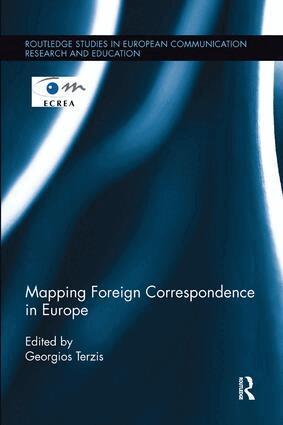
    Mapping Foreign Correspondence in Europe

    AvGeorgios Terzis

    Häftad, Engelska, 2017

    Del i serien Routledge Studies in European Communication Research and Education

    513 kr

    Beställningsvara. Skickas inom 10-15 vardagar. Fri frakt över 249 kr.

    Beskrivning

    The book studies the current trends of foreign correspondence in Europe. The EU’s expansion has had abundant effects on news coverage and some of the European capitals have become home to the biggest international press corps in world. So, who are these "professional strangers" stationed in Europe and how do they try to make their stories, that are clearly important in today’s interconnected world, interesting for viewers and readers?This book represents the first Pan-European study of foreign correspondents and their reporting. It includes chapters from 27 countries, and it aims to study them and the direction, flow and pattern of their coverage, as well as answer questions regarding the impact of new technologies on the quantity, frequency and speed of their coverage. Do more sophisticated communications tools yield better international news coverage of Europe? Or does the audience’s increasing apathy and the downsizing of the foreign bureaus offset these advances? And how do the seemingly unstoppable media trends of convergence, commercialization, concentration, and globalization affect the way Europe and individual European countries are reported?

    Produktinformation

    • Utgivningsdatum:2017-06-16
    • Mått:152 x 229 x undefined mm
    • Vikt:521 g
    • Format:Häftad
    • Språk:Engelska
    • Serie:Routledge Studies in European Communication Research and Education
    • Antal sidor:368
    • Förlag:Taylor & Francis Ltd
    • ISBN:9781138097742

    Utforska kategorier

    • Medievetenskap inom Samhälle och politik

    Mer om författaren

    Georgios Terzis is Associate Professor at Vesalius College and Senior Associate Researcher at the Institute for European Studies, Vrije Universiteit Brussel, Belgium. A senior expert at the Global Governance Institute, his research focuses on media and security governance, European media governance, and the development of pan-European media. He is the founding Chair of the Journalism Studies Section of the European Communication Research and Education Association.

    Innehållsförteckning

    • Prologue Johan Galtung Introduction: Foreign Correspondents in Perspective Stylianos Papathanassopoulos and Iliana Giannouli 1.Foreign Correspondents in Austria: Vienna: a Central and Eastern Europe-Base in Transition Roman Hummel, Johanna Dorer, Sarah Anne Ganter, Gerit Götzenbrucker and Dimitri Prandner 2. Foreign Correspondents in Belgium: Brussels Correspondents’ Struggle to Make the Important Interesting Georgios Terzis and Gareth Harding 3. Foreign Correspondents in Bulgaria: News from the Eastern Frontier of the European Union Lulivera Krusteva 4. Foreign Correspondents in Cyprus: Tacking between Tradition and Change Vaia Doudaki and Dimitra L. Milioni 5. Foreign Correspondents in the Czech Republic: Coping with Social Transition and Financial Crisis Alice N. Tejkalová and Filip Láb 6. Foreign Correspondents in Denmark: All Quiet on the Northern News Front? Morten Skovsgaard and Arjen van Dalen 7. Foreign Correspondents in Estonia: Representatives of Nordic-Baltic Region Ragne Kõuts and Marju Himma-Kadakas 8. Foreign Correspondents in Finland: News from the Fringe of Europe Raimo Salokangas 9. Foreign Correspondents in France: From Prestige Status to Changing Practices and Complex Perspectives Jérémie Nicey and Antonella Agostino 10. Reporting Teutonia: Foreign Correspondents in Germany: Doing Well Despite Pessimistic Outlook Thomas Hanitzsch, Oliver Hahn, and Michael Brüggemann 11. Foreign Correspondents in Greece: Facing the "communication deficit" Stylianos Papathanassopoulos and Iliana Giannouli 12. Foreign Correspondents in Hungary: Local, Glocal, Global Agendas Jolán Róka 13. Foreign Correspondents in Ireland: Close Neighbours, Global Agenda John O’Sullivan 14. Foreign Correspondents in Latvia: Can a Small Country Have Big News? Inta Brikše 15. Foreign Correspondents in Lithuania: Between Glorious Past and Miserable Future Gintaras Aleknonis 16. Foreign Correspondents in Malta: Peculiarities of a Small Nation State Joseph Borg 17. Foreign Correspondent in the Netherlands: Anything That Would be of Interest for Our Readers Bernadette C.M. Kester and Mirjam Goudswaard 18. Foreign Correspondents in Norway: Covering a small, rich country near the Artic Sigurd Allern 19. Foreign Correspondents in Portugal: News from Portugal: Thanks to the Debt Crisis Carla Baptista and Cláudia Henriques 20. Foreign Correspondents in Serbia: What Happens When a War Ends? Verica Rupar and Sonja Seizova 21. Foreign Correspondents in Slovakia: Economy, Minorities and Sometimes Politics Andrej Školkay 22. Foreign Correspondents in Slovenia: A Small Country Neglected by Foreign Media Marko Milosavljević and Gašper Završnik 23. Foreign Correspondents in Spain: Facing the Economic and Professional Crisis Ramón Salaverría 24. Foreign Correspondents in Sweden: Professional Challenges and Strategies of Domestication Jessica Gustafsson and Andreas Widholm 25. Foreign Correspondents in Switzerland: Hard News, No Chocolate Michael Brüggemann, Guido Keel, and Martina van Berkel 26. Foreign Correspondents in Turkey: Between the Home and Host Agendas Eylem Yanardağoğlu and L. Doğan Tılıç 27. Foreign Correspondents in the UK: London: a city 'bathed in light' Michael Bromley, Howard Tumber, and Julian Fritsch Conclusions: The 'Professional Strangers' of Europe at the Dawn of the 21st Century Georgios Terzis Epilogue Cees Hamelink