• Fri frakt över 249 kr
  • •
  • Snabba leveranser
  • •
  • Billiga böcker
Kundservice

Du är på sajten för privatpersoner.

Företag, bibliotek eller offentlig verksamhet?

Du handlar på classic.bokus.com, där alla dina funktioner finns intakta.
Till classic.bokus.com
Bokus logotyp. Gå till startsidan.
  • Erbjudanden
  • Nyheter
  • Student
  • Topplistor
  • Barn & ungdom
  • Bokus Play
  • E-böcker
  • Pocketböcker
  • Spel & pussel

10% rabatt på allt med kod: NYSTART10 →

Sidfot

Mina sidor

    Hjälp

    • Kundservice
    • Vanliga frågor och svar
    • Frakt och leverans
    • Retur vid ångerrätt
    • Reklamera vara
    • Betalning
    • Köpvillkor
    • Allmänna villkor
    • Information om webbplatsens tillgänglighet

    Om Bokus

    • Om oss
    • Pressrum
    • För studenter
    • För företag
    • För bibliotek och offentlig verksamhet
    • För leverantörer
    • Hållbarhet

    Populärt

    • Aktuella erbjudanden
    • Presentkort
    • Studentlitteratur
    • Nya böcker
    • Topplistor
    • Signerade böcker
    • Engelska böcker

    Inspiration

    • Boktips
    • BookTok
    • Populära bokserier
    • Barnbokskaraktärer
    • Populära författare
    Logotyp för Bokus
    Följ oss på Facebook (extern länk)Följ oss på Instagram (extern länk)Följ oss på YouTube (extern länk)Följ oss på TikTok (extern länk)
    bokus @ CookiesAnpassa cookiesIntegritetspolicyKöpvillkor
    Till Citymail hemsida (extern länk)Till Budbee hemsida (extern länk)Till Postnord hemsida (extern länk)Till Schenker hemsida (extern länk)Till Early Bird hemsida (extern länk)Till Walleys hemsida (extern länk)
    1. Samhälle och politik
    2. Samhälle och kultur
    3. Kultur och medier
    4. Referensverk och tvärvetenskap

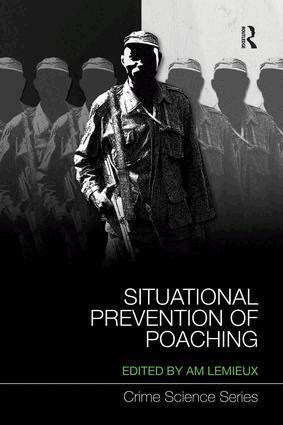
    Situational Prevention of Poaching

    AvAndrew Lemieux

    Häftad, Engelska, 2015

    Del i serien Crime Science Series

    793 kr

    Beställningsvara. Skickas inom 10-15 vardagar. Fri frakt över 249 kr.

    Beskrivning

    For centuries, criminologists have looked for scientific ways to study, understand, and ultimately prevent crime. In this volume, a unique offense, poaching, is explored in various contexts to determine what opportunity structures favor this crime and how situational crime prevention may reduce its prevalence. The data sources used range from publically available secondary data about animal populations, to interviews with hunters, to actual law enforcement data collected inside protected areas. Various methods are utilized to look for patterns in poaching behaviour regarding where poachers strike, which species they target and their modus operandi. Collectively, the volume shows that principles of criminal opportunity theory and situational crime prevention are useful for studying and preventing poaching in a variety of contexts. The methods employed by each chapter are easily replicated and meant to stimulate empirical poaching research where data is available. While the theoretical grounding of this volume is drawn from criminology, it is written for a broad audience of academics, practitioners and those interested in wildlife conservation.

    Produktinformation

    • Utgivningsdatum:2015-08-04
    • Mått:156 x 234 x 19 mm
    • Vikt:430 g
    • Format:Häftad
    • Språk:Engelska
    • Serie:Crime Science Series
    • Antal sidor:232
    • Förlag:Taylor & Francis Ltd
    • ISBN:9781138120297

    Utforska kategorier

    • Referensverk och tvärvetenskap inom Samhälle och politik
    • Brottslighet och kriminologi inom Samhälle och politik

    Mer om författaren

    AM Lemieux is a Researcher at the Netherlands Institute for the Study of Crime and Law Enforcement. His main areas of interest are the spatial and temporal distribution of crime, the use of technology to improve law enforcement operations, and anti-poaching operations in Africa.

    Recensioner i media

    "Poaching is a crime with global and historical repercussions. This important and timely book, written by some of the most influential scholars in the field, fills a critical void in the criminology and crime prevention literature."D. Kim Rossmo, Department of Criminal Justice, Texas State University"Andrew Lemieux’s Situational Crime Prevention of Poaching is a marvellous book. Its internationally respected contributors go far beyond lamenting the impact of poaching on our wildlife. They show with rigorous research why this is happening, and as important, they show how practical steps can be taken to stop it. Anyone – wildlife manager, conservation official, policy maker, researcher, student, or informed citizen – concerned with the protection of wildlife must read this book."John E. Eck, Professor, School of Criminal Justice, University of Cincinnati"Most crime prevention literature concerns itself with attacks on people and property in the Western world. Meanwhile, a quarter of all mammalian species are now at risk of extinction in the wild by dint of human agency. Our children and grandchildren seem destined to inhabit a world of diminished biodiversity unless more attention is directed towards crimes contributing towards that bleak prospect. This book marries the necessary focus on wildlife crime with a set of practical and achievable tactics for its reduction."Ken Pease, University College London

    Innehållsförteckning

    • 1. Introduction, AM Lemieux 2. Rhino Poaching in Kruger National Park, South Africa: Aligning Analysis, Technology and Prevention, Corné Eloff and AM Lemieux 3. Does Opportunity Make the Poacher?: An Analysis of Neo-Tropical Illicit Parrot Markets, Stephen Pires and Rob T. Guerette 4. Can the Problem Analysis Module (PAM) Help Us Imagine New Preventative Solutions to a Specific Tiger Poaching Issue?, Jennifer Mailley 5. Law Enforcement Monitoring in Uganda: The Utility of Official Data and Time/Distance-Based Ranger Efficiency Measures, William D. Moreto, AM Lemieux, A. Rwetsiba, N. Guma, M. Driciru and H. Kulu Kirya 6. Tracking Poachers in Uganda: Spatial Models of Patrol Intensity and Patrol Efficiency, AM Lemieux, Wim Bernasco, A. Rwetsiba, N. Guma, M. Driciru and H. Kulu Kirya 7. Potential Uses of Computer Agent-Based Simulation Modeling in the Evaluation of Wildlife Poaching, Joanna F. Hill, Shane D. Johnson and Hervé Borrion 8. Poaching and Tiger Populations in Indian Reserves, Jeong Hyun Kim, Ronald V. Clarke and Joel Miller 9. Eyes on the Forest: CCTV and Ecotourism in Indian Tiger Reserves, Ronald V Clarke, Kevin Chetty and Mangai Natarajan.