• Fri frakt över 249 kr
  • •
  • Snabba leveranser
  • •
  • Billiga böcker
Kundservice

Du är på sajten för privatpersoner.

Företag, bibliotek eller offentlig verksamhet?

Du handlar på classic.bokus.com, där alla dina funktioner finns intakta.
Till classic.bokus.com
Bokus logotyp. Gå till startsidan.
  • Erbjudanden
  • Nyheter
  • Student
  • Topplistor
  • Barn & ungdom
  • Bokus Play
  • E-böcker
  • Pocketböcker
  • Spel & pussel

10% rabatt på allt med kod NYSTART10 →

Sidfot

Mina sidor

    Hjälp

    • Kundservice
    • Vanliga frågor och svar
    • Frakt och leverans
    • Retur vid ångerrätt
    • Reklamera vara
    • Betalning
    • Köpvillkor
    • Allmänna villkor
    • Information om webbplatsens tillgänglighet

    Om Bokus

    • Om oss
    • Pressrum
    • För studenter
    • För företag
    • För bibliotek och offentlig verksamhet
    • För leverantörer
    • Hållbarhet

    Populärt

    • Aktuella erbjudanden
    • Presentkort
    • Studentlitteratur
    • Nya böcker
    • Topplistor
    • Signerade böcker
    • Engelska böcker

    Inspiration

    • Boktips
    • BookTok
    • Populära bokserier
    • Barnbokskaraktärer
    • Populära författare
    Logotyp för Bokus
    Följ oss på Facebook (extern länk)Följ oss på Instagram (extern länk)Följ oss på YouTube (extern länk)Följ oss på TikTok (extern länk)
    bokus @ CookiesAnpassa cookiesIntegritetspolicyKöpvillkor
    Till Citymail hemsida (extern länk)Till Budbee hemsida (extern länk)Till Postnord hemsida (extern länk)Till Schenker hemsida (extern länk)Till Early Bird hemsida (extern länk)Till Walleys hemsida (extern länk)
    1. Samhälle och politik
    2. Samhälle och kultur
    3. Kultur och medier
    4. Kulturvetenskap

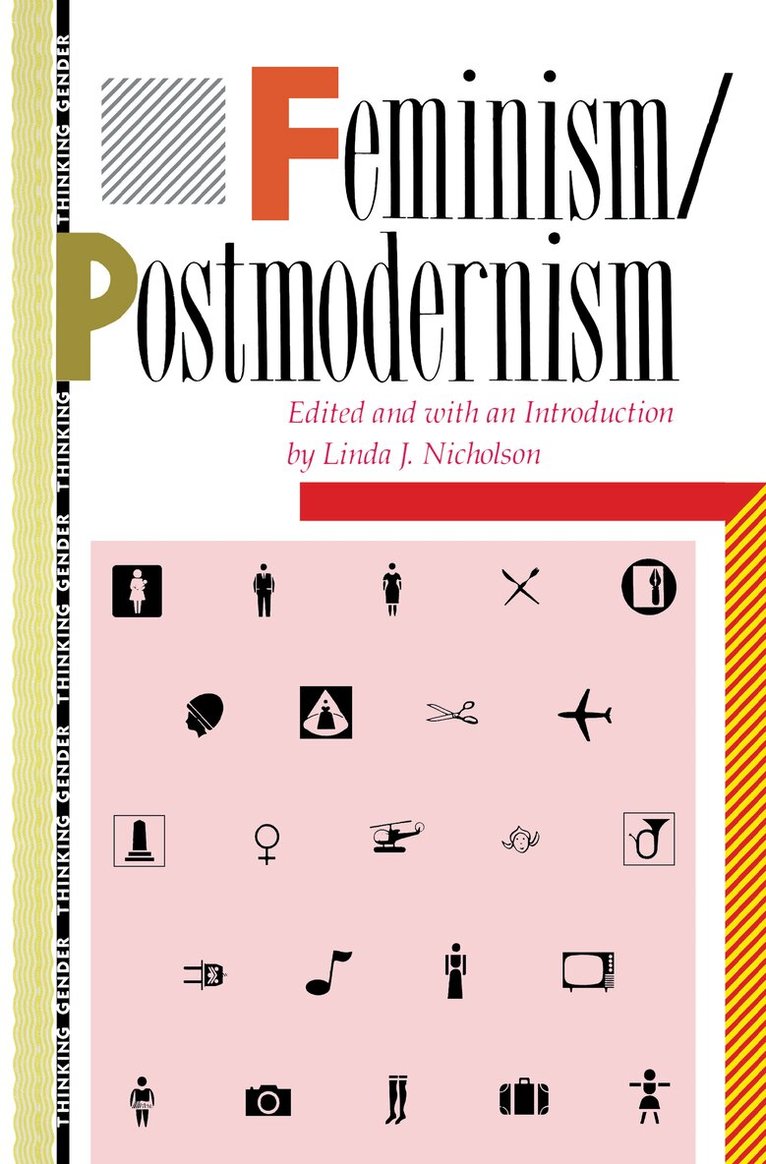
    Feminism/Postmodernism

    AvLinda Nicholson

    Inbunden, Engelska, 2016

    Del i serien Thinking Gender

    2 057 kr

    Beställningsvara. Skickas inom 10-15 vardagar. Fri frakt över 249 kr.

    Beskrivning

    In this anthology, prominent contemporary theorists assess the benefits and dangers of postmodernism for feminist theory. The contributors examine the meaning of postmodernism both as a methodological position and a diagnosis of the times. They consider such issues as the nature of personal and social identity today, the political implications of recent aesthetic trends, and the consequences of changing work and family relations on women's lives. Contributors: Seyla Benhabib, Susan Bordo, Judith Butler, Christine Di Stefano, Jane Flax, Nancy Fraser, Donna Haraway, Sandra Harding, Nancy Hartsock, Andreas Huyssen, Linda J. Nicholson, Elspeth Probyn, Anna Yeatman, Iris Young.

    Produktinformation

    • Utgivningsdatum:2016-06-22
    • Mått:152 x 229 x 24 mm
    • Vikt:453 g
    • Format:Inbunden
    • Språk:Engelska
    • Serie:Thinking Gender
    • Antal sidor:360
    • Förlag:Taylor & Francis Ltd
    • ISBN:9781138146143

    Utforska kategorier

    • Kulturvetenskap inom Samhälle och politik
    • Genusvetenskap inom Samhälle och politik

    Recensioner i media

    ". . . the collection provides an incisive debate over some of the major issues confronting feminism in relation to postmodernism." -- The Women's Review of Books". . . a valuable collection for anyone concerned with either feminism or postmodernism, but especially for those concerned with their integration." -- Studies inthe Humanities"This collection represents some of the vanguard feminist philosophy today. The complexity and erudition of the scholarship are proof of the maturity of feminist thought. The energy and depth of the analyses are proof that feminist theory has both the ability to keep its critical edge even when the subject of attack is itself and a deep reserve of vitality nourished by commitment to practical struggle." -- Hypatia"The papers collected here are among the very best, feminist or other, that try to map out the tortured terrain and point the way to an answer." -- Andrea Nye, Hypatia

    Innehållsförteckning

    • Introduction; Part 1 Feminism As Against Epistemology?; Chapter 1 Social Criticism without Philosophy: An Encounter between Feminism and PostmodernismThis essay has previously appeared in Communication, Vol. 10, Nos. 3 and 4, 1988, pp. 345–366; Theory, Culture and Society, Vol. 5, Nos. 2 and 3, June 1988, pp. 373–394; Universal Abandon? The Politics of Postmodernism, ed. Andrew Ross (Minneapolis: University of Minnesota Press, 1988) pp. 83–104; The Institution of Philosophy: A Discipline in Crisis? ed. Avner Cohen and Marcelo Dascal (Peru, Illinois: Open Court Press, 1989). We are grateful for the helpful suggestions of many people, especially Jonathan Arac, Ann Ferguson, Marilyn Frye, Nancy Hartsock, Alison Jaggar, Berel Lang, Thomas McCarthy, Karsten Struhl, Iris Young, Thomas Wartenburg, and the members of SOFPHIA. We are also grateful for word-processing help from Marina Rosiene., Nancy Fraser, Linda J. Nicholson; Chapter 2 Postmodernism and Gender Relations in Feminist Theory, Jane Flax; Chapter 3 Dilemmas of Difference: Feminism, Modernity, and PostmodernismEarlier versions and portions of this paper were delivered to the Northwest Women's Studies Association Conference, Eastern Washington University, Cheney, WA, October 17 and 18, 1986, and to the Annual Meeting of the American Political Science Association, the Palmer House, Chicago, September 3–6, 1987. I am grateful to the various panel organizers, Part icipants, and audiences for helpful criticism and encouragement. Special thanks to Tom Dalglish, Susan Hekman, and Lisa Orlando for notably generous and detailed critical responses., Christine Di Stefano; Chapter 4 Feminism, Science, and the Anti-Enlightenment Critiques, Sandra Harding; Chapter 5 Epistemologies of Postmodernism: A Rejoinder to Jean-François LyotardI would like to thank Andreas Huyssen and Wolf Schàfer for comments and criticisms., Seyla Benhabib; Part 2 The Politics of Location; Chapter 6 Feminism, Postmodernism, and Gender-ScepticismThe writing of this Chapter was made possible by the generous support of the Rockefeller Foundation and the American Council of Learned Societies/Ford Foundation. Written while I was in residence at the Duke University/University of North Carolina Center for Research on Women, it has benefitted greatly from my Part icipation in the Duke/UNC communities, especially from almost daily conversation with Lee Ann Whites, and from the insights and suggestions of friends and colleagues there who read and commented on earlier drafts: Ted Koditschek, Jean O'Barr, Lynne Tirrell, Jane Tompkins, and Mary Wyer. I am grateful to Mario Moussa and Linda Robertson for their help in enabling me to shape and clarify later drafts, at a point when I was beginning to lose my own distance and focus on the piece. I would also like to thank Pat Keane, Edward Lee, Bruce Shefrin, and Linda Nicholson for their comments and suggestions. Finally, it is impossible to adequately acknowledge the contribution of Lynne Arnault, for whose friendship, insight, ability to help me untie my intellectual knots, and deep philosophical and practical engagement with the issues of importance to both of us, I am constantly grateful., Susan Bordo; Chapter 7 Foucault on Power: A Theory for Women? This Chapter is a revised version of a paper presented at a conference titled “The Gender of Power,” at University of Leiden, September 1987, and published as a Part of the conference proceedings. The Gender of Power, ed. Monique Lejnaar, Kathy Davis, Claudine Helleman, Jantine Oldersmaa, Dini Vos (Leiden: University of Leiden, 1987)., Nancy Hartsock; Chapter 8 Travels in the Postmodern: Making Sense of the LocalMy thanks to Marty Allor and Larry Grossberg for their invaluable comments and conversations on these subjects., Elspeth Probyn; Chapter 9 A Manifesto for Cyborgs: Science, Technology, and Socialist Feminism in the 1980sThis article was first published in Socialist Review, No. 80, 1985. The essay originated as a response to a call for political thinking about the 1980s from socialist-feminist points of view, in hopes of deepening our political and cultural debates in order to renew commitments to fundamental social change in the face of the Reagan years. The cyborg manifesto tried to find a feminist place for connected thinking and acting in profoundly contradictory worlds. Since its publication, this bit of cyborgian writing has had a surprising half life. It has proved impossible to rewrite the cyborg. Cyborg's daughter will have to find its own matrix in another essay, starting from the proposition that the immune system is the biotechnical body's chief system of differences in late capitalism, where feminists might find provocative extraterrestrial maps of the networks of embodied power marked by race, sex, and class. This Chapter is substantially the same as the 1985 version, with minor revisions and correction of notes., Donna Haraway; Chapter 10 Mapping the PostmodernThis essay was first published in a slightly longer version in New German Critique, Vol. 33, Fall 1984, pp. 5–52. It was also published in Andreas Huyssen, After the Great Divide: Modernism, Mass Culture, Postmodernism, (Bloomington, IN: Indiana University Press, 1986)., Andreas Huyssen; Part 3 Identity and Differentiation; Chapter 11 A Feminist Theory of Social Differentiation, Anna Yeatman; Chapter 12 The Ideal of Community and the Politics of DifferenceI am grateful to David Alexander, Ann Ferguson, Roger Gottlieb, Peter Manicas, Peter Onuf, Lucius Outlaw, Michael Ryan, Richard Schmitt, Ruth Smith, Tom Wartenburg, and Hugh Wilder for helpful comments on earlier versions of this Chapter., Iris Marion Young; Chapter 13 Gender Trouble, Feminist Theory, and Psychoanalytic DiscourseMy genuine thanks to Joan W. Scott for giving thoughtful response to many versions of this piece. I am grateful to the American Council of Learned Societies and to the Institute for Advanced Study in Princeton for sponsoring this work., Judith Butler