• Fri frakt över 249 kr
  • •
  • Snabba leveranser
  • •
  • Billiga böcker
Kundservice

Du är på sajten för privatpersoner.

Företag, bibliotek eller offentlig verksamhet?

Du handlar på classic.bokus.com, där alla dina funktioner finns intakta.
Till classic.bokus.com
Bokus logotyp. Gå till startsidan.
  • Erbjudanden
  • Nyheter
  • Student
  • Topplistor
  • Barn & ungdom
  • Bokus Play
  • E-böcker
  • Pocketböcker
  • Spel & pussel

10% rabatt på allt med kod: NYSTART10 →

Sidfot

Mina sidor

    Hjälp

    • Kundservice
    • Vanliga frågor och svar
    • Frakt och leverans
    • Retur vid ångerrätt
    • Reklamera vara
    • Betalning
    • Köpvillkor
    • Allmänna villkor
    • Information om webbplatsens tillgänglighet

    Om Bokus

    • Om oss
    • Pressrum
    • För studenter
    • För företag
    • För bibliotek och offentlig verksamhet
    • För leverantörer
    • Hållbarhet

    Populärt

    • Aktuella erbjudanden
    • Presentkort
    • Studentlitteratur
    • Nya böcker
    • Topplistor
    • Signerade böcker
    • Engelska böcker

    Inspiration

    • Boktips
    • BookTok
    • Populära bokserier
    • Barnbokskaraktärer
    • Populära författare
    Logotyp för Bokus
    Följ oss på Facebook (extern länk)Följ oss på Instagram (extern länk)Följ oss på YouTube (extern länk)Följ oss på TikTok (extern länk)
    bokus @ CookiesAnpassa cookiesIntegritetspolicyKöpvillkor
    Till Citymail hemsida (extern länk)Till Budbee hemsida (extern länk)Till Postnord hemsida (extern länk)Till Schenker hemsida (extern länk)Till Early Bird hemsida (extern länk)Till Walleys hemsida (extern länk)
    1. Samhälle och politik
    2. Social välfärd och brottslighet
    3. Brottslighet och kriminologi

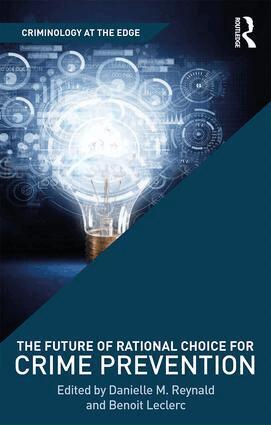
    Future of Rational Choice for Crime Prevention

    AvDanielle Reynald,Benoit Leclerc

    Inbunden, Engelska, 2017

    Del i serien Criminology at the Edge

    2 421 kr

    Beställningsvara. Skickas inom 10-15 vardagar. Fri frakt över 249 kr.

    Beskrivning

    The rational choice perspective (RCP) is currently the core theoretical approach underpinning situational crime prevention (SCP). To date, many crimes have been studied through the lens of RCP, which increased our understanding of these phenomena, how they are committed and how they could potentially be prevented through SCP. This book, designed with the hope of moving RCP forward for SCP purposes, takes a challenging but novel step in providing leading experts from different disciplines with the opportunity to express themselves on how we could best achieve this task. This book explores various perspectives, which include the development of frameworks based on the role of situations in crime or forensic sciences for improving crime prevention practices. The need to consider affective states and other offender-related factors to improve our understanding of offender decision-making models is highlighted as a means to better predict which SCP mechanisms may be most useful in discouraging particular types of offenders. Finally, it is also argued that the use of RCP should be more pragmatic and that this perspective should be preserved and adapted based on what we find in our experiments.Taken together, these theoretically distinctive and challenging contributions ultimately guide how crime prevention practices could be best approached in the future.

    Produktinformation

    • Utgivningsdatum:2017-09-21
    • Mått:138 x 216 x 15 mm
    • Vikt:296 g
    • Format:Inbunden
    • Språk:Engelska
    • Serie:Criminology at the Edge
    • Antal sidor:118
    • Förlag:Taylor & Francis Ltd
    • ISBN:9781138217225

    Utforska kategorier

    • Brottslighet och kriminologi inom Samhälle och politik

    Mer om författaren

    Danielle M. Reynald is a criminologist at the Griffith Criminology Institute and senior lecturer at the School of Criminology and Criminal Justice at Griffith University, Brisbane, Australia. Benoit Leclerc is a researcher at the Griffith Criminology Institute and associate professor of criminology and criminal justice at Griffith University, Brisbane, Australia.

    Recensioner i media

    "Hurray! This is the book my students and I have been awaiting: a systematic rational discussion of the problems, advantages, and future directions of offender choice perspectives. Danielle Reynald and Benoit Leclerc have produced an essential book probing the foundations of scientific and practical crime prevention. Only irrational criminologists will ignore it."- John E. Eck, Professor of Criminal Justice, University of Cincinnati, USA"The idea that offending involves rational decision-making has been extremely important in criminology and has had significant practical implications for situational crime prevention. This book presents many insightful findings on these topics, including the influence of emotional factors as well as the subjective costs and benefits of offending, and the importance of interactions between types of people and types of situations. It should be of great interest to all criminologists, especially in advancing the understanding of offender decision-making and its implications for crime prevention."- David P. Farrington, Emeritus Professor of Psychological Criminology, University of Cambridge, UK"A closer look at Jeremy Bentham's original work shows that he had a very nuanced and diversified view of what pleasures and punishments people consider when they make decisions. Bentham was not fortunate enough to have the data or the accumulated research now available. In the current volume the contributors apply more modern knowledge to evaluate how offenders make choices, the nuances affecting their choices, and how this extra information helps us design lower crime rates."- Marcus Felson, Professor in the School of Criminal Justice, Texas State University, USA

    Innehållsförteckning

    • 1. What could be the future of rational choice for crime prevention? Benoit Leclerc and Danielle M. Reynald, 2. Does situational crime prevention require a rational offender? Richard Wortley and Nick Tilley, 3. Hot criminology or what Homer’s Odyssea can teach criminologists about decision-making, Jean-Louis van Gelder, 4. Theorising forensic science: a model for crime prevention, Paul Knepper, 5. A baseline model of deterrence, Matthew Manning, 6. Another look at person-situation interaction: what offenders are sensitive to what situational crime prevention measures? Henk Elffers and Danielle M. Reynald