• Fri frakt över 249 kr
  • •
  • Snabba leveranser
  • •
  • Billiga böcker
Kundservice

Du är på sajten för privatpersoner.

Företag, bibliotek eller offentlig verksamhet?

Du handlar på classic.bokus.com, där alla dina funktioner finns intakta.
Till classic.bokus.com
Bokus logotyp. Gå till startsidan.
  • Erbjudanden
  • Nyheter
  • Student
  • Topplistor
  • Barn & ungdom
  • Bokus Play
  • E-böcker
  • Pocketböcker
  • Spel & pussel

10% rabatt på allt med kod NYSTART10 →

Sidfot

Mina sidor

    Hjälp

    • Kundservice
    • Vanliga frågor och svar
    • Frakt och leverans
    • Retur vid ångerrätt
    • Reklamera vara
    • Betalning
    • Köpvillkor
    • Allmänna villkor
    • Information om webbplatsens tillgänglighet

    Om Bokus

    • Om oss
    • Pressrum
    • För studenter
    • För företag
    • För bibliotek och offentlig verksamhet
    • För leverantörer
    • Hållbarhet

    Populärt

    • Aktuella erbjudanden
    • Presentkort
    • Studentlitteratur
    • Nya böcker
    • Topplistor
    • Signerade böcker
    • Engelska böcker

    Inspiration

    • Boktips
    • BookTok
    • Populära bokserier
    • Barnbokskaraktärer
    • Populära författare
    Logotyp för Bokus
    Följ oss på Facebook (extern länk)Följ oss på Instagram (extern länk)Följ oss på YouTube (extern länk)Följ oss på TikTok (extern länk)
    bokus @ CookiesAnpassa cookiesIntegritetspolicyKöpvillkor
    Till Citymail hemsida (extern länk)Till Budbee hemsida (extern länk)Till Postnord hemsida (extern länk)Till Schenker hemsida (extern länk)Till Early Bird hemsida (extern länk)Till Walleys hemsida (extern länk)
    1. Språk och ordböcker
    2. Språk: referensverk och allmänt

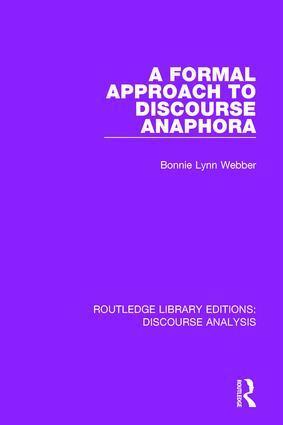
    Formal Approach to Discourse Anaphora

    AvBonnie Lynn Webber

    Häftad, Engelska, 2018

    Del i serien RLE: Discourse Analysis

    615 kr

    Beställningsvara. Skickas inom 10-15 vardagar. Fri frakt över 249 kr.

    Beskrivning

    First published in 1979, this book starts from the perspective that dealing with anaphoric language can be decomposed into two complementary tasks: 1. identifying what a text potentially makes available for anaphoric reference and 2. constraining the candidate set of a given anaphoric expression down to one possible choice. The author argues there is an intimate connection between formal sentential analysis and the synthesis of an appropriate conceptual model of the discourse. Some of the issues with the creation of this conceptual model are discussed in the second chapter, which follows a background to the thesis that catalogues the types of anaphoric expression available in English and lists the types of things that can be referred to anaphorically. The third and fourth chapters examine two types of anaphoric expression that do not refer to non-linguistic entities. The final chapter details three areas into which this research could potentially be extended. This book will be of interest to students of linguistics.

    Produktinformation

    • Utgivningsdatum:2018-05-17
    • Mått:156 x 234 x 11 mm
    • Vikt:340 g
    • Format:Häftad
    • Språk:Engelska
    • Serie:RLE: Discourse Analysis
    • Antal sidor:204
    • Förlag:Taylor & Francis Ltd
    • ISBN:9781138224056

    Utforska kategorier

    • Språk: referensverk och allmänt inom Språk och ordböcker
    • Språkvetenskap och lingvistik inom Språk och ordböcker

    Innehållsförteckning

    • Acknowledgements; Table of Contents; Synopsis; Chapter 1. Introduction; 1. Statement of the Problem 2. The Range of Discourse Anaphora 3. Historical Background 3.1 Factors Influencing Anaphor Resolution 3.1.1 Number/gender agreement 3.1.2 Backwards Anaphora constraint 3.1.3 Theme 3.1.4 Role Inertia 3.1.5 Semantic Sectional Restrictions 3.1.6 Recency and Scene Shifts 3.1.7 Implicit Causality 3.1.8 Possible Words 3.2 Methods of Simplifying Anaphor Resolution 3.3. Previous Research on Verb Phrase Ellipsis 4. The Range of Antecedents and Referents 4.1 Individuals 4.2 Sets 4.3 Stuff 4.4 Generics 4.5 Prototypes 4.6 Actions, Events, States, Prepositions 4.7 Descriptions 4.8 Predicates 5. Fundamental Assumptions 6. Thesis Organisation; Chapter 2. Definite Pronouns; 1. Introduction 1.1 The Notion of a Discourse Model 1.2 The Importance of Descriptions 1.3 Warnings to the Reader 1.4 Chapter Organisation 2. Factors in forming Discourse Entity IDs 2.1 Noun Phrase Specificity 2.1.1 The Definite/Indefinite Distinction 2.1.2 The Referential/Attributive Distinction 2.1.3 The Specific/Non-specific Distinction 2.1.4 Non-standard Determiners 2.2 Member/Set Information 2.3 Three Uses of Plurals 2.4 Pronouns in the Input 2.5 Alternative Perspectives 2.6 Embedded Noun Phrases 3. Representational Conventions 3.1 Noun Phrases in General 3.2 Singular Noun Phrases 3.3 Plural Noun Phrases 4. Preliminary Rule for Deriving Discourse Entity IDs 4.1 Informal Examples 4.2 Independent Quantifiers and Definite Descriptions 4.3 Dependent Quantifiers and Definite Descriptions 4.3.1 For each… there exists 4.3.2 Class Restriction Dependencies 4.3.3 Quantifiers in class Restrictions 5. Other Factors in Deriving Descriptions 5.1 Tense 5.2 Conditionals 5.3 Disjunction 5.4 Negation 6. Discourse Models and Anaphor Resolution 7. Summary; Chapter 3. "One Anaphora"; 1. Introduction 2. Requirements on a Representation 2.1 Preserving Noun Phrases as Structural Units 2.2 Further Factoring of Descriptions 2.3 Disambiguating Word Senses 2.4 Resolving Definite Pronouns 3. Possible Representations 3.1 Syntactic Surface Structure 3.2 Level-2 Interpretations 4. Identifying Candidate Antecedents 5. Representatives of ‘One’-Anaphora 5.1 That and Those 5.2 O 5.3 It 6. Non-explicit Descriptions 7. Summary; Chapter 4: Verb Phrases Ellipsis; 1. Introduction 1.1 Historical Context 1.2 Chapter Organisation 2. System Requirements: Representational & Procedural 2.1 Surface Subjects 2.2 Pronouns 2.3 Existential Quantifiers 2.4 Negation 25 Plurals 2.6 Non-subject Relative Clauses 3. Surface Constraints on Verb Phrases Ellipsis 3.1 Proximity 3.2 Structural Position 3.3 Voice Constraints 3.4 Negation 3.5 Tense and Aspect 4. Resolving Verb Phrase Ellipsis 5. Inference and Verb Phrase Ellipsis 5.1 Conjoined Predicates and ‘Headless’ relatives 5.2 Split Reciprocals 5.3 Embedded Descriptions 6. Summary; Chapter 5. Conclusion; 1. Summary 2. Future Research 2.1 Data-driven and expectation-driven Processes in Model Synthesis 2.2 Reference Requirements in Limited Contexts 2.3 Sententially-evoked Discourse Entities 3. Epilogue; Bibliography