• Fri frakt över 249 kr
  • •
  • Snabba leveranser
  • •
  • Billiga böcker
Kundservice

Du är på sajten för privatpersoner.

Företag, bibliotek eller offentlig verksamhet?

Du handlar på classic.bokus.com, där alla dina funktioner finns intakta.
Till classic.bokus.com
Bokus logotyp. Gå till startsidan.
  • Erbjudanden
  • Nyheter
  • Student
  • Topplistor
  • Barn & ungdom
  • Bokus Play
  • E-böcker
  • Pocketböcker
  • Spel & pussel

10% rabatt på allt med kod: NYSTART10 →

Sidfot

Mina sidor

    Hjälp

    • Kundservice
    • Vanliga frågor och svar
    • Frakt och leverans
    • Retur vid ångerrätt
    • Reklamera vara
    • Betalning
    • Köpvillkor
    • Allmänna villkor
    • Information om webbplatsens tillgänglighet

    Om Bokus

    • Om oss
    • Pressrum
    • För studenter
    • För företag
    • För bibliotek och offentlig verksamhet
    • För leverantörer
    • Hållbarhet

    Populärt

    • Aktuella erbjudanden
    • Presentkort
    • Studentlitteratur
    • Nya böcker
    • Topplistor
    • Signerade böcker
    • Engelska böcker

    Inspiration

    • Boktips
    • BookTok
    • Populära bokserier
    • Barnbokskaraktärer
    • Populära författare
    Logotyp för Bokus
    Följ oss på Facebook (extern länk)Följ oss på Instagram (extern länk)Följ oss på YouTube (extern länk)Följ oss på TikTok (extern länk)
    bokus @ CookiesAnpassa cookiesIntegritetspolicyKöpvillkor
    Till Citymail hemsida (extern länk)Till Budbee hemsida (extern länk)Till Postnord hemsida (extern länk)Till Schenker hemsida (extern länk)Till Early Bird hemsida (extern länk)Till Walleys hemsida (extern länk)
    1. Medicin
    2. Medicin: allmänt
    3. Medicinhistoria

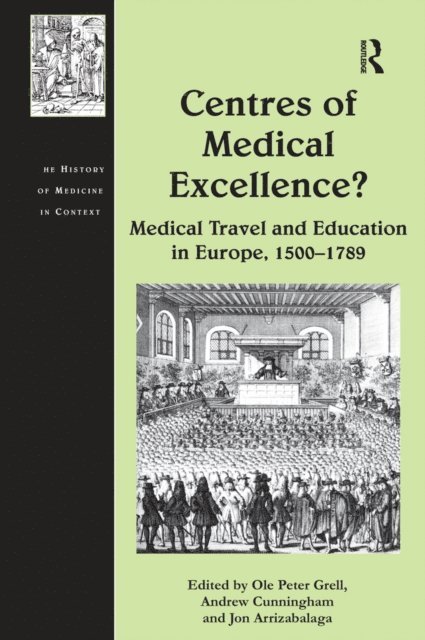
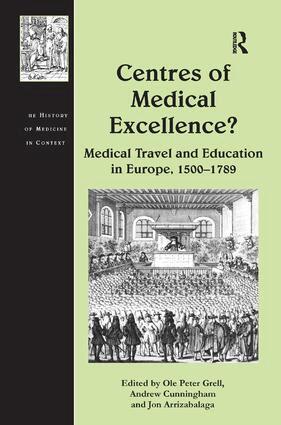
    Centres of Medical Excellence?

    Medical Travel and Education in Europe, 1500–1789

    AvAndrew Cunningham,Ole Peter Grell

    Häftad, Engelska, 2016

    Del i serien History of Medicine in Context

    860 kr

    Beställningsvara. Skickas inom 10-15 vardagar. Fri frakt över 249 kr.

    Fler format och utgåvor

    Inbunden

    2 493 kr

    E-bok

    1 019 kr

    E-bok

    1 019 kr

    Beskrivning

    Students notoriously vote with their feet, seeking out the best and most innovative teachers of their subject. The most ambitious students have been travelling long distances for their education since universities were first founded in the 13th century, making their own educational pilgrimage or peregrinatio. This volume deals with the peregrinatio medica from the viewpoint of the travelling students: who went where; how did they travel; what did they find when they arrived; what did they take back with them from their studies. Even a single individual could transform medical studies or practice back home on the periphery by trying to reform teaching and practice the way they had seen it at the best universities. Other contributions look at the universities themselves and how they were actively developed to attract students, and at some of the most successful teachers, such as Boerhaave at Leiden or the Monros at Edinburgh. The essays show how increasing levels of wealth allowed more and more students to make their pilgrimages, travelling for weeks at a time to sit at the feet of a particular master. In medicine this meant that, over the period c.1500 to 1789, a succession of universities became the medical school of choice for ambitious students: Padua and Bologna in the 1500s, Paris, Leiden and Montpellier in the 1600s, and Leiden, Göttingen and Edinburgh in the 1700s. The arrival of foreign students brought wealth to the university towns and this significant economic benefit meant that the governors of these universities tried to ensure the defence of freedom of religion and freedom of speech, thus providing the best conditions for the promotion of new views and innovation in medicine. The collection presents a new take on the history of medical education, as well as universities, travel and education more widely in ancien régime Europe.

    Produktinformation

    • Utgivningsdatum:2016-11-30
    • Mått:156 x 234 x 26 mm
    • Vikt:650 g
    • Format:Häftad
    • Språk:Engelska
    • Serie:History of Medicine in Context
    • Antal sidor:350
    • Förlag:Taylor & Francis Ltd
    • ISBN:9781138275393

    Utforska kategorier

    • Medicinhistoria inom Medicin
    • Sjöfartshistoria inom Historia och arkeologi
    • Historia inom Historia och arkeologi

    Mer om författaren

    Ole Peter Grell is Professor in Early Modern History and Director of the Renaissance and Early Modern Research Group at The Open University, UK. Andrew Cunningham is Senior Research Fellow in the Department of History and Philosophy of Science at the University of Cambridge, UK. He also wrote and presented the BBC Radio 4 series The Making of Modern Medicine; and Jon Arrizabalaga is Senior Researcher in History of Science at the Spanish National Research Council (CSIC), Institución Milà i Fontanals (IMF), Barcelona, Spain

    Recensioner i media

    '... an engaging and insightful volume... Although the evidence based on student responses to university life may sometimes be scant and problematic, it is to the contributors' credit to have successfully based their accounts on fresh documentary material and a subtle reading of the student records.' Renaissance Quarterly 'It is richly detailed and the scope of its component methodologies impressive, managing to balance individual case studies with broader contextual discussions... The breadth and scope of the research throughout the work is truly impressive, and it is pleasing to note that the spread of essays is truly pan-European, with no one area especially privileged... this work will doubtless make a strong contribution not only to the increasing historiography of medical education in the early modern period, but to the history of European medicine more generally.' British Journal for the History of Science '[Centres of Medical Excellence]'s real contribution is to revitalize and reorient the existing historiography on medical education by directing more attention to students and by explicating the dynamically interactive quality of learning in the early modern world.' European History Quarterly

    Innehållsförteckning

    • Contents: Part I Where to Go and How to Get There: The Bartholins, the Platters and Laurentius Gryllus: the peregrinato medica in the 16th and 17th centuries, Andrew Cunningham; Medical education and centres of excellence in 18th-century Europe: towards an identification, Laurence Brockliss; The mobility of medical students from the 15th to the 18th centuries: the institutional context, Hilde Ridder-Symoens. Part II The Peregrinato Medica, from the Peripheries to the Centres and Back Again: Spanish medical students' peregrinato to Italian universities in the Renaissance, Jon Arrizabalaga; On Portuguese medical students and masters travelling abroad: an overview from the early modern period to the Enlightenment, Mário Sérgio Farelo; Pieter van Foreest and the acquisition and travelling of medical knowledge in the 16th century, Catrien Santing; 'Like bees, who neither suck nor generate their honey from one flower': the significance of the peregrinato academica for Danish medical students in the late 16th and early 17th centuries, Ole Peter Grell. Part III The Centres of Excellence: Medical education in Padua: students, faculty and facilities, Cynthia Klestinec; Paris: 'certainly the best place for learning the practical part of anatomy and surgery', Toby Gelfland; Medical education in 18th-century Montpellier, Elizabeth A. Williams; Herman Boerhaave at Leiden: communis Europae praeceptor, Rina Knoeff; Science, practice and reputation: the University of Göttingen and its medical faculty in the 18th century, Hubert Steinke; The importance of being Edinburgh: the rise and fall of the Edinburgh medical school in the 18th century, Helen Dingwall; Index.