• Fri frakt över 249 kr
  • •
  • Snabba leveranser
  • •
  • Billiga böcker
Kundservice

Du är på sajten för privatpersoner.

Företag, bibliotek eller offentlig verksamhet?

Du handlar på classic.bokus.com, där alla dina funktioner finns intakta.
Till classic.bokus.com
Bokus logotyp. Gå till startsidan.
  • Erbjudanden
  • Nyheter
  • Student
  • Topplistor
  • Barn & ungdom
  • Bokus Play
  • E-böcker
  • Pocketböcker
  • Spel & pussel

10% rabatt på allt med kod: NYSTART10 →

Sidfot

Mina sidor

    Hjälp

    • Kundservice
    • Vanliga frågor och svar
    • Frakt och leverans
    • Retur vid ångerrätt
    • Reklamera vara
    • Betalning
    • Köpvillkor
    • Allmänna villkor
    • Information om webbplatsens tillgänglighet

    Om Bokus

    • Om oss
    • Pressrum
    • För studenter
    • För företag
    • För bibliotek och offentlig verksamhet
    • För leverantörer
    • Hållbarhet

    Populärt

    • Aktuella erbjudanden
    • Presentkort
    • Studentlitteratur
    • Nya böcker
    • Topplistor
    • Signerade böcker
    • Engelska böcker

    Inspiration

    • Boktips
    • BookTok
    • Populära bokserier
    • Barnbokskaraktärer
    • Populära författare
    Logotyp för Bokus
    Följ oss på Facebook (extern länk)Följ oss på Instagram (extern länk)Följ oss på YouTube (extern länk)Följ oss på TikTok (extern länk)
    bokus @ CookiesAnpassa cookiesIntegritetspolicyKöpvillkor
    Till Citymail hemsida (extern länk)Till Budbee hemsida (extern länk)Till Postnord hemsida (extern länk)Till Schenker hemsida (extern länk)Till Early Bird hemsida (extern länk)Till Walleys hemsida (extern länk)
    1. Samhälle och politik
    2. Samhälle och kultur

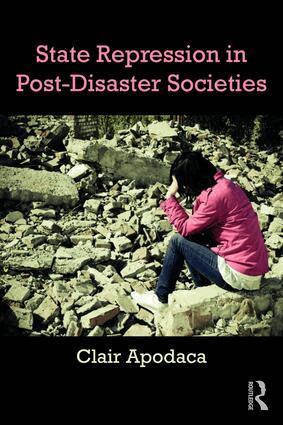
    State Repression in Post-Disaster Societies

    AvClair Apodaca

    Häftad, Engelska, 2017

    709 kr

    Beställningsvara. Skickas inom 10-15 vardagar. Fri frakt över 249 kr.

    Fler format och utgåvor

    Inbunden

    2 421 kr

    E-bok

    838 kr

    E-bok

    838 kr

    Beskrivning

    A natural hazard is a physical event but a disaster is a social and political phenomenon. Natural hazards are, for the most part, unavoidable and apolitical. However, they carry with them serious political, economic, and social consequences. Disasters also have adverse consequences on human rights standards. An understanding of the relationship between disasters and human rights outcomes requires knowledge of how disasters increase grievance and frustration, and impact the probability of contentious political behavior. To date, there has been little empirical or theoretical research on the specific circumstances under which disasters impact antigovernment political behavior, and even less is known of the causal chain between a natural disaster, protest activity, and human rights violations. In this book, Clair Apodaca maps a comprehensive causal model of the complex interactions between disasters and human rights violations. She claims that pre-existing inequalities and societal grievances turn a natural hazard into a disaster.A grievance-based theory of protests suggests that the underlying structural causes are social and economic group disparities, political exclusion, along with population pressures. To turn these all too common conditions into active political behavior requires a triggering event. When a damage–loss is the primary consequence of a disaster, the government and international community can compensate victims by providing rebuilding and reconstruction aid. However, when the disaster results in high numbers of fatalities, the government and international community cannot adequately compensate survivors for their losses. Grievances cannot be easily or effectively eliminated, and survivors and their supporters mobilize for change even if they are likely to face state repression.Clair Apodaca offers a unique contribution to our understanding of human rights violations. She effectively shows that there is a causal process between hazard events, protest activities, and government repression, a finding that is key to scholars, practitioners, and policy-makers working in this field.

    Produktinformation

    • Utgivningsdatum:2017-02-03
    • Mått:152 x 229 x 18 mm
    • Vikt:290 g
    • Format:Häftad
    • Språk:Engelska
    • Antal sidor:192
    • Förlag:Taylor & Francis Ltd
    • ISBN:9781138286092

    Utforska kategorier

    • Samhälle och kultur inom Samhälle och politik
    • Statsskick och politiska processer inom Samhälle och politik
    • Politik och statsskick inom Samhälle och politik

    Mer om författaren

    Clair Apodaca is an associate professor in the Department of Political Science at Virginia Tech. Her research attempts to understand the many multifaceted and interrelated causes of human rights violations and how those violations threaten human wellbeing, the nation-state, and international peace.

    Recensioner i media

    'Clair Apodaca provides a fascinating account of the relationship between the natural world and the political world. As she painstakingly shows, natural disasters have had a profound effect on politics, especially in non-democratic states. In some instances this has led to the overthrow of the old order. However, at other times the government has responded to the public dissatisfaction of its response with even more repression. As climate change increases, the book’s timing could not be better – nor its message more important.' - Mark Gibney, Carol G. Belk Distinguished Professor in Humanities, University of North Carolina Asheville'When natural disasters strike, the world’s attention becomes focused on the human tragedy that ensues, and the international community mobilizes to get emergency relief to the affected areas. All too often, though, the TV cameras leave, sympathy fatigue sets in, and the world’s attention shifts to the next crisis, leaving the victims to rebuild at best they can. Clair Apodaca shines a light on one troubling phenomenon that occurs in the aftermath of some of these events: the rise in repression and human rights violations by the government of the affected nation. Apodaca painstakingly traces out a causal process by which dissident movements can arise in the aftermath of natural disasters, the types of regimes under which such movements are likely to arise, and how, when faced with such challenges, which regime types are likely to respond with repression rather than some form of accommodation. Her analysis reveals that NGOs play a crucial role in this process by enabling affected populations in solving the collective action problems that, amid the conditions of a natural disaster, would otherwise preclude social movements by those most affected by the disaster but least served by the emergency aid from the international community. The story is compelling and the empirical tests are rigorous and convincing. This is an important work that creates an intersection between such diverse fields as human rights and state repression, social movements, and emergency management.' - T. David Mason, Regents Professor and Johnie Christian Family Peace Professor, University of North Texas

    Innehållsförteckning

    • Table of ContentsLists of figuresList of tablesAcknowledgementsChapter 1: The Causal Chain Chapter 2: Root Causes: Disasters Lead to Grievances Chapter 3: Proximate Causes: Public Displays of Grievance and Civil Unrest Chapter 4: Government Response to Civil Unrest Chapter 5: Theory-Based Causal Model of Disaster-Related Repression Chapter 6: Empirical Support for the Causal Chain: Results of the Analysis of Disaster Related RepressionChapter 7: Conclusion AppendixIndex