• Fri frakt över 249 kr
  • •
  • Snabba leveranser
  • •
  • Billiga böcker
Kundservice

Du är på sajten för privatpersoner.

Företag, bibliotek eller offentlig verksamhet?

Du handlar på classic.bokus.com, där alla dina funktioner finns intakta.
Till classic.bokus.com
Bokus logotyp. Gå till startsidan.
  • Erbjudanden
  • Nyheter
  • Student
  • Topplistor
  • Barn & ungdom
  • Bokus Play
  • E-böcker
  • Pocketböcker
  • Spel & pussel

10% studentrabatt med kod TERM26

Sidfot

Mina sidor

    Hjälp

    • Kundservice
    • Vanliga frågor och svar
    • Frakt och leverans
    • Retur vid ångerrätt
    • Reklamera vara
    • Betalning
    • Köpvillkor
    • Allmänna villkor
    • Information om webbplatsens tillgänglighet

    Om Bokus

    • Om oss
    • Pressrum
    • För studenter
    • För företag
    • För bibliotek och offentlig verksamhet
    • För leverantörer
    • Hållbarhet

    Populärt

    • Aktuella erbjudanden
    • Presentkort
    • Studentlitteratur
    • Nya böcker
    • Topplistor
    • Signerade böcker
    • Engelska böcker

    Inspiration

    • Boktips
    • BookTok
    • Populära bokserier
    • Barnbokskaraktärer
    • Populära författare
    Logotyp för Bokus
    Följ oss på Facebook (extern länk)Följ oss på Instagram (extern länk)Följ oss på YouTube (extern länk)Följ oss på TikTok (extern länk)
    bokus @ CookiesAnpassa cookiesIntegritetspolicyKöpvillkor
    Till Citymail hemsida (extern länk)Till Budbee hemsida (extern länk)Till Postnord hemsida (extern länk)Till Schenker hemsida (extern länk)Till Early Bird hemsida (extern länk)Till Walleys hemsida (extern länk)
    1. Historia och arkeologi
    2. Arkeologi

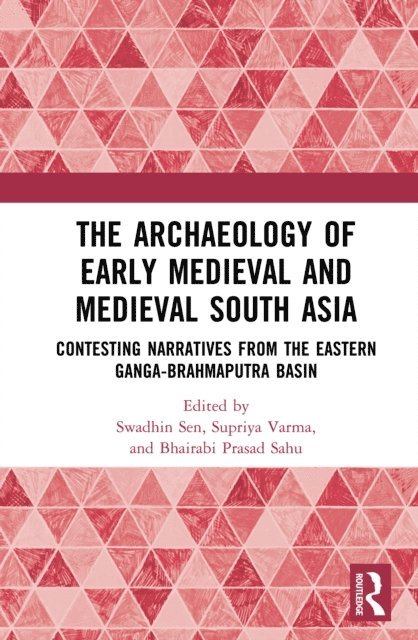
    Archaeology of Early Medieval and Medieval South Asia

    Contesting Narratives from the Eastern Ganga-Brahmaputra Basin

    AvSwadhin Sen,Supriya Varma

    Inbunden, Engelska, 2022

    2 129 kr

    Beställningsvara. Skickas inom 10-15 vardagar. Fri frakt över 249 kr.
    Beskrivning

    This book looks at the ways in which archaeological methods have been used in debates concerning the early medieval and medieval periods in South Asia. Despite the incorporation and use of archaeological data to corroborate historical narratives, the theories and methods of archaeology are largely ignored in and excluded from the dominating, institutionalized, and hegemonic disciplinary discourses. The volume offers contesting insights, polemical narratives, and new data from archaeological contexts to initiate a debate on many foundational premises of archaeological and historical narratives. It focuses on the much-neglected region of the Eastern Ganga-Brahmaputra Basin as a spatial frame to do this and studies themes such as spatial and temporal scales of concepts and methods, multi-scaler factors and processes of continuity and changes, the settlement archaeology of the alluvial landscape, changing patterns of agrarian transformation, and material cultures, including coins, inscriptions, pottery, and sculptures, in their contexts in sub-regional, regional, and supra-regional intersections. Dedicated to historian Brajadulal Chattopadhyaya, this volume presents a crucial and unprecedented intervention in the study of the early medieval and the medieval periods. It will be useful for scholars and researchers of archaeology, ancient history, medieval history, water history, earth sciences, palaeoecology, historical ecology, epigraphy, art history, material culture studies, Indian history, and South Asian studies in general.

    Produktinformation

    • Utgivningsdatum:2022-11-30
    • Mått:156 x 234 x 27 mm
    • Vikt:720 g
    • Format:Inbunden
    • Språk:Engelska
    • Antal sidor:374
    • Förlag:Taylor & Francis Ltd
    • ISBN:9781138320925

    Utforska kategorier

    • Arkeologi inom Historia och arkeologi
    • Referensverk och tvärvetenskap inom Samhälle och politik
    • Asiens historia inom Historia och arkeologi

    Mer om författaren

    Swadhin Sen has been teaching in the Department of Archaeology of Jahangirnagar University, Bangladesh, as a Professor. He has directed several excavations and undertaken full-coverage surveys in the northern part of Bangladesh. He has conducted ethnoarchaeological and ethnoecological studies in the north-western and south-western parts of Bangladesh. Currently he is directing research projects on the palaeoecology of Bengal and the archaeology of dynamic terrain of Bengal. His fields of interest also include politics of the pasts, critical studies of heritage, archaeologies of religions, popular culture of landscape and waterscapes, and cultural politics of ecology. He loves conversation with people and is passionately entangled with water and rivers.Supriya Varma is in the process of transitioning from Jawaharlal Nehru University, New Delhi, to Azim Premji University, Bhopal. She has been the Co-Director of several archaeological projects including the Indor Khera Archaeological Project (IKAP) and the Rohana Khurd Archaeological Project (ROKAP). Her research interests include land use, pastoralism, mobility, landscapes, waterscapes, urbanism, childhood, households, crafts, identities, heritage, and sustainability. Her earlier work focused on the archaeology of childhood and households in ancient cities, but in the last several years, her research has shifted to the medieval and early modern periods. Among her publications are the co-edited book Traditions in Motion: Religion and Society in History and a special issue on Archaeologies of the Medieval in South Asia for The Medieval History Journal. She is currently co-directing an international and interdisciplinary project called MANDU: Monsoon, Climate, and Society in Medieval and Early Modern Times.Bhairabi Prasad Sahu was a Professor at the Department of History, University of Delhi. He was the Head of the Department during 2004–7, and Dean of International Relations at Delhi University during 2007–11. He served the Indian History Congress as its Secretary (2006–9) and the Indian Council of Historical Research as a Council Member (2008–15). He was President of Ancient Indian History at the Indian History Congress (2003) and presided over the Ancient Section of the Punjab History Conference, Historiography Section of the Andhra Pradesh History Congress, and the Uttarakhand History and Culture Association. Professor Sahu was on the editorial board of Indian Historical Review, Studies in People’s History, and Proceedings of the Indian History Congress. He was associated with the German Research Council’s Orissa Research Project (1999–2005). His areas of interest were historiography, political processes, and social formations in pre-modern India, with a greater focus on early medieval Odisha and Chhattisgarh.

    Innehållsförteckning

    • A Dedicatory Note: The unsettling interrogative sensibilities of Brajadulal Chattopadhyaya and transgression of the disciplinary boundaries1 Introduction: Trouble of thinking about the archaeology of the early medieval and the medieval in Ganges–Brahmaputra–Meghna BasinPART 1: Conceptual, methodological, and spatiotemporal domains of archaeology 2 Locating the medieval in South Asian archaeology: Resetting field methods and practices3 The changing landscape of early medieval Indian history: Perspectives from archaeology4 Engaging with the past beyond the comfort zone: Early medieval and medieval in the archaeological context of the north-western part of BengalPART 2: Settlements, landscapes, and interpretive frameworks5 Changing patterns of agrarian development in early medieval North Bengal: A delineation from the inscriptions6 Early medieval and medieval settlements on the littoral and active part of a delta: An archaeological study of the southwestern part of Bangladesh7 Chronicles of perpetually reconfiguring entanglements: A precursory understanding of the landscape archaeology of Teesta Megafan of BangladeshPART 3: Pottery analyses and the spatiotemporal indexes8 Pottery of Bengal during the early medieval period9 Analysing the pottery from the Brahmaputra Valley: Issues within archaeology and history (seventh to fifteenth centuries CE)PART 4: Material culture and monumental remains in context10 Religious pictures from Bengal and Eastern Bihar: More than illustrating pantheons11 Temple-building in the early medieval–medieval Bengal: Revisiting contexts in Western Bengal12 The regional monetary identity of ‘medieval Bengal’ (thirteenth to sixteenth centuries CE): Coin hoards, mint towns, and connectivity