• Fri frakt över 249 kr
  • •
  • Snabba leveranser
  • •
  • Billiga böcker
Kundservice

Du är på sajten för privatpersoner.

Företag, bibliotek eller offentlig verksamhet?

Du handlar på classic.bokus.com, där alla dina funktioner finns intakta.
Till classic.bokus.com
Bokus logotyp. Gå till startsidan.
  • Erbjudanden
  • Nyheter
  • Student
  • Topplistor
  • Barn & ungdom
  • Bokus Play
  • E-böcker
  • Pocketböcker
  • Spel & pussel

10% rabatt på allt med kod NYSTART10 →

Sidfot

Mina sidor

    Hjälp

    • Kundservice
    • Vanliga frågor och svar
    • Frakt och leverans
    • Retur vid ångerrätt
    • Reklamera vara
    • Betalning
    • Köpvillkor
    • Allmänna villkor
    • Information om webbplatsens tillgänglighet

    Om Bokus

    • Om oss
    • Pressrum
    • För studenter
    • För företag
    • För bibliotek och offentlig verksamhet
    • För leverantörer
    • Hållbarhet

    Populärt

    • Aktuella erbjudanden
    • Presentkort
    • Studentlitteratur
    • Nya böcker
    • Topplistor
    • Signerade böcker
    • Engelska böcker

    Inspiration

    • Boktips
    • BookTok
    • Populära bokserier
    • Barnbokskaraktärer
    • Populära författare
    Logotyp för Bokus
    Följ oss på Facebook (extern länk)Följ oss på Instagram (extern länk)Följ oss på YouTube (extern länk)Följ oss på TikTok (extern länk)
    bokus @ CookiesAnpassa cookiesIntegritetspolicyKöpvillkor
    Till Citymail hemsida (extern länk)Till Budbee hemsida (extern länk)Till Postnord hemsida (extern länk)Till Schenker hemsida (extern länk)Till Early Bird hemsida (extern länk)Till Walleys hemsida (extern länk)
    1. Naturvetenskap och teknik
    2. Teknik och industri
    3. Energiteknik

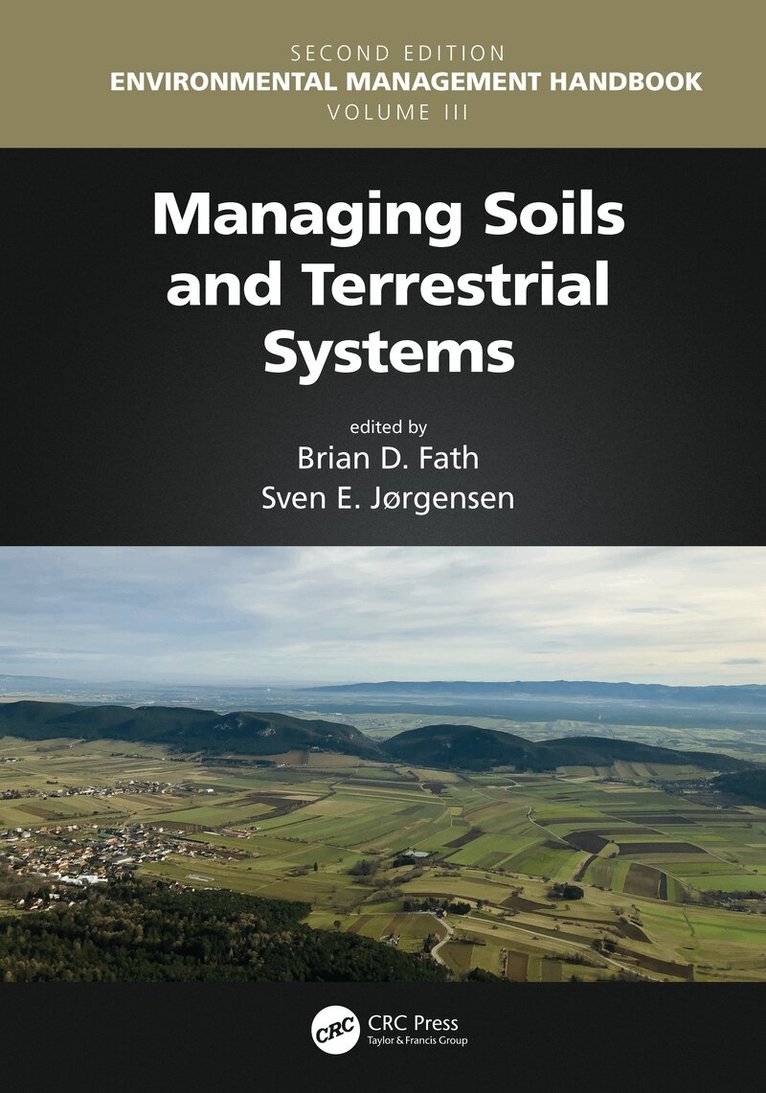
    Managing Soils and Terrestrial Systems

    AvBrian D. Fath,Sven E. Jørgensen

    Inbunden, Engelska, 2020

    Del i serien Environmental Management Handbook, Second Edition, Six-Volume Set

    2 648 kr

    Beställningsvara. Skickas inom 10-15 vardagar. Fri frakt över 249 kr.

    Beskrivning

    Bringing together a wealth of knowledge, Environmental Management Handbook, Second Edition, gives a comprehensive overview of environmental problems, their sources, their assessment, and their solutions. Through in-depth entries and a topical table of contents, readers will quickly find answers to questions about environmental problems and their corresponding management issues. This six-volume set is a reimagining of the award-winning Encyclopedia of Environmental Management, published in 2013, and features insights from more than 400 contributors, all experts in their field.The experience, evidence, methods, and models used in studying environmental management are presented here in six stand-alone volumes, arranged along the major environmental systems.Features The first handbook that demonstrates the key processes and provisions for enhancing environmental management Addresses new and cutting-edge topics on ecosystem services, resilience, sustainability, food–energy–water nexus, socio-ecological systems, and more Provides an excellent basic knowledge on environmental systems, explains how these systems function, and offers strategies on how to best manage them Includes the most important problems and solutions facing environmental management todayIn this third volume, Managing Soils and Terrestrial Systems, the general concepts and processes of the geosphere with its related soil and terrestrial systems are introduced. It explains how these systems function and provides strategies on how to best manage them. It serves as an excellent resource for finding basic knowledge on the geosphere systems and includes important problems and solutions that environmental managers face today. This book practically demonstrates the key processes, methods, and models used in studying environmental management.

    Produktinformation

    • Utgivningsdatum:2020-07-30
    • Mått:178 x 254 x undefined mm
    • Vikt:1 390 g
    • Format:Inbunden
    • Språk:Engelska
    • Serie:Environmental Management Handbook, Second Edition, Six-Volume Set
    • Antal sidor:642
    • Upplaga:2
    • Förlag:Taylor & Francis Ltd
    • ISBN:9781138342651

    Utforska kategorier

    • Energiteknik inom Naturvetenskap och teknik
    • Miljövetenskap och miljöpolitik inom Naturvetenskap och teknik
    • Hydrologi inom Naturvetenskap och teknik

    Mer om författaren

    Brian D. Fath is a Professor in the Department of Biological Sciences at Towson University (Maryland, USA) and a Senior Research Scholar at the International Institute for Applied Systems Analysis (Laxenburg, Austria). He has published over 180 research papers, reports, and book chapters on environmental systems modeling, specifically in the areas of network analysis, urban metabolism, and sustainability. He has co-authored the books A New Ecology: Systems Perspective (2020), Foundations for Sustainability: A Coherent Framework of Life–Environment Relations (2019), and Flourishing within Limits to Growth: Following Nature’s Way (2015). He is also Editor-in-Chief for the journal Ecological Modelling and Co-Editor-in-Chief for Current Research in Environmental Sustainability. Dr. Fath was the 2016 recipient of the Prigogine Medal for outstanding work in systems ecology and twice a Fulbright Distinguished Chair (Parthenope University, Naples, Italy, in 2012 and Masaryk University, Czech Republic, in 2019). In addition, he has served as Secretary General of the International Society for Ecological Modelling, Co-Chair of the Ecosystem Dynamics Focus Research Group in the Community Surface Modeling Dynamics System, and member and past Chair of the Baltimore County Commission on Environmental Quality.Sven E. Jørgensen (1934–2016) was a Professor of Environmental Chemistry at Copenhagen University. He earned a doctorate of engineering in environmental technology and a doctorate of science in ecological modeling. He was an honorable doctor of science at Coimbra University (Portugal) and at Dar es Salaam (Tanzania). He was Editor-in-Chief of Ecological Modelling from the journal’s inception in 1975 until 2009. He was Editor-in-Chief for the Encyclopedia of Environmental Management (2013) and Encyclopedia of Ecology (2008). In 2004, Dr. Jorgensen was awarded the Stockholm Water Prize and the Prigogine Medal. He was awarded the Einstein Professorship by the Chinese Academy of Sciences in 2005. In 2007, he received the Pascal Medal and was elected a member of the European Academy of Sciences. He published over 350 papers and has edited or written over 70 books. Dr. Jorgensen gave popular and well-received lectures and courses in ecological modeling, ecosystem theory, and ecological engineering worldwide.

    Innehållsförteckning

    • Section I: APC: Anthropogenic Chemicals and Activities 1. Agricultural Soils: Nitrous Oxide Emissions 2. Agriculture: Energy Use and Conservation 3. Agriculture: Organic 4. Erosion by Water: Accelerated 5. Erosion: Irrigation-Induced 6. Pesticide Translocation Control: Soil Erosion 7. Pesticides 8. Salt-Affected Soils: Sustainable Agriculture 9. Sodic Soils: Irrigation Farming Section II: COV: Comparative Overviews of Important Topics for Environmental Management 10. Agricultural Soils: Carbon and Nitrogen Biological Cycling 11. Agricultural Soils: Phosphorus 12. Erosion and Global Change 13. Erosion and Precipitation 14. Erosion: History 15. Erosion by Wind: Global Hot Spots 16. Erosion by Wind: Principles 17. Erosion: Snowmelt 18. Erosion: Soil Quality 19. Farming: Organic 20. Global Climate Change: World Soils 21. Integrated Farming Systems 22. Organic Soil Amendments 23. Pasturelands, Rangelands, and Other Grazing Social-Ecological Systems 24. Salt-Affected Soils: Physical Properties and Behavior 25. Sodic Soils: Properties 26. Soil Degradation: Global Assessment 27. Soil Erosion and Carbon Dioxide 28. Soil Quality: Carbon and Nitrogen Gases 29. Sustainable Agriculture: Soil Quality Section III: CSS: Case Studies of Environmental Management 30. Drought and Agricultural Production in the Central Andes 31. Mines: Rehabilitation of Open Cut Section IV: DIA: Diagnostic Tools: Monitoring, Ecological Modeling, Ecological Indicators, and Ecological Services 32. Bioenergy Crops: Carbon Balance Assessment 33. Erosion by Water: Amendment Techniques 34. Erosion by Water: Assessment and Control 35. Erosion by Water: Empirical Methods 36. Erosion by Water: Process-Based Modeling 37. Erosion by Wind: Source, Measurement, Prediction, and Control 38. Erosion Control: Tillage and Residue Methods 39. Pest Management: Modeling 40. Soil Quality: Indicators Section V: ELE: Focuses on the Use of Legislation or Policy to Address Environmental Problems 41. Acid Sulfate Soils: Management 42. Agricultural Water Quantity Management 43. Erosion by Water: Vegetative Control 44. Erosion Control: Soil Conservation 45. Farming: Organic Pest Management 46. Integrated Nutrient Management 47. Integrated Pest Management 48. Integrated Weed Management 49. Manure Management: Compost and Biosolids 50. Manure Management: Dairy 51. Manure Management: Phosphorus 52. Manure Management: Poultry 53. Organic Matter: Management 54. Pest Management 55. Pest Management: Ecological Agriculture 56. Pest Management: Ecological Aspects 57. Pest Management: Legal Aspects Section VI: ENT: Environmental Management Using Environmental Technologies 58. Acid Sulfate Soils: Formation 59. Erosion and Sediment Control: Vegetative Techniques 60. Precision Agriculture: Engineering Aspects 61. Sodic Soils: Reclamation 62. Tillage Erosion: Terrace Formation Section VII: NEC: Natural Elements and Chemicals Found in Nature 63. Erosion by Wind-Driven Rain 64. Organic Matter: Global Distribution in World Ecosystems 65. Permafrost 66. Salt-Affected Soils: Plant Response Section VIII: PRO: Basic Environmental Processes 67. Agricultural Runoff 68. Desertification 69. Desertification: Prevention and Restoration 70. Erosion 71. Erosion by Water: Erosivity and Erodibility