• Fri frakt över 249 kr
  • •
  • Snabba leveranser
  • •
  • Billiga böcker
Kundservice

Du är på sajten för privatpersoner.

Företag, bibliotek eller offentlig verksamhet?

Du handlar på classic.bokus.com, där alla dina funktioner finns intakta.
Till classic.bokus.com
Bokus logotyp. Gå till startsidan.
  • Erbjudanden
  • Nyheter
  • Student
  • Topplistor
  • Barn & ungdom
  • Bokus Play
  • E-böcker
  • Pocketböcker
  • Spel & pussel

10% studentrabatt med kod TERM26

Sidfot

Mina sidor

    Hjälp

    • Kundservice
    • Vanliga frågor och svar
    • Frakt och leverans
    • Retur vid ångerrätt
    • Reklamera vara
    • Betalning
    • Köpvillkor
    • Allmänna villkor
    • Information om webbplatsens tillgänglighet

    Om Bokus

    • Om oss
    • Pressrum
    • För studenter
    • För företag
    • För bibliotek och offentlig verksamhet
    • För leverantörer
    • Hållbarhet

    Populärt

    • Aktuella erbjudanden
    • Presentkort
    • Studentlitteratur
    • Nya böcker
    • Topplistor
    • Signerade böcker
    • Engelska böcker

    Inspiration

    • Boktips
    • BookTok
    • Populära bokserier
    • Barnbokskaraktärer
    • Populära författare
    Logotyp för Bokus
    Följ oss på Facebook (extern länk)Följ oss på Instagram (extern länk)Följ oss på YouTube (extern länk)Följ oss på TikTok (extern länk)
    bokus @ CookiesAnpassa cookiesIntegritetspolicyKöpvillkor
    Till Citymail hemsida (extern länk)Till Budbee hemsida (extern länk)Till Postnord hemsida (extern länk)Till Schenker hemsida (extern länk)Till Early Bird hemsida (extern länk)Till Walleys hemsida (extern länk)
    1. Ekonomi och Ledarskap
    2. Nationalekonomi
    3. Mikroekonomi

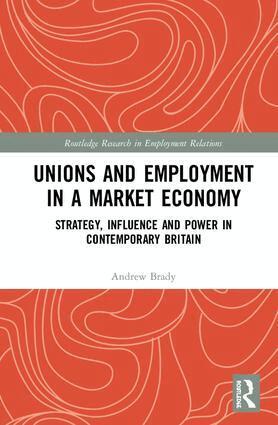
    Unions and Employment in a Market Economy

    Strategy, Influence and Power in Contemporary Britain

    AvAndrew Brady

    Inbunden, Engelska, 2019

    Del i serien Routledge Research in Employment Relations

    2 506 kr

    Beställningsvara. Skickas inom 10-15 vardagar. Fri frakt över 249 kr.

    Fler format och utgåvor

    Häftad

    690 kr

    E-bok

    727 kr

    E-bok

    725 kr

    Beskrivning

    Due to the sharp declines in trade union density and collective bargaining coverage post-1979, the shift by trade unions towards political action has had significant implications for employment relations regulation in contemporary Britain. Yet, there remains insufficient discussion of the factors of influence affecting changes in the political action process from a historical and contemporary perspective. Unions and Employment in a Market Economy will evidence how trade unions were able to offset environmental constraints through a progressive focus on political action, despite diminished power in the Labour Party’s structures and the wider economy. The book presents four legislative events categorised as functional equivalents enacted in two different periods of Labour governance (1974-79 and 1997-2010). The selected events are the Social Contract (1974-79), National Minimum Wage (1998), Employment Relations Act (1999) and the Warwick Agreement (2004). The book’s findings lend credence to the proposition that in a liberal market economy there is a valuable dividend associated with trade union political exchange through the Labour Party.

    Produktinformation

    • Utgivningsdatum:2019-03-08
    • Mått:152 x 229 x 13 mm
    • Vikt:438 g
    • Format:Inbunden
    • Språk:Engelska
    • Serie:Routledge Research in Employment Relations
    • Antal sidor:210
    • Förlag:Taylor & Francis Ltd
    • ISBN:9781138489875

    Utforska kategorier

    • Mikroekonomi inom Ekonomi och Ledarskap
    • Arbetsmarknaden inom Ekonomi och Ledarskap

    Mer om författaren

    Andrew Brady is an academic with a PhD from the University of Strathclyde and works in the British labour movement.

    Recensioner i media

    "Ever since the trades unions were defeated in the 1980s, alienated work, unbearable inequality and disappearing quality jobs have become the order of the day. Andrew Brady's new book focuses on the unfashionable but crucial role of trades unions as a break on this never-ending decline and as a source of hope for the future." –Yanis Varoufakis"Andrew Brady has produced an important and original new study of the changing ways through which British trade unions have exercised national political influence through the Labour Party over the past fifty years, which draws on detailed interviews with leading Labour and trade union figures. The ‘insider views’ of the Union-Party relationships during the New Labour period, in particular, are a major contribution to our political and historical understanding. The book is very timely, as Labour enters a new political phase and union influence over policy appears to be growing." —Peter Ackers - Visiting Professor in the History of Industrial Relations, Loughborough University "Andrew Brady has the skills of the academic, the guile of a street politician, and the negotiating noose of the trade unionist. He needed all three of these traits in writing this book of unravelling the almost schizophrenic relationship between the New Labour and the UK Trade Union Leaderships. He has succeeded brilliantly." –Sir Ian McCartney - former Labour Government Minster and Chairman of the Labour Party "Using a unique dataset drawn from interviews with leading players from the trade unions and Labour, Andrew Brady’s book allows us to rethink key events such as the struggle for the National Minimum Wage and the Employment Relations Act in new and insightful ways’."—Paul Thompson - Professor of Employment Studies, University of Stirling "The mass re-engagement of voters with the radical left in Britain has its roots in a political turn by trade unions in the early 21st century. Andrew Brady's timely book traces the change in strategy that has led to unions taking overt political action to represent their members, and to a wave of unionisation struggles by precarious workers. Brady's rigorous overview of these developments will stimulate debate among academics, HR professionals and the wider labour and trade union movement itself." –Paul Mason"In this important book, Brady uses a rich body of research findings to analyse the role of the main trade unions in the ‘social contract’ under the Labour governments of the 1970s, and the very different dynamics of their involvement with the Blair-Brown governments after 1997. His major contribution is to chart the micro-politics of Party-union relations, and to demonstrate how strategic interventions can shape outcomes, even in a difficult environment. Persuading major actors on both sides of the relationship to speak frankly and at length about the policy dynamics represents a major research achievement."-Richard Hyman, Emeritus Professor of Industrial Relations at the London School of Economics."We are all in debt to Andrew Brady for providing us with fresh insight into what has sometimes been a tortuous and, at times, even tormented relationship between the British Labour Party and the British trades union movement over the last half-century. His story starts in the 1960s, with the efforts of the Wilson administration to bring order to British factories through the Donovan Commission and the ill-fated White Paper In Place of Strife, and ends with the Warwick Agreement of 2004, New Labour’s effort, in the wake of Blair’s disastrous war in Iraq, to revive some intimacy with its trades union partners. This is a timely and thoughtful book."- Professor Jan Toporowski in Economics and Finance at SOAS, University of London.

    Innehållsförteckning

    • List of TablesList of Boxes PrefaceChapter 1: Trade Union Strategy, Influence and Power in Contemporary Britain: An IntroductionIntroduction Varieties of CapitalismDeconstruction and Reconstruction New Labour: Continuation of neoliberalism or breaking with the past? Labour Party: A Channel for Trade Union Political Action Trade Union Leadership, Strategy and Structure Conclusion Chapter 2: The Social Contract (1974-79)Introduction Donovan Commission and In Place of Strife The Industrial Relations Act (1971) The Social Contract in Formation The Social Contract in OperationThe Winter of Discontent 1978/9 Evaluation and Reflections Chapter 3: Employment Relations Reform under New Labour: Context, Continuity and ChangeIntroductionConservative Liberal Market Reform Political Action: New Mechanisms Ideological Disunity, Space and Convergence: Opposition Years Progressive Centralisation Formal to Informal Processes 1993/7 Political Fund Ballots New Policy-Making Processes Agency and Diminishing Trust Chapter 4: The National Minimum Wage (1998)Introduction The Development of the NMW The Low Pay Commission Policy contestation and division Evaluation and ReflectionsChapter 5: The Employment Relations Act (1999)Introduction Fairness at Work (May 1998) Employment Relations Bill ERA (1999) Evaluation and Reflections Chapter 6: The Warwick Agreement (2004)Introduction Exeter Policy Forum (2000) Leadership Dynamics The Big Four Institutional Reconfiguration: TULO The Agreement Implementation Evaluation and ReflectionsChapter 7: Strategy, Influence and Power: lessons from historyIntroductionStructural Context: shifting frontsDegree of CoordinationTransition to InformalityConcluding ObservationsChapter 8: Conclusion Leadership and Strategic ChoicePolitical Action and Electoral ReformNew Structural PressuresAppendix A: List of Interviews as Introduced Appendix B: Key provisions of the Employment Act 2002 Appendix C: Key Warwick Agreement pledges Glossary Index