• Fri frakt över 249 kr
  • •
  • Snabba leveranser
  • •
  • Billiga böcker
Kundservice

Du är på sajten för privatpersoner.

Företag, bibliotek eller offentlig verksamhet?

Du handlar på classic.bokus.com, där alla dina funktioner finns intakta.
Till classic.bokus.com
Bokus logotyp. Gå till startsidan.
  • Erbjudanden
  • Nyheter
  • Student
  • Topplistor
  • Barn & ungdom
  • Bokus Play
  • E-böcker
  • Pocketböcker
  • Spel & pussel

10% rabatt på allt med kod: NYSTART10 →

Sidfot

Mina sidor

    Hjälp

    • Kundservice
    • Vanliga frågor och svar
    • Frakt och leverans
    • Retur vid ångerrätt
    • Reklamera vara
    • Betalning
    • Köpvillkor
    • Allmänna villkor
    • Information om webbplatsens tillgänglighet

    Om Bokus

    • Om oss
    • Pressrum
    • För studenter
    • För företag
    • För bibliotek och offentlig verksamhet
    • För leverantörer
    • Hållbarhet

    Populärt

    • Aktuella erbjudanden
    • Presentkort
    • Studentlitteratur
    • Nya böcker
    • Topplistor
    • Signerade böcker
    • Engelska böcker

    Inspiration

    • Boktips
    • BookTok
    • Populära bokserier
    • Barnbokskaraktärer
    • Populära författare
    Logotyp för Bokus
    Följ oss på Facebook (extern länk)Följ oss på Instagram (extern länk)Följ oss på YouTube (extern länk)Följ oss på TikTok (extern länk)
    bokus @ CookiesAnpassa cookiesIntegritetspolicyKöpvillkor
    Till Citymail hemsida (extern länk)Till Budbee hemsida (extern länk)Till Postnord hemsida (extern länk)Till Schenker hemsida (extern länk)Till Early Bird hemsida (extern länk)Till Walleys hemsida (extern länk)
    1. Naturvetenskap och teknik
    2. Teknik och industri
    3. Energiteknik

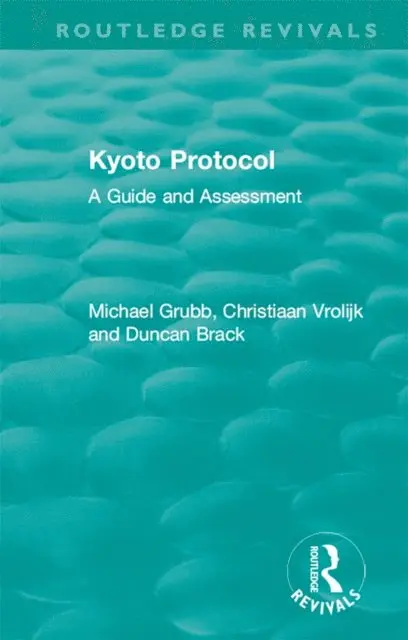
    Routledge Revivals: Kyoto Protocol (1999)

    A Guide and Assessment

    AvMichael Grubb,Christiaan Vrolijk

    Inbunden, Engelska, 2017

    Del i serien Routledge Revivals

    2 058 kr

    Beställningsvara. Skickas inom 10-15 vardagar. Fri frakt över 249 kr.

    Fler format och utgåvor

    Häftad

    541 kr

    Beskrivning

    Originally published in 1999, The Kyoto Protocol provides a detailed discussion on the history, terms and implications of the Kyoto Protocol 1997. It explains the meaning of provision on emissions trading and other flexibility mechanisms, and provides a quantitative analysis using the Energy and Environment Programme's emissions trading model. It also contains the full text of the Kyoto Protocol and developments at the 4th Conference of the Parties in December 1998. This book will be of interest to academics working in the field of climate change, as well as the broader area of environment and sustainability.

    Produktinformation

    • Utgivningsdatum:2017-12-15
    • Mått:138 x 216 x 24 mm
    • Vikt:870 g
    • Format:Inbunden
    • Språk:Engelska
    • Serie:Routledge Revivals
    • Antal sidor:386
    • Förlag:Taylor & Francis Ltd
    • ISBN:9781138506046

    Utforska kategorier

    • Energiteknik inom Naturvetenskap och teknik
    • Miljövetenskap och miljöpolitik inom Naturvetenskap och teknik

    Mer om författaren

    Michael Grubb, Christiaan Vrolijk, Duncan Brack

    Innehållsförteckning

    • Foreword, (H.E. Raul & A. Estrada-Oyuela) Preface Acknowledgements About the authors Outline structure of Convention and Protocol Glossary Summary and conclusions Part I: The Making of the Protocol 1. Analytic Foundations: Science, Response Options and IPCC 1.1. Origins and the Intergovernmental Panel on Climate Change 1.2. Scientific Foundations and the First Assessment Report 1.3. Findings of the IPCC Second Assessment Report 1.4. Key Debates and Implications of the Second Assessment Report 1.5. Developments After the Second Assessment Report 1.6. Conclusions 2. Political and Legal Foundations: National Perspectives and the Road to Kyoto 2.1. National Interests, Perspectives and Negotiating Groups 2.2. The UN Framework Convention on Climate Change 2.3. From Rio to the First Conference of Parties at Berlin 2.4. The Shifting Political Foundations 2.5. Milestones to Kyoto 3. Negotiating the Kyoto Protocol 3.1. The Negotiating Process 3.2. Policies and Measures 3.3. Defining Emissions Targets: Time Scales, Gas Coverage and Sinks 3.4. Assigning Emissions Targets: Differentiation and the EU Bubble 3.5. International Flexibility within Annex I: Joint Implementation and Emissions Trading 3.6. International Flexibility with Developing Countries: Objections to JI and the Emergence of the CDM 3.7. Developing-country Concerns and Participation 3.8. Extending Commitments to New Countries: Evolution and Voluntary Accession 3.9. Conclusions 4. The Kyoto Protocol 4.1. Definition of Annex I Commitments 4.2. ‘Bubbling’ and the EU Redistribution of Emission Commitments 4.3. Policies and Measures 4.4. Mechanisms for International Transfer 4.5. Additional Issues Relating to Developing Countries 4.6. Compliance, Future Development and Related Issues: Monitoring Reporting and Review 4.7. Conclusions Part II: Analysis of Commitments, Mechanisms and Prospects 5. Environmental and Economic Implications of the Kyoto Commitments 5.1. Environmental Consequences of the Kyoto Commitments 5.2. Economic Consequences of the Kyoto Commitments 5.3. The Potential Impact of Flexibility within Annex I 5.4. Potential Impact of Sinks and the CDM 5.5. Conclusions: Inflation, Efficiency and Competition Between the Mechanisms 6. Implementing International Transfers under the Kyoto Mechanisms 6.1. General Principles Governing the Creation and Transfer of Emissions Credits and Allowances 6.2. Acquisiton and Trade of Emissions Credits from JI and the CDM 6.3. Governing International Emissions Trading 6.4. Supplementary, Balancing and Charges Under the Kyoto Mechanisms 6.5. Conclusions 7. The Clean Development Mechanism 7.1. Introduction 7.2. A: Additionality, and Adaptation and Administration Charges 7.3. B: Bilateral or Portfolio Structure 7.4. C: Crediting, Certification and the Control of Corruption 7.5. D: Distribution of Activities Under the CDM 7.6. E: Eligibity Criteria 7.7. F: Financing Sources 7.8. G: Governing the CDM 7.9. Conclusions 8. Prospects for the Kyoto Regime 8.1. The Buenos Aires ‘Plan of Action’ 8.2. Prospects for Ratification and Entry Into Force 8.3. Business and Public Involvement in the Kyoto Regime 8.4. First-Period Developing-Country Commitments: Accession, Expansion and Inflation 8.5. Longer-term Approaches: An Overview 8.6. Emissions Convergence: Any Room for Compromise 8.7. Conclusions Part III: Appendices 1. Text of the Kyoto Protocol 2. Key Themes in Economic Debates: Insights From the IPCC Second Assessment Report 3. Analysis of International Trade in Emission Allowances 4. Further Reading and Sources of Information Index