• Fri frakt över 249 kr
  • •
  • Snabba leveranser
  • •
  • Billiga böcker
Kundservice

Du är på sajten för privatpersoner.

Företag, bibliotek eller offentlig verksamhet?

Du handlar på classic.bokus.com, där alla dina funktioner finns intakta.
Till classic.bokus.com
Bokus logotyp. Gå till startsidan.
  • Erbjudanden
  • Nyheter
  • Student
  • Topplistor
  • Barn & ungdom
  • Bokus Play
  • E-böcker
  • Pocketböcker
  • Spel & pussel

10% rabatt på allt med kod: NYSTART10 →

Sidfot

Mina sidor

    Hjälp

    • Kundservice
    • Vanliga frågor och svar
    • Frakt och leverans
    • Retur vid ångerrätt
    • Reklamera vara
    • Betalning
    • Köpvillkor
    • Allmänna villkor
    • Information om webbplatsens tillgänglighet

    Om Bokus

    • Om oss
    • Pressrum
    • För studenter
    • För företag
    • För bibliotek och offentlig verksamhet
    • För leverantörer
    • Hållbarhet

    Populärt

    • Aktuella erbjudanden
    • Presentkort
    • Studentlitteratur
    • Nya böcker
    • Topplistor
    • Signerade böcker
    • Engelska böcker

    Inspiration

    • Boktips
    • BookTok
    • Populära bokserier
    • Barnbokskaraktärer
    • Populära författare
    Logotyp för Bokus
    Följ oss på Facebook (extern länk)Följ oss på Instagram (extern länk)Följ oss på YouTube (extern länk)Följ oss på TikTok (extern länk)
    bokus @ CookiesAnpassa cookiesIntegritetspolicyKöpvillkor
    Till Citymail hemsida (extern länk)Till Budbee hemsida (extern länk)Till Postnord hemsida (extern länk)Till Schenker hemsida (extern länk)Till Early Bird hemsida (extern länk)Till Walleys hemsida (extern länk)
    1. Naturvetenskap och teknik
    2. Matematik och naturvetenskap
    3. Biologi
    4. Biovetenskap

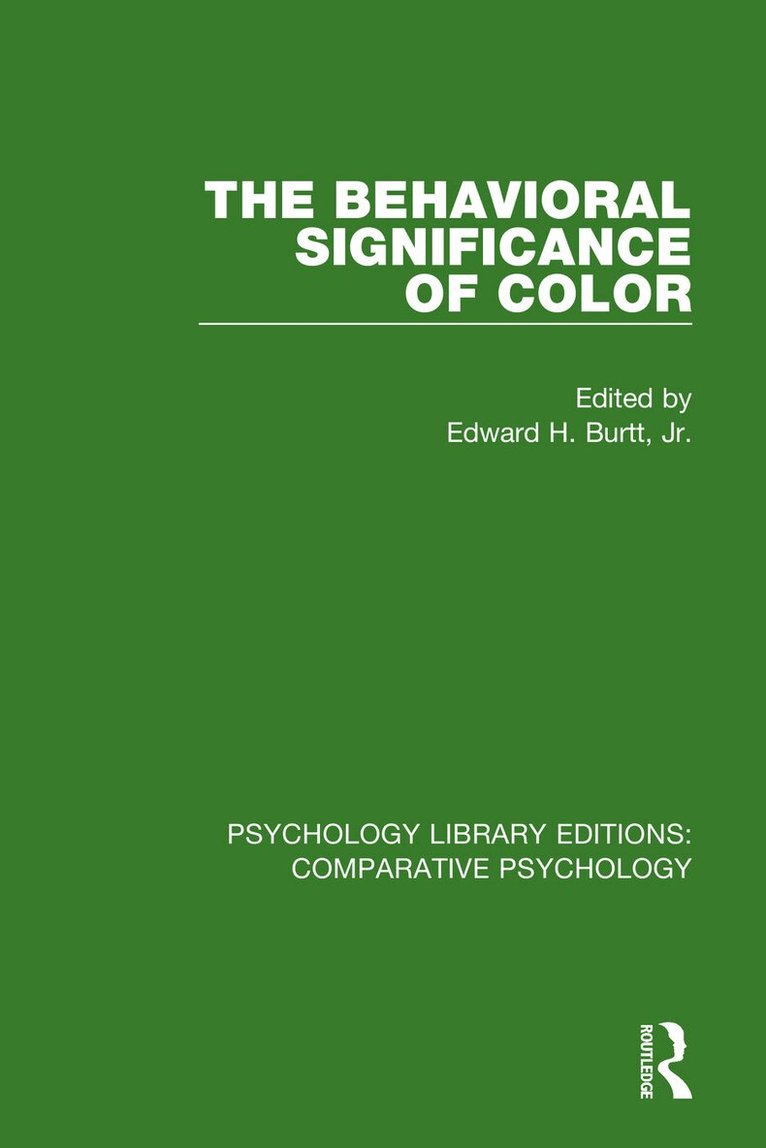
    Behavioral Significance of Color

    AvEdward H. Burtt, Jr.

    Häftad, Engelska, 2020

    Del i serien Psychology Library Editions: Comparative Psychology

    540 kr

    Beställningsvara. Skickas inom 10-15 vardagar. Fri frakt över 249 kr.

    Beskrivning

    Prior to publication the study of animal coloration was plagued by fanciful speculations, post hoc explanations and untestable hypotheses. This title, originally published in 1979, draws together widely scattered research into the coloration of animals; formulates predictive hypotheses to account for color; documents the accuracy of many of these hypotheses; and suggests directions for future research. The book grew out of a symposium, The Behavioral Significance of Color at the 1977 meeting of the Animal Behavior Society, and presents evidence concerning patterns of coloration and their influence on animal behaviour and interactionPhysical principles of radiation are discussed in Chapter 1, followed, in subsequent chapters, by an examination of the physiological functions of animal coloration (e.g. thermoregulation, hydroregulation, abrasion-resistance, extraretinal photoreception). Treatment of coloration that affects the animal’s visibility to other animals opens with a masterful overview of theories of color vision and its occurrence throughout the animal kingdom. Chapter 6 explores the role of color vision and fruit color in the selection of food by wild primates with comments on the coevolution of fruiting trees and their primate customers. Dr Jack P. Hailman addresses the elusive concept of conspicuousness. He summarizes a strategy for calculating conspicuous coloration based on measurements in natural habitats. Experiments, naturalistic observations and anecdotes of optical communication are exceedingly numerous. Chapters 8 and 9 review these data and suggest general principles of inter- and intraspecific optical communication. Each chapter is enhanced by the critical evaluations of Drs. C. Richard Tracy and W. J. Hamilton III. In closing, the editor discusses coloration as it affects an animal’s own vision (e.g., black eyelines to reduce glare). Most significantly the book emphasizes the need for a balanced, scientifically rigorous approach to the question of evolution of animal coloration. It is an important source for anyone contemplating or currently involved in research in this field of investigation.

    Produktinformation

    • Utgivningsdatum:2020-03-03
    • Mått:156 x 234 x 45 mm
    • Vikt:870 g
    • Format:Häftad
    • Språk:Engelska
    • Serie:Psychology Library Editions: Comparative Psychology
    • Antal sidor:472
    • Förlag:Taylor & Francis Ltd
    • ISBN:9781138576254

    Utforska kategorier

    • Biovetenskap inom Naturvetenskap och teknik
    • Djurböcker inom Djur och Natur
    • Djurens beteende inom Naturvetenskap och teknik

    Mer om författaren

    Edward H. Burtt, Jr.

    Innehållsförteckning

    • Preface. Contributing Authors. Introduction Edward H. Burtt, Jr. Part 1: Physical Principles 1. Physics of Light: An Introduction for Light-Minded Ethologists B. Dennis Sustare Emissivity, a Little-Explored Variable: Discussion C. Richard Tracy Part 2: Physiological Functions of Animal Coloration 2. The Influence of Color on Behavioral Thermoregulation and Hydroregulation David M. Hoppe Further Thoughts on Anuran Thermoregulation: Discussion C. Richard Tracy Maximization of Reproduction: Discussion William J. Hamilton III Audience Questions: Discussion 3. Tips on Wings and Other Things Edward H. Burtt, Jr. The Evolutiono-Engineering Approach: Discussion C. Richard Tracy Where is the Evidence for Ultra-Violet Damage: Discussion William J. Hamilton III Audience Questions: Discussion Part 3: Photoreception 4. Extraretinal Photoreception: Words of Caution: Discussion C. Richard Tracy 5. Mechanisms of Color Vision: An Ethologist’s Primer Samuel H. Gruber 6. Visual Discriminations Encountered in Food Foraging by a Neotropical Primate: Implications for the Evolution of Color Vision D. Max Snodderly Comments on Coevolution: Discussion C. Richard Tracy Are Selection Pressures Different? Discussion William J. Hamilton III Audience Questions: Discussion Part 4: Coloration for Communication 7. Environmental Light and Conspicuous Colors Jack P. Hailman Audience Questions: Discussion 8. Optical Signals and Interspecific Communication Jeffrey R. Baylis 9. The Use of Color in Intraspecific Communication William J. Rowland Visual Functions of Color: The Predictive Approach: Discussion C. Richard Tracy Audience Questions: Discussion 10. Conclusion Edward H. Burtt, Jr. Index