• Fri frakt över 249 kr
  • •
  • Snabba leveranser
  • •
  • Billiga böcker
Kundservice

Du är på sajten för privatpersoner.

Företag, bibliotek eller offentlig verksamhet?

Du handlar på classic.bokus.com, där alla dina funktioner finns intakta.
Till classic.bokus.com
Bokus logotyp. Gå till startsidan.
  • Erbjudanden
  • Nyheter
  • Student
  • Topplistor
  • Barn & ungdom
  • Bokus Play
  • E-böcker
  • Pocketböcker
  • Spel & pussel

10% rabatt på allt med kod: NYSTART10 →

Sidfot

Mina sidor

    Hjälp

    • Kundservice
    • Vanliga frågor och svar
    • Frakt och leverans
    • Retur vid ångerrätt
    • Reklamera vara
    • Betalning
    • Köpvillkor
    • Allmänna villkor
    • Information om webbplatsens tillgänglighet

    Om Bokus

    • Om oss
    • Pressrum
    • För studenter
    • För företag
    • För bibliotek och offentlig verksamhet
    • För leverantörer
    • Hållbarhet

    Populärt

    • Aktuella erbjudanden
    • Presentkort
    • Studentlitteratur
    • Nya böcker
    • Topplistor
    • Signerade böcker
    • Engelska böcker

    Inspiration

    • Boktips
    • BookTok
    • Populära bokserier
    • Barnbokskaraktärer
    • Populära författare
    Logotyp för Bokus
    Följ oss på Facebook (extern länk)Följ oss på Instagram (extern länk)Följ oss på YouTube (extern länk)Följ oss på TikTok (extern länk)
    bokus @ CookiesAnpassa cookiesIntegritetspolicyKöpvillkor
    Till Citymail hemsida (extern länk)Till Budbee hemsida (extern länk)Till Postnord hemsida (extern länk)Till Schenker hemsida (extern länk)Till Early Bird hemsida (extern länk)Till Walleys hemsida (extern länk)
    1. Ekonomi och Ledarskap
    2. Nationalekonomi
    3. Ekonomisk historia

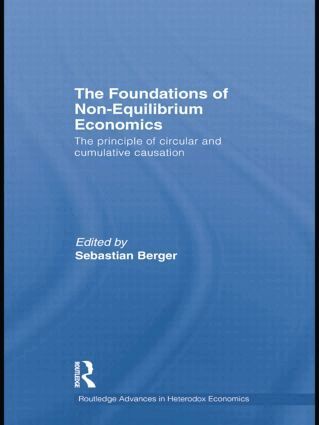
    Foundations of Non-Equilibrium Economics

    The principle of circular and cumulative causation

    AvSebastian Berger

    Häftad, Engelska, 2014

    Del i serien Routledge Advances in Heterodox Economics

    744 kr

    Beställningsvara. Skickas inom 10-15 vardagar. Fri frakt över 249 kr.

    Beskrivning

    This thought-provoking volume presents essays on the foundations of non-equilibrium economics, i.e. the principle of circular cumulative causation (CCC). This work presents empirical research on how the interplay of technology’s increasing returns to scale, institutions, resources, and economic policy leads to virtuous circles of economic growth and development, but also to vicious circles of social and ecological degradation. In particular, evidence is provided for the important role of the "development state" and strategic trade policy, economies of large-scale production in manufacturing, the regional level of development and community-based resource management regimes. While demonstrating CCC’s strength in generating empirical research, the book also provides insights into its philosophical foundations and intellectual history. Several essays trace the roots of this full-fledged theoretical framework back to Adam Smith, Classical Political Economy, Thorstein Veblen, Gunnar Myrdal, K. William Kapp and Nicholas Kaldor. As the most comprehensive collection of the growing body of CCC research to date, this book also reflects the emergence of an economic paradigm for understanding economic dynamics and for crafting viable development strategies for the 21st century. The volume will be of great interest to scholars of growth and development economics, institutional and evolutionary economics, political economy, and Post Keynesian economics from undergraduate to postgraduate research levels.

    Produktinformation

    • Utgivningsdatum:2014-05-30
    • Mått:156 x 234 x 13 mm
    • Vikt:410 g
    • Format:Häftad
    • Språk:Engelska
    • Serie:Routledge Advances in Heterodox Economics
    • Antal sidor:224
    • Förlag:Taylor & Francis Ltd
    • ISBN:9781138802919

    Utforska kategorier

    • Ekonomisk historia inom Ekonomi och Ledarskap
    • Internationell ekonomi inom Ekonomi och Ledarskap
    • Ekonomisk politik inom Ekonomi och Ledarskap

    Mer om författaren

    Sebastian Berger is an assistant professor at Roanoke College and was awarded the 2008 Helen Potter Award for the best paper in the Review of Social Economy.

    Recensioner i media

    'The theory of circular cumulative causation (CCC) is imbued with a long and distinguished intellectual legacy in the history of economic thought. Its intellectual roots can be traced back to Adam Smith, Veblen, Myrdal and Kaldor. CCC represents a rigorous alternative paradigm in the study of the dynamics of growth and technological change. Quite contrary to prevailing neoclassical theories based upon mechanistic notions of equilibrium, CCC offers a powerful critique and develops a sophisticated theory of non-equilibrium dynamics. At present, the research in this exciting new school is still in its infancy and comprises an eclectic mixture of diverse approaches and methodologies. This volume represents an important contribution to this growing literature and should become an invaluable source to academics and practitioners alike.' - Bill Lucarelli, University of Western Sydney, Australia'Set out to bring different traditions of [circular cumulative causation] CCC theorists together and to revitalize the nonequilibrium approach to economic research and teaching, The Foundations of Non-Equilibrium Economics has at least succeeded in providing the scientific community with a comprehensive review of the state of the art of using CCC as a very powerful tool of economic analysis.' - Torsten Heinrich, Heterodox Economics Newsletter'This edited collection of articles explores the theoretical basis and links of CCC within the traditions of institutional and post-Keynesian economics.' - Journal of Australian Political Economy'...these ideas of circular and cumulative causation can create a platform to bring together the whole range of heterodox economic approaches, creating enough common ground on how the economy - and indeed society - actually functions, so that these various schools of thought can engage in dialgoue and joint research.' - Jonathan Michie, International Review of Applied Economics

    Innehållsförteckning

    • 1. Introduction Sebastian Berger 2. On Competing Views of the Importance of Increasing Returns, Cumulative Causation and Path-Dependence John McCombie and Mark Roberts 3. Cumulative Causation in Northeast Asian Post-War Industry Policy Phillip Toner and Gavan Butler 4. Cumulative Causation and Industrial Development: The Regional Stage George Argyrous and Geoff Bamberry 5. Nicholas Kaldor and Cumulative Causation: Public Policy Implications Ric Holt and Steven Pressman 6. The Principle of Circular and Cumulative Causation: Myrdal, Kaldor and Contemporary Heterodox Political Economy Phillip Anthony O’Hara 7. Circular Cumulative Causation à la Myrdal and Kapp Sebastian Berger 8. Utilizing the Social Fabric Matrix to Articulate Circular and Cumulative Causation for Conceptual Conclusions F. Gregory Hayden 9. Unnatural Depletion and Artificial Abundance: A Circular Cumulative Causation Analysis of Salmon Fisheries and Some Implications for Political Ecological Economics Sebastian Berger and James Edward Glavin IV 10. Circular and Cumulative Causation in the Classics: Anticipations, Family Resemblances, and the Influence of Post-Keynesian Economics Mathew Forstater and Michael Murray 11. Continuity, Continuousness: The Chain of Ideas Linking Peirce’s Synechism to Veblen’s Cumulative Causation John Hall and Oliver Whybrow 12. Cumulative Causation and the Origin of Money Alla Semenova