• Fri frakt över 249 kr
  • •
  • Snabba leveranser
  • •
  • Billiga böcker
Kundservice

Du är på sajten för privatpersoner.

Företag, bibliotek eller offentlig verksamhet?

Du handlar på classic.bokus.com, där alla dina funktioner finns intakta.
Till classic.bokus.com
Bokus logotyp. Gå till startsidan.
  • Erbjudanden
  • Student
  • Topplistor
  • Barn & ungdom
  • Bokus Play
  • E-böcker
  • Ljudböcker
  • Pocketböcker
  • Spel & pussel

10% rabatt på allt med kod NYSTART10 →

Sidfot

Mina sidor

    Hjälp

    • Kundservice
    • Vanliga frågor och svar
    • Frakt och leverans
    • Retur vid ångerrätt
    • Reklamera vara
    • Betalning
    • Köpvillkor
    • Allmänna villkor
    • Information om webbplatsens tillgänglighet

    Om Bokus

    • Om oss
    • Pressrum
    • För studenter
    • För företag
    • För bibliotek och offentlig verksamhet
    • För leverantörer
    • Hållbarhet

    Populärt

    • Aktuella erbjudanden
    • Presentkort
    • Studentlitteratur
    • Nya böcker
    • Topplistor
    • Signerade böcker
    • Engelska böcker

    Inspiration

    • Boktips
    • BookTok
    • Populära bokserier
    • Barnbokskaraktärer
    • Populära författare
    Logotyp för Bokus
    Följ oss på Facebook (extern länk)Följ oss på Instagram (extern länk)Följ oss på YouTube (extern länk)Följ oss på TikTok (extern länk)
    bokus @ CookiesAnpassa cookiesIntegritetspolicyKöpvillkor
    Till Citymail hemsida (extern länk)Till Budbee hemsida (extern länk)Till Postnord hemsida (extern länk)Till Schenker hemsida (extern länk)Till Early Bird hemsida (extern länk)Till Walleys hemsida (extern länk)
    1. Psykologi och pedagogik
    2. Pedagogik
    3. Pedagogisk metodik

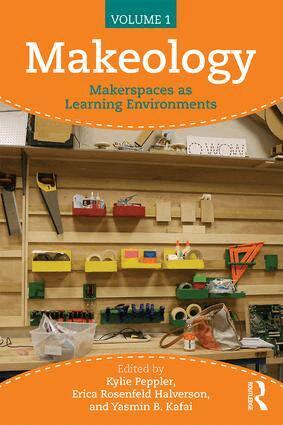
    Makeology

    Makerspaces as Learning Environments (Volume 1)

    AvKylie Peppler,Erica Halverson

    Häftad, Engelska, 2016

    511 kr

    Beställningsvara. Skickas inom 10-15 vardagar. Fri frakt över 249 kr.

    Beskrivning

    Makeology introduces the emerging landscape of the Maker Movement and its connection to interest-driven learning. While the movement is fueled in part by new tools, technologies, and online communities available to today’s makers, its simultaneous emphasis on engaging the world through design and sharing with others harkens back to early educational predecessors including Froebel, Dewey, Montessori, and Papert. Makerspaces as Learning Environments (Volume 1) focuses on making in a variety of educational ecosystems, spanning nursery schools, K-12 environments, higher education, museums, and after-school spaces. Each chapter closes with a set of practical takeaways for educators, researchers, and parents.

    Produktinformation

    • Utgivningsdatum:2016-05-26
    • Mått:152 x 229 x 21 mm
    • Vikt:420 g
    • Format:Häftad
    • Språk:Engelska
    • Antal sidor:288
    • Förlag:Taylor & Francis Ltd
    • ISBN:9781138847774

    Utforska kategorier

    • Pedagogisk metodik inom Psykologi och pedagogik

    Mer om författaren

    Kylie Peppler is Associate Professor of Learning Sciences at Indiana University. An artist by training, she engages in research that focuses on the intersection of arts, media, new technologies, and informal learning. Her current work focuses on maker culture.Erica Rosenfeld Halverson is Associate Professor of Digital Media and Literacy in the Department of Curriculum & Instruction at the University of Wisconsin-Madison. Her work focuses on what it means to learn in and through the arts across a range of contexts, including out-of-school arts organizations, museums, libraries, and arts-based classrooms.Yasmin B. Kafai is Professor of Learning Sciences at the University of Pennsylvania. She is a researcher and developer of tools, communities, and materials to promote computational participation, crafting, and creativity across K-16.

    Recensioner i media

    "The Maker Movement promises a revolution in education that the Makeology volumes beautifully describe. Adults and children work together to develop designs and products they can be proud of, involving science, technology, engineering, and the arts. This is the kind of collaborative education that helps people develop identities as lifelong learners and producers."--Allan Collins, Professor Emeritus of Learning Sciences, Northwestern University, USA"Makeology is the first broad and comprehensive examination of the Maker Movement as a catalytic force for young people's learning. Practitioners and scholars interested in implementing and studying making as a force for creative expression and student-centered learning will find in this two-volume collection a wealth of thoughtful and significant information."--Margaret Honey, President & CEO, New York Hall of Science, USA"Our goal should be helping children see themselves as good learners, as lifelong learners. The impact of what they create, design, shape, and build will be known in the future, but the time for making it happen is now. This book can increase the opportunities for making in educational settings by sharing the insights of many leading practitioners."--Dale Dougherty, Founder & Executive Chairman, Maker Media, Inc., USA, from the foreword"One thing we have in common is our commitment to putting more power in the hands of people from all backgrounds, enabling everyone to develop their voice and express themselves. There’s a special opportunity right now. But that moment could also slip away, so it is all the more important to make connections and join forces with other communities with shared values, to make sure that all children have the opportunity to grow up as full and active participants in tomorrow’s society."--Dr. Mitchel Resnick, LEGO Papert Professor of Learning Research and head of the Lifelong Kindergarten group at the Media Laboratory at Massachusetts Institute of Technology, USA, from Volume 2

    Innehållsförteckning

    • ForewordDale DoughertyAcknowledgementsChapter 1: Introduction to this volumeKylie Peppler, Erica Rosenfeld Halverson, & Yasmin B. KafaiSection 1: Out-of-School MakerspacesChapter 2: Learning to Make in the Museum: The Role of Maker Educators Lisa Brahms & Kevin CrowleyChapter 3: Designing for Resourcefulness in a Community-Based MakerspaceKimberly M. Sheridan & Abigail Konopasky,Chapter 4: Family Creative Learning Ricarose RoqueChapter 5: Children are not Hackers: Building a Culture of Powerful Ideas, Deep Learning, and Equity in the Maker MovementPaulo Blikstein & Marcelo WorsleySection 2: Makerspaces in P-16 educationChapter 6: Design Playshop: Preschoolers Making, Playing, and Learning with Squishy CircuitsKaren Wohlwend, Anna Keune & Kylie PepplerChapter 7: Taking Making to School: A Model for Integrating Making into ClassroomsPeter Samuelson Wardrip & Lisa BrahmsChapter 8: The Composition of MakingChristina Cantrill & Paul OhChapter 9: Craft Technologies 101: Bringing Making to Higher EducationDeborah A. Fields & Victor R. LeeSection 3: Online MakerspacesChapter 10: The Make-to-Learn Youth Contest: Gaining Youth Perspectives on Learning Through MakingKylie Peppler & Ted HallChapter 11: Tinkering Online: Digital Supports for Making and SharingMatt RafalowChapter 12: Tinkering with MOOCS and Social MediaMike Petrich, Karen Wilkinson & Bronwyn BevanChapter 13: The Role of Online Communication in a Maker CommunityBreanne K. Litts, Utah State UniversityErica Rosenfeld Halverson, & Maria BakkerSection 4: Designing for MakingChapter 14: Paper Electronics with Circuit StickersJie Qi, Natalie Freed, Jennifer Dick, & David ColeChapter 15: Designing for Connected Making: Supports for Collaboration and Community Building in Crafting ActivitiesOrkan Telhan, Yasmin B. Kafai, & Breanne K. LittsChapter 16: Build in Progress: Building Process-Oriented DocumentationTiffany TsengClosingChapter 17: Developing a Maker MindsetLisa RegallaAbout the ContributorsIndex