Yasmin B. Kafai – författare
336 kr
Läs direkt efter köp
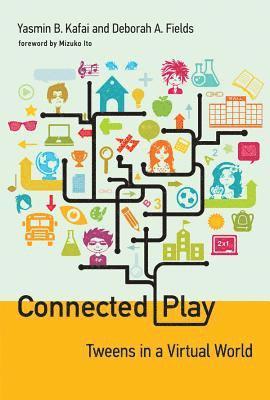
How kids play in virtual worlds, how it matters for their offline lives, and what this means for designing educational opportunities.
Millions of children visit virtual worlds every day. In such virtual play spaces as Habbo Hotel, Toontown, and Whyville, kids chat with friends from school, meet new people, construct avatars, and earn and spend virtual currency. In Connected Play, Yasmin Kafai and Deborah Fields investigate what happens when kids play in virtual worlds, how this matters for their offline lives, and what this means for the design of educational opportunities in digital worlds.
Play is fundamentally important for kids'' development, but, Kafai and Fields argue, to understand play in virtual worlds, we need to connect concerns of development and culture with those of digital media and learning. Kafai and Fields do this through a detailed study of kids'' play in Whyville, a massive, informal virtual world with educational content for tween players. Combining ethnographic accounts with analysis of logfile data, they present rich portraits and overviews of how kids learn to play in a digital domain, developing certain technological competencies; how kids learn to play well—responsibly, respectfully, and safely; and how kids learn to play creatively, creating content that becomes a part of the virtual world itself.
224 kr
Läs direkt efter köp
Why every child needs to learn to code: the shift from “computational thinking” to computational participation.
Coding, once considered an arcane craft practiced by solitary techies, is now recognized by educators and theorists as a crucial skill, even a new literacy, for all children. Programming is often promoted in K-12 schools as a way to encourage “computational thinking”—which has now become the umbrella term for understanding what computer science has to contribute to reasoning and communicating in an ever-increasingly digital world.
In Connected Code, Yasmin Kafai and Quinn Burke argue that although computational thinking represents an excellent starting point, the broader conception of “computational participation” better captures the twenty-first-century reality. Computational participation moves beyond the individual to focus on wider social networks and a DIY culture of digital “making.”
Kafai and Burke describe contemporary examples of computational participation: students who code not for the sake of coding but to create games, stories, and animations to share; the emergence of youth programming communities; the practices and ethical challenges of remixing (rather than starting from scratch); and the move beyond stationary screens to programmable toys, tools, and textiles.
386 kr
Läs direkt efter köp
How making and sharing video games offer educational benefits for coding, collaboration, and creativity.
Over the last decade, video games designed to teach academic content have multiplied. Students can learn about Newtonian physics from a game or prep for entry into the army. An emphasis on the instructionist approach to gaming, however, has overshadowed the constructionist approach, in which students learn by designing their own games themselves. In this book, Yasmin Kafai and Quinn Burke discuss the educational benefits of constructionist gaming—coding, collaboration, and creativity—and the move from “computational thinking” toward “computational participation.”
Kafai and Burke point to recent developments that support a shift to game making from game playing, including the game industry''s acceptance, and even promotion, of “modding” and the growth of a DIY culture. Kafai and Burke show that student-designed games teach not only such technical skills as programming but also academic subjects. Making games also teaches collaboration, as students frequently work in teams to produce content and then share their games with in class or with others online. Yet Kafai and Burke don''t advocate abandoning instructionist for constructionist approaches. Rather, they argue for a more comprehensive, inclusive idea of connected gaming in which both making and gaming play a part.
671 kr
Läs direkt efter köp
568 kr
Skickas
474 kr
Skickas inom 5-8 vardagar
2 117 kr
Skickas inom 10-15 vardagar
851 kr
Skickas inom 10-15 vardagar
2 526 kr
Skickas inom 10-15 vardagar
324 kr
Skickas inom 5-8 vardagar
2 917 kr
Läs direkt efter köp
More than a decade has passed since the First International Conference of the Learning Sciences (ICLS) was held at Northwestern University in 1991. The conference has now become an established place for researchers to gather. The 2004 meeting is the first under the official sponsorship of the International Society of the Learning Sciences (ISLS). The theme of this conference is "Embracing Diversity in the Learning Sciences." As a field, the learning sciences have always drawn from a diverse set of disciplines to study learning in an array of settings. Psychology, cognitive science, anthropology, and artificial intelligence have all contributed to the development of methodologies to study learning in schools, museums, and organizations. As the field grows, however, it increasingly recognizes the challenges to studying and changing learning environments across levels in complex social systems. This demands attention to new kinds of diversity in who, what, and how we study; and to the issues raised to develop coherent accounts of how learning occurs. Ranging from schools to families, and across all levels of formal schooling from pre-school through higher education, this ideology can be supported in a multitude of social contexts. The papers in these conference proceedings respond to the call.
2 917 kr
Läs direkt efter köp
More than a decade has passed since the First International Conference of the Learning Sciences (ICLS) was held at Northwestern University in 1991. The conference has now become an established place for researchers to gather. The 2004 meeting is the first under the official sponsorship of the International Society of the Learning Sciences (ISLS). The theme of this conference is "Embracing Diversity in the Learning Sciences." As a field, the learning sciences have always drawn from a diverse set of disciplines to study learning in an array of settings. Psychology, cognitive science, anthropology, and artificial intelligence have all contributed to the development of methodologies to study learning in schools, museums, and organizations. As the field grows, however, it increasingly recognizes the challenges to studying and changing learning environments across levels in complex social systems. This demands attention to new kinds of diversity in who, what, and how we study; and to the issues raised to develop coherent accounts of how learning occurs. Ranging from schools to families, and across all levels of formal schooling from pre-school through higher education, this ideology can be supported in a multitude of social contexts. The papers in these conference proceedings respond to the call.
788 kr
Läs direkt efter köp
795 kr
Läs direkt efter köp
978 kr
Läs direkt efter köp
The digital revolution necessitates, but also makes possible, radical changes in how and what we learn. This book describes a set of innovative educational research projects at the MIT Media Laboratory, illustrating how new computational technologies can transform our conceptions of learning, education, and knowledge. The book draws on real-world education experiments conducted in formal and informal contexts: from inner-city schools and university labs to neighborhoods and after-school clubhouses. The papers in this book are divided in four interrelated sections as follows: * Perspectives in Constructionism further develops the intellectual underpinnings of constructionist theory. This section looks closely at the role of perspective-taking in learning and discusses how both cognitive and affective processes play a central role in building connections between old and new knowledge. * Learning through Design analyzes the relationship between designing and learning, and discusses ways that design activities can provide personally meaningful contexts for learning. This section investigates how and why children can learn through the processes of constructing artifacts such as games, textile patterns, robots and interactive devices. * Learning in Communities focuses on the social aspects of constructionist learning, recognizing that how people learn is deeply influenced by the communities and cultures with which they interact. It examines the nature of learning in classroom, inner-city, and virtual communities. * Learning about Systems examines how students make sense of biological, technological, and mathematical systems. This section explores the conceptual and epistemological barriers to learning about feedback, self-organization, and probability, and it discusses new technological tools and activities that can help people develop new ways of thinking about these phenomena.
978 kr
Läs direkt efter köp
The digital revolution necessitates, but also makes possible, radical changes in how and what we learn. This book describes a set of innovative educational research projects at the MIT Media Laboratory, illustrating how new computational technologies can transform our conceptions of learning, education, and knowledge. The book draws on real-world education experiments conducted in formal and informal contexts: from inner-city schools and university labs to neighborhoods and after-school clubhouses. The papers in this book are divided in four interrelated sections as follows: * Perspectives in Constructionism further develops the intellectual underpinnings of constructionist theory. This section looks closely at the role of perspective-taking in learning and discusses how both cognitive and affective processes play a central role in building connections between old and new knowledge. * Learning through Design analyzes the relationship between designing and learning, and discusses ways that design activities can provide personally meaningful contexts for learning. This section investigates how and why children can learn through the processes of constructing artifacts such as games, textile patterns, robots and interactive devices. * Learning in Communities focuses on the social aspects of constructionist learning, recognizing that how people learn is deeply influenced by the communities and cultures with which they interact. It examines the nature of learning in classroom, inner-city, and virtual communities. * Learning about Systems examines how students make sense of biological, technological, and mathematical systems. This section explores the conceptual and epistemological barriers to learning about feedback, self-organization, and probability, and it discusses new technological tools and activities that can help people develop new ways of thinking about these phenomena.
2 730 kr
Skickas inom 10-15 vardagar
2 185 kr
Skickas inom 10-15 vardagar
483 kr
Skickas inom 10-15 vardagar
2 185 kr
Skickas inom 10-15 vardagar
483 kr
Skickas inom 10-15 vardagar
552 kr
Läs direkt efter köp
Makeology introduces the emerging landscape of the Maker Movement and its connection to interest-driven learning. While the movement is fueled in part by new tools, technologies, and online communities available to today’s makers, its simultaneous emphasis on engaging the world through design and sharing with others harkens back to early educational predecessors including Froebel, Dewey, Montessori, and Papert. Makers as Learners (Volume 2) highlights leading researchers and practitioners as they discuss and share current perspectives on the Maker movement and research on educational outcomes in makerspaces. Each chapter closes with a set of practical takeaways for educators, researchers, and parents.
552 kr
Läs direkt efter köp
Makeology introduces the emerging landscape of the Maker Movement and its connection to interest-driven learning. While the movement is fueled in part by new tools, technologies, and online communities available to today’s makers, its simultaneous emphasis on engaging the world through design and sharing with others harkens back to early educational predecessors including Froebel, Dewey, Montessori, and Papert. Makers as Learners (Volume 2) highlights leading researchers and practitioners as they discuss and share current perspectives on the Maker movement and research on educational outcomes in makerspaces. Each chapter closes with a set of practical takeaways for educators, researchers, and parents.
552 kr
Läs direkt efter köp
Makeology introduces the emerging landscape of the Maker Movement and its connection to interest-driven learning. While the movement is fueled in part by new tools, technologies, and online communities available to today’s makers, its simultaneous emphasis on engaging the world through design and sharing with others harkens back to early educational predecessors including Froebel, Dewey, Montessori, and Papert. Makerspaces as Learning Environments (Volume 1) focuses on making in a variety of educational ecosystems, spanning nursery schools, K-12 environments, higher education, museums, and after-school spaces. Each chapter closes with a set of practical takeaways for educators, researchers, and parents.
552 kr
Läs direkt efter köp
Makeology introduces the emerging landscape of the Maker Movement and its connection to interest-driven learning. While the movement is fueled in part by new tools, technologies, and online communities available to today’s makers, its simultaneous emphasis on engaging the world through design and sharing with others harkens back to early educational predecessors including Froebel, Dewey, Montessori, and Papert. Makerspaces as Learning Environments (Volume 1) focuses on making in a variety of educational ecosystems, spanning nursery schools, K-12 environments, higher education, museums, and after-school spaces. Each chapter closes with a set of practical takeaways for educators, researchers, and parents.
307 kr
Skickas inom 5-8 vardagar
57 kr
Läs direkt efter köp
282 kr
Tillfälligt slut
184 kr
Tillfälligt slut
290 kr
Tillfälligt slut