• Fri frakt över 249 kr
  • •
  • Snabba leveranser
  • •
  • Billiga böcker
Kundservice

Du är på sajten för privatpersoner.

Företag, bibliotek eller offentlig verksamhet?

Du handlar på classic.bokus.com, där alla dina funktioner finns intakta.
Till classic.bokus.com
Bokus logotyp. Gå till startsidan.
  • Erbjudanden
  • Nyheter
  • Student
  • Topplistor
  • Barn & ungdom
  • Bokus Play
  • E-böcker
  • Pocketböcker
  • Spel & pussel

10% rabatt på allt med kod: NYSTART10 →

Sidfot

Mina sidor

    Hjälp

    • Kundservice
    • Vanliga frågor och svar
    • Frakt och leverans
    • Retur vid ångerrätt
    • Reklamera vara
    • Betalning
    • Köpvillkor
    • Allmänna villkor
    • Information om webbplatsens tillgänglighet

    Om Bokus

    • Om oss
    • Pressrum
    • För studenter
    • För företag
    • För bibliotek och offentlig verksamhet
    • För leverantörer
    • Hållbarhet

    Populärt

    • Aktuella erbjudanden
    • Presentkort
    • Studentlitteratur
    • Nya böcker
    • Topplistor
    • Signerade böcker
    • Engelska böcker

    Inspiration

    • Boktips
    • BookTok
    • Populära bokserier
    • Barnbokskaraktärer
    • Populära författare
    Logotyp för Bokus
    Följ oss på Facebook (extern länk)Följ oss på Instagram (extern länk)Följ oss på YouTube (extern länk)Följ oss på TikTok (extern länk)
    bokus @ CookiesAnpassa cookiesIntegritetspolicyKöpvillkor
    Till Citymail hemsida (extern länk)Till Budbee hemsida (extern länk)Till Postnord hemsida (extern länk)Till Schenker hemsida (extern länk)Till Early Bird hemsida (extern länk)Till Walleys hemsida (extern länk)
    1. Psykologi och pedagogik
    2. Psykologi
    3. Psykologi: känslor

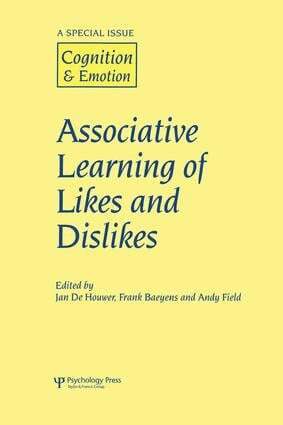
    Associative Learning of Likes and Dislikes

    A Special Issue of Cognition and Emotion

    AvJan de Houwer,Frank Baeyens

    Häftad, Engelska, 2015

    Del i serien Special Issues of Cognition and Emotion

    743 kr

    Beställningsvara. Skickas inom 10-15 vardagar. Fri frakt över 249 kr.

    Beskrivning

    Preferences are assumed to play a crucial role in many phenomena that are studied in learning psychology, social psychology, consumer science, emotion research, and clinical psychology. Given the pervasive impact that preferences have on behaviour, it is important to know where these likes and dislikes come from. Although some preferences are genetically determined, most stem from learning that took place during the lifetime of the individual. In this special issue, the editors focus on one such type of learning: associative learning of likes and dislikes, that is, changes in liking that are due to the pairing of stimuli. Prior studies on evaluative conditioning have shown that pairing an affectively neutral stimulus with an affectively positive or negative stimulus will change the liking of the originally neutral stimulus. The papers that are part of this special issue explore the relevance of evaluative conditioning for social psychology, provide new data about the impact of contingency awareness, attention, and extinction trials on evaluative conditioning, and examine whether pairing stimuli can also result in the transfer of non-evaluative stimulus properties.

    Produktinformation

    • Utgivningsdatum:2015-06-25
    • Mått:156 x 234 x 13 mm
    • Vikt:249 g
    • Format:Häftad
    • Språk:Engelska
    • Serie:Special Issues of Cognition and Emotion
    • Antal sidor:156
    • Förlag:Taylor & Francis Ltd
    • ISBN:9781138877955

    Utforska kategorier

    • Psykologi: känslor inom Psykologi och pedagogik
    • Beteendeteori inom Psykologi och pedagogik

    Mer om författaren

    Jan de Houwer, Frank Baeyens, Andy Field

    Innehållsförteckning

    • J. De Houwer, F. Baeyens, A. Field, Associative Learning of Likes and Dislikes: Some Current Controversies and Possible Ways Forward. E. Walther, B. Nagengast, C. Trasselli, Evaluative Conditioning in Social Psychology: Facts and Speculations. M. Hammerl, E.P. Fulcher, Reactance in Affective-evaluative Learning: Outside of Conscious Control? A.P. Field, A.C. Moore, Dissociating the Effects of Attention and Contingency Awareness on Evaluative Conditioning Effects in the Visual Paradigm. E. Diaz, G. Ruis, F. Baeyens, Resistance to Extinction of Human Evaluative Conditioning Using a Between-subjects Design. O.V. Lipp, H.M. Purkis, No Support for Dual Process Accounts of Human Affective Learning in Simple Pavlovian Conditioning. T. Meersmans, J. De Houwer, F. Baeyens, T. Randell, P. Eelen, Beyond Evaluative Conditioning: Searching for Associative Transfer of Non-evaluative Stimulus Properties.