• Fri frakt över 249 kr
  • •
  • Snabba leveranser
  • •
  • Billiga böcker
Kundservice

Du är på sajten för privatpersoner.

Företag, bibliotek eller offentlig verksamhet?

Du handlar på classic.bokus.com, där alla dina funktioner finns intakta.
Till classic.bokus.com
Bokus logotyp. Gå till startsidan.
  • Erbjudanden
  • Nyheter
  • Student
  • Topplistor
  • Barn & ungdom
  • Bokus Play
  • E-böcker
  • Pocketböcker
  • Spel & pussel

10% rabatt på allt med kod: NYSTART10 →

Sidfot

Mina sidor

    Hjälp

    • Kundservice
    • Vanliga frågor och svar
    • Frakt och leverans
    • Retur vid ångerrätt
    • Reklamera vara
    • Betalning
    • Köpvillkor
    • Allmänna villkor
    • Information om webbplatsens tillgänglighet

    Om Bokus

    • Om oss
    • Pressrum
    • För studenter
    • För företag
    • För bibliotek och offentlig verksamhet
    • För leverantörer
    • Hållbarhet

    Populärt

    • Aktuella erbjudanden
    • Presentkort
    • Studentlitteratur
    • Nya böcker
    • Topplistor
    • Signerade böcker
    • Engelska böcker

    Inspiration

    • Boktips
    • BookTok
    • Populära bokserier
    • Barnbokskaraktärer
    • Populära författare
    Logotyp för Bokus
    Följ oss på Facebook (extern länk)Följ oss på Instagram (extern länk)Följ oss på YouTube (extern länk)Följ oss på TikTok (extern länk)
    bokus @ CookiesAnpassa cookiesIntegritetspolicyKöpvillkor
    Till Citymail hemsida (extern länk)Till Budbee hemsida (extern länk)Till Postnord hemsida (extern länk)Till Schenker hemsida (extern länk)Till Early Bird hemsida (extern länk)Till Walleys hemsida (extern länk)
    1. Samhälle och politik
    2. Politik och statsskick
    3. Offentlig förvaltning

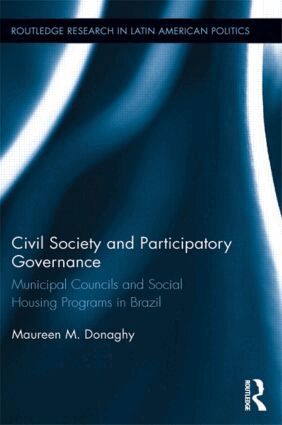
    Civil Society and Participatory Governance

    Municipal Councils and Social Housing Programs in Brazil

    AvMaureen M. Donaghy

    Häftad, Engelska, 2015

    Del i serien Routledge Studies in Latin American Politics

    414 kr

    Beställningsvara. Skickas inom 10-15 vardagar. Fri frakt över 249 kr.

    Fler format och utgåvor

    Inbunden

    1 466 kr

    E-bok

    486 kr

    E-bok

    486 kr

    Beskrivning

    Democratic institutions should promote accountability of government officials to the needs of citizens. Civil society plays a role in exposing corruption as well as in communicating the needs of low-income residents to officials. Neither the institutions of representative democracy nor the presence of civil society, however, appears to automatically guarantee adoption of social benefits for the poor. Can democratic institutions be created to address social challenges?Scholars, development practitioners, donors, and activists propose participatory governance institutions as mechanisms to create accountability and responsiveness through a public forum incorporating civil society. To date, however, little comparative research exists to confirm whether these institutions do influence adoption of social policies. Maureen M. Donaghy remedies this gap by combining data from Brazil’s 5,564 municipalities with extensive fieldwork from five Brazilian cities to test whether participatory municipal housing councils are associated with an increase in adoption of social housing programs to benefit the poor. Housing represents an issue of critical importance in Brazil and other developing countries where large populations reside in informal settlements in unsafe and insecure conditions. Civil Society and Participatory Governance is the first book of its kind to move the conversation beyond budgeting to other social policy areas, providing fresh theoretical and empirical insights to demonstrate that participatory governance institutions are effective mechanisms to coordinate government officials and civil society to alter policy-making.

    Produktinformation

    • Utgivningsdatum:2015-05-21
    • Mått:152 x 229 x 12 mm
    • Vikt:317 g
    • Format:Häftad
    • Språk:Engelska
    • Serie:Routledge Studies in Latin American Politics
    • Antal sidor:214
    • Förlag:Taylor & Francis Ltd
    • ISBN:9781138915749

    Utforska kategorier

    • Offentlig förvaltning inom Samhälle och politik
    • Regionalt styre och förvaltning inom Samhälle och politik

    Mer om författaren

    Maureen M. Donaghy is Assistant Professor at Rutgers University-Camden.  Her research and teaching interests focus on development and civil society with an emphasis on participatory governance, urban politics and Latin America.

    Recensioner i media

    "This book makes an important contribution to our understanding of how participatory governance can produce improvements in social well-being and public goods allocations. Donaghy’s work is a welcome addition to a growing body of work on citizen participation and participatory democracy, because it is the first book that combines large-N and case study analyses to demonstrate that these new democratic institutions generate public policies that have beneficial impacts on the lives of poor citizens."—Brian Wampler, Boise State University"This is an empirically rich and innovative "mixed-method" study of participatory institutions in Brazil. Donaghy does more than tell us that civic participation makes for good social policy. She presents a nuanced analysis of why that is so, breaking with commonly accepted hypotheses such as that a preexisting history of civil society mobilization determines the success of government sponsored efforts to include citizens in decision making."—Rebecca Abers, University of Brasília

    Innehållsförteckning

    • 1: Introduction 2: Housing Policy as Critical Challenge for Development and Democracy 3: The Effect of Municipal Housing Councils on Policy Outcomes 4: Civil Society Density, Participatory Governance, and Policy Outcomes 5: Pathways to Participatory Governance: Policy-Making in Brazil’s Municipal Housing Councils 6: The Creation Effect: Evaluating Commitment in Participatory Governance Institutions 7: Longevity in Participatory Governance Institutions: São Paulo’s Municipal Housing Council at 10 8: Conclusion: Can Democracy Remedy Social Challenges? Findings on the Effect of Participatory Governance Institutions