• Fri frakt över 249 kr
  • •
  • Snabba leveranser
  • •
  • Billiga böcker
Kundservice

Du är på sajten för privatpersoner.

Företag, bibliotek eller offentlig verksamhet?

Du handlar på classic.bokus.com, där alla dina funktioner finns intakta.
Till classic.bokus.com
Bokus logotyp. Gå till startsidan.
  • Erbjudanden
  • Nyheter
  • Student
  • Topplistor
  • Barn & ungdom
  • Bokus Play
  • E-böcker
  • Pocketböcker
  • Spel & pussel

10% rabatt på allt med kod: NYSTART10 →

Sidfot

Mina sidor

    Hjälp

    • Kundservice
    • Vanliga frågor och svar
    • Frakt och leverans
    • Retur vid ångerrätt
    • Reklamera vara
    • Betalning
    • Köpvillkor
    • Allmänna villkor
    • Information om webbplatsens tillgänglighet

    Om Bokus

    • Om oss
    • Pressrum
    • För studenter
    • För företag
    • För bibliotek och offentlig verksamhet
    • För leverantörer
    • Hållbarhet

    Populärt

    • Aktuella erbjudanden
    • Presentkort
    • Studentlitteratur
    • Nya böcker
    • Topplistor
    • Signerade böcker
    • Engelska böcker

    Inspiration

    • Boktips
    • BookTok
    • Populära bokserier
    • Barnbokskaraktärer
    • Populära författare
    Logotyp för Bokus
    Följ oss på Facebook (extern länk)Följ oss på Instagram (extern länk)Följ oss på YouTube (extern länk)Följ oss på TikTok (extern länk)
    bokus @ CookiesAnpassa cookiesIntegritetspolicyKöpvillkor
    Till Citymail hemsida (extern länk)Till Budbee hemsida (extern länk)Till Postnord hemsida (extern länk)Till Schenker hemsida (extern länk)Till Early Bird hemsida (extern länk)Till Walleys hemsida (extern länk)
    1. Samhälle och politik
    2. Samhälle och kultur
    3. Kultur och medier
    4. Referensverk och tvärvetenskap

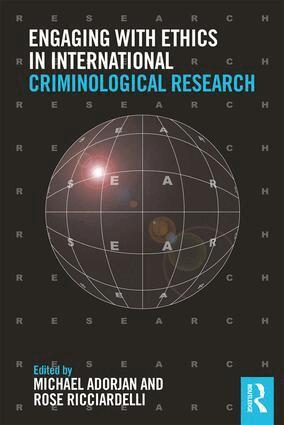
    Engaging with Ethics in International Criminological Research

    AvMichael Adorjan,Rose Ricciardelli

    Häftad, Engelska, 2016

    793 kr

    Beställningsvara. Skickas inom 10-15 vardagar. Fri frakt över 249 kr.

    Beskrivning

    Despite a voluminous literature detailing the procedures of research ethics boards and institutional ethical review processes, there are few texts that explore the realpolitik of conducting criminal research in practice. This book explores the unique lived experiences of scholars engaging with ethics during their criminological research, and focuses on the ethical dilemmas that researchers encounter both in the field and while writing up results for publication. Who benefits from criminological research? What are the roles and impacts of ethics review boards? How do methodological and theoretical decisions factor in to questions of ethical conduct and research ethics governance?This book is divided into four parts: Part I, Institutional arrangements and positionality, explores the ongoing and expanding process of ethics protocol and procedures, principles of confidentiality, and the positionality of the researcher. Part II, Trust and research with vulnerable populations, examines the complexity of work involving prisoners, indigenous peoples and victims of extreme violence, power dynamics between researchers and participants, and the challenges of informed consent. Part III, Research on and with police, reflects on the importance of transparent relations with police, best practices, and the consequences of undertaking research in authoritarian contexts. Part IV, Emerging areas, scrutinizes the ethics of carceral tours and suggests possible alternatives, and offers one of the first sociological and criminological examinations of dark net cryptomarkets.Drawing upon the experiences of international experts, this book aims to provoke further reflection on and discussion of ethics in practice. This book is ideal for students undertaking courses on research methods in criminology, as well as a key resource for criminology researchers around the world.

    Produktinformation

    • Utgivningsdatum:2016-06-23
    • Mått:156 x 234 x 15 mm
    • Vikt:406 g
    • Format:Häftad
    • Språk:Engelska
    • Antal sidor:258
    • Förlag:Taylor & Francis Ltd
    • ISBN:9781138938403

    Utforska kategorier

    • Referensverk och tvärvetenskap inom Samhälle och politik
    • Brottslighet och kriminologi inom Samhälle och politik

    Mer om författaren

    Michael Adorjan is Assistant Professor of Sociology at the University of Calgary, Canada, and Fellow with the Centre for Criminology, University of Hong Kong, China.Rose Ricciardelli is Associate Professor at Memorial University of Newfoundland, Canada.

    Recensioner i media

    "Engaging with Ethics in International Criminological Research brings the ethical issues and challenges confronted by the criminological researcher to life. Rather than provide dry guidance on how to navigate institutional ethics review, it contains a wealth of insights – from international scholars at the forefront to contemporary criminology – into the ethical thinking and decision-making involved in all serious criminology. These contributions are full of interesting and thought-provoking discussion of profound moral issues. It will be of interest to anyone researching, studying, or teaching criminology."Gerry Johnstone, Professor of Law, University of Hull, UK"Drawing on scholars studying myriad international sites, Engaging with Ethics goes beyond other books that merely criticize the power structure providing a blockade for research, instead offering programmatic statements and examples of how to navigate through these barriers to produce empirically rich, theoretically driven, yet ethical research that honors both those we study and those who write about criminals and criminal justice settings."Patricia A. Adler, Professor Emeritus, University of Colorado, and Peter Adler, Professor Emeritus, University of Denver, USA"Universities have defined ‘ethics up’. In doing so they have fundamentally reshaped, and are actively reshaping, how research is done. Nowhere is this more evident than in Criminology. Engaging with Ethics offers insightful reflections on this ‘ethical creep’ – its history and its implication across geographically dispersed research areas. It calls for an ‘ethical imagination’ grounded in the ‘lived experiences’ of active, experienced and sensitive researchers."Clifford Shearing, Professor in the School of Criminology and Criminal Justice, Griffith University, Australia"Adorjan and Ricciardelli and the contributors have assembled a valuable set of materials on a critical, yet understudied topic. They take the reader inside the dynamics of field research to explore areas not covered in traditional methods texts. A must-read for both experienced and novice field researchers." Curt Taylor Griffiths, Professor and Director of thePolice Studies Centre, Simon Fraser University, Canada

    Innehållsförteckning

    • 1. Introduction (Michael Adorjan and Rose Ricciardelli)Part I: Institutional Arrangements & Positionality2. Ethics Creep: Governing Social Science Research in the Name of Ethics (Kevin Haggerty)3. The Ethical Imagination - Reflections on conducting research in Hong Kong (Michael Adorjan)4. Ethics, Politics and the Limits to Knowledge (Pat Carlen)Part II: Trust and Research with Vulnerable Populations5. A History of Coercive Practices: The Abuse of Consent in Research involving Prisoners and Prisons in the United States (Mark Israel)6. Indigenous Peoples, Research and Ethics (Maggie Walter) 7. Ethics as Witnessing: ‘Science’, Research Ethics, and Victimization (Dale Spencer) Part III: Research on and with Police8. Navigating Research Relationships: Academia and Criminal Justice Agencies (Erin Gibbs Van Brunschot)9. Commanding Officer, faculty member, and student: Auto-ethnographic experiences of academic-police collaborative partnerships (Rose Ricciardelli, Laura Huey, Hayley Crichton, and Tracy Hardy)10. Criminologizing Everyday Life and Doing Policing Ethnography in China (Jianhua Xu)Part IV: Emerging Areas11. Carceral Tours and Missed Opportunities: Revisiting conceptual, ethical and pedagogical dilemmas (Justin Piché, Kevin Walby and Craig Minogue)12. Illuminating the Dark Net: Methods and Ethics in Cryptomarket Research (James Martin)13. Conclusion (Rose Ricciardelli and Michael Adorjan)