• Fri frakt över 249 kr
  • •
  • Snabba leveranser
  • •
  • Billiga böcker
Kundservice

Du är på sajten för privatpersoner.

Företag, bibliotek eller offentlig verksamhet?

Du handlar på classic.bokus.com, där alla dina funktioner finns intakta.
Till classic.bokus.com
Bokus logotyp. Gå till startsidan.
  • Erbjudanden
  • Nyheter
  • Student
  • Topplistor
  • Barn & ungdom
  • Bokus Play
  • E-böcker
  • Pocketböcker
  • Spel & pussel

10% rabatt på allt med kod: NYSTART10 →

Sidfot

Mina sidor

    Hjälp

    • Kundservice
    • Vanliga frågor och svar
    • Frakt och leverans
    • Retur vid ångerrätt
    • Reklamera vara
    • Betalning
    • Köpvillkor
    • Allmänna villkor
    • Information om webbplatsens tillgänglighet

    Om Bokus

    • Om oss
    • Pressrum
    • För studenter
    • För företag
    • För bibliotek och offentlig verksamhet
    • För leverantörer
    • Hållbarhet

    Populärt

    • Aktuella erbjudanden
    • Presentkort
    • Studentlitteratur
    • Nya böcker
    • Topplistor
    • Signerade böcker
    • Engelska böcker

    Inspiration

    • Boktips
    • BookTok
    • Populära bokserier
    • Barnbokskaraktärer
    • Populära författare
    Logotyp för Bokus
    Följ oss på Facebook (extern länk)Följ oss på Instagram (extern länk)Följ oss på YouTube (extern länk)Följ oss på TikTok (extern länk)
    bokus @ CookiesAnpassa cookiesIntegritetspolicyKöpvillkor
    Till Citymail hemsida (extern länk)Till Budbee hemsida (extern länk)Till Postnord hemsida (extern länk)Till Schenker hemsida (extern länk)Till Early Bird hemsida (extern länk)Till Walleys hemsida (extern länk)
    1. Samhälle och politik
    2. Social välfärd och brottslighet
    3. Brottslighet och kriminologi
    4. Kriminalvård och straff

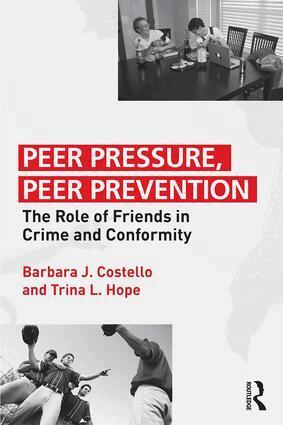
    Peer Pressure, Peer Prevention

    The Role of Friends in Crime and Conformity

    AvBarbara J. Costello,Trina L. Hope

    Häftad, Engelska, 2016

    770 kr

    Beställningsvara. Skickas inom 10-15 vardagar. Fri frakt över 249 kr.

    Fler format och utgåvor

    Inbunden

    2 571 kr

    Beskrivning

    Criminological research has largely neglected the possibility that positive peer influence is a potentially powerful source of social control. Quantitative methods tease out cause, effect, and spuriousness in the relationship between peer delinquency and personal delinquency, but these methods do little or nothing to reveal how and why peers might influence each other toward--or away from--deviance. Costello and Hope take a first step toward uncovering the mechanisms of peer influence, drawing on quantitative and qualitative data collected from two convenience samples of university students. Their quantitative analyses showed that positive peer influence occurs most frequently among those who associate with the most deviant peers and self-report the most deviance, contrary to predictions drawn from social learning theories. Their qualitative data revealed a variety of methods of negative influence, including encouraging deviant behavior for others' amusement, a motive for peer influence never before reported in the literature.

    Produktinformation

    • Utgivningsdatum:2016-03-01
    • Mått:191 x 235 x 13 mm
    • Vikt:240 g
    • Format:Häftad
    • Språk:Engelska
    • Antal sidor:132
    • Förlag:Taylor & Francis Ltd
    • ISBN:9781138951693

    Utforska kategorier

    • Kriminalvård och straff inom Samhälle och politik
    • Socialpsykologi och gruppsykologi inom Psykologi och pedagogik
    • Brottslighet och kriminologi inom Samhälle och politik

    Mer om författaren

    Barbara J. Costello (Ph.D., University of Arizona) is Associate Professor of Sociology at the University of Rhode Island. Her research has focused on testing and extending control theories of crime and delinquency, and on the explanation of both positive and negative peer influence.Trina L. Hope (Ph.D., University of Arizona) is Associate Professor of Sociology at the University of Oklahoma. Her research has focused primary on criminological theory-testing, including applying concepts from control theories to gang membership, gang and dating violence, adolescent sexual activity, pregnancy resolution, and substance use.

    Recensioner i media

    "This is an original effort to calm long-standing squabbles among criminologists about the place of peers in explanations of deviant acts. Costello and Hope see that these disputes—fueled by deductive theory and statistical analyses—may be resolved by quietly questioning people performing and reacting to the acts in question. Their findings justify their effort. All is not as we have been led to believe. The several claimants to this disputed territory—whether strain, control, or learning theorists—will find good reasons to rethink their claims. Need I note that such progress is rare?"-Travis Hirschi, Emeritus Professor of Sociology, University of Arizona. "This book makes a major contribution by considering how peer pressure goes in multiple directions. It broadens our discussion of peer effects on crime and thus can help resolve many of the issues that have been discussed for many decades."- Marcus Felson, Professor of Sociology, Texas State University"Criminologists know little more about mechanisms of peer influence or the everyday social interaction of youth than they did a generation ago. This is a sad and startling admission, particularly in light of all the attention that peer influence has received in recent years. This book brings the authority and richness of real life back into the study of peer influence, along with an abundance of original insights and ideas. For an area often hindered by methodological controversies and theoretical inertia, this should be welcome news. Costello and Hope deserve our thanks."-Mark Warr, Professor of Sociology, University of Texas at Austin

    Innehållsförteckning

    • 1. Introduction: The Study of Peers and Deviant Behavior2. Theory and Research on Peers and Deviance3. Qualitative Accounts of Negative Peer Influence4. Mechanisms of Positive Influence5. Explaining Peer Informal Social Control6. Conclusions and Recommendations for Future Research and Policy