• Fri frakt över 249 kr
  • •
  • Snabba leveranser
  • •
  • Billiga böcker
Kundservice

Du är på sajten för privatpersoner.

Företag, bibliotek eller offentlig verksamhet?

Du handlar på classic.bokus.com, där alla dina funktioner finns intakta.
Till classic.bokus.com
Bokus logotyp. Gå till startsidan.
  • Erbjudanden
  • Nyheter
  • Student
  • Topplistor
  • Barn & ungdom
  • Bokus Play
  • E-böcker
  • Pocketböcker
  • Spel & pussel

10% rabatt på allt med kod: NYSTART10 →

Sidfot

Mina sidor

    Hjälp

    • Kundservice
    • Vanliga frågor och svar
    • Frakt och leverans
    • Retur vid ångerrätt
    • Reklamera vara
    • Betalning
    • Köpvillkor
    • Allmänna villkor
    • Information om webbplatsens tillgänglighet

    Om Bokus

    • Om oss
    • Pressrum
    • För studenter
    • För företag
    • För bibliotek och offentlig verksamhet
    • För leverantörer
    • Hållbarhet

    Populärt

    • Aktuella erbjudanden
    • Presentkort
    • Studentlitteratur
    • Nya böcker
    • Topplistor
    • Signerade böcker
    • Engelska böcker

    Inspiration

    • Boktips
    • BookTok
    • Populära bokserier
    • Barnbokskaraktärer
    • Populära författare
    Logotyp för Bokus
    Följ oss på Facebook (extern länk)Följ oss på Instagram (extern länk)Följ oss på YouTube (extern länk)Följ oss på TikTok (extern länk)
    bokus @ CookiesAnpassa cookiesIntegritetspolicyKöpvillkor
    Till Citymail hemsida (extern länk)Till Budbee hemsida (extern länk)Till Postnord hemsida (extern länk)Till Schenker hemsida (extern länk)Till Early Bird hemsida (extern länk)Till Walleys hemsida (extern länk)
    1. Psykologi och pedagogik
    2. Pedagogik
    3. Skolan och förskolan

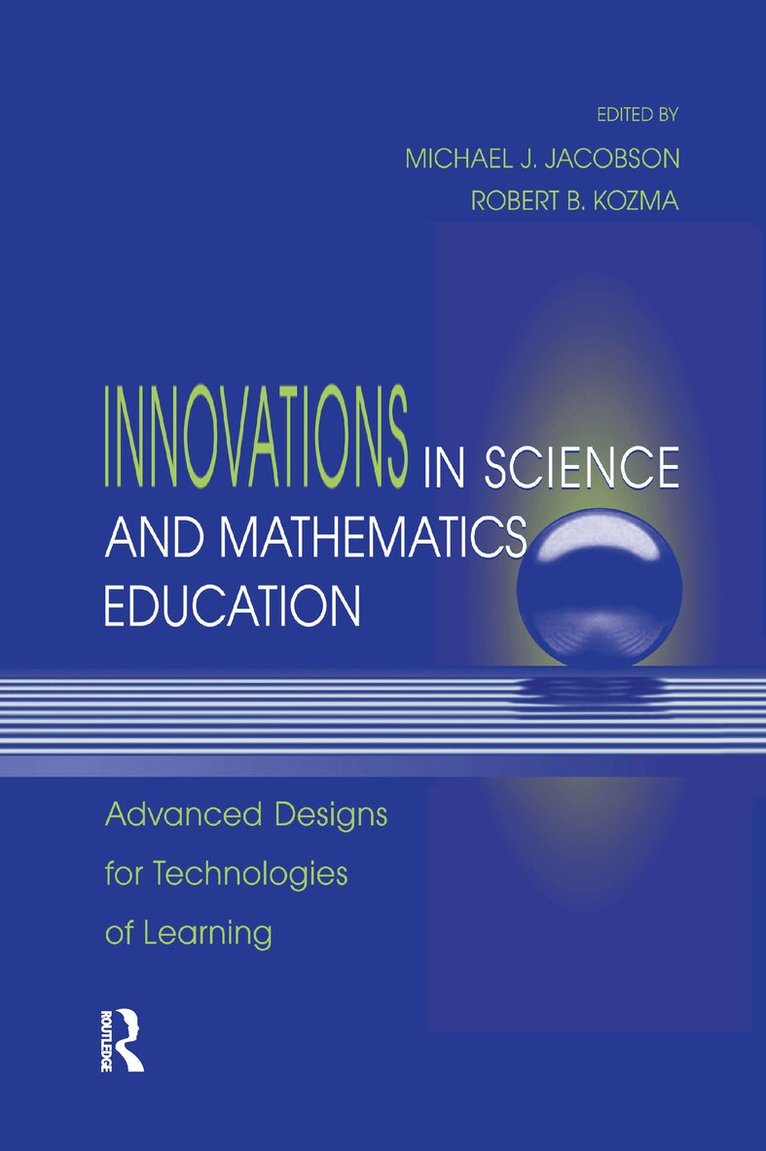
    Innovations in Science and Mathematics Education

    Advanced Designs for Technologies of Learning

    AvMichael J. Jacobson Jr.,Robert B. Kozma

    Häftad, Engelska, 2016

    511 kr

    Beställningsvara. Skickas inom 10-15 vardagar. Fri frakt över 249 kr.

    Beskrivning

    The uses of technology in education have kindled great interest in recent years. Currently, considerable resources are being expended to connect schools to the Internet, to purchase powerful (and increasingly affordable) computers, and on other implementations of educational technologies. However, the mere availability of powerful, globally-connected computers is not sufficient to insure that students will learn--particularly in subjects that pose considerable conceptual difficulties, such as in science and mathematics. The true challenge is not just to put the newest technologies in our schools, but to identify advanced ways to design and use these new technologies to advance learning. This book offers a "snapshot" of current work that is attempting to address this challenge. It provides valuable and timely information to science and mathematics educators, educational and cognitive researchers, instructional technologists and educational software developers, educational policymakers, and to scholars and students in these fields.

    Produktinformation

    • Utgivningsdatum:2016-07-21
    • Mått:152 x 229 x 24 mm
    • Vikt:453 g
    • Format:Häftad
    • Språk:Engelska
    • Antal sidor:448
    • Förlag:Taylor & Francis Ltd
    • ISBN:9781138972797

    Utforska kategorier

    • Skolan och förskolan inom Psykologi och pedagogik
    • Undervisning i specifika ämnen inom Psykologi och pedagogik

    Mer om författaren

    Jacobson, Michael J.; Kozma, Robert B.

    Recensioner i media

    "Chapters are well organized, making the book easy to follow....good resource for graduate students, faculty, and university libraries."—CHOICE"The articles included are clearly written at a level that should be accessible to any educational professional familiar with learning theory and technology. The chapters of the book are essentially research papers and, as such, meet a high standard of timeliness."—Horizon Research"The greatest strength of this book is in its ability to demonstrate the ways in which technological learning tools foster deep understandings of difficult scientific and mathematical knowledge and ideas. Innovations clearly encapsulates the role of visualization, simulation, modeling, and computer-based manipulation in the development of increasingly complex scientific concepts and abstractions."—Science Education"Represents the state of the art in designing learning environments....An important collection."—David JonassenPennsylvania State University

    Innehållsförteckning

    • Contents: M.J. Jacobson, A.J. Angulo, R.B. Kozma, Introduction: New Perspectives on Designing the Technologies of Learning. R.B. Kozma, The Use of Multiple Representations and the Social Construction of Understanding in Chemistry. J. Roschelle, J.J. Kaput, W. Stroup, SIMCALC: Accelerating Students' Engagement With the Mathematics of Change. S.J. Metcalf, J. Krajcik, E. Soloway, Model-It: A Design Retrospective. M.J. Jacobson, A. Archodidou, The Knowledge Mediator Framework: Toward the Design of Hypermedia Tools for Learning. P. Horwitz, M.A. Christie, Computer-Based Manipulatives for Teaching Scientific Reasoning: An Example. J.D. Slotta, M.C. Linn, The Knowledge Integration Environment: Helping Students Use the Internet Effectively. M. Guzdial, J. Turns, Computer-Supported Collaborative Learning in Engineering: The Challenge of Scaling-Up Assessment. P.M. Sadler, R. Gould, K. Brecher, B. Hoffman, Asstronomical Experiences Using Internet-Accessible Remote Instumentation. B. Means, E. Coleman, Technology Supports for Student Participation in Science Investigations. B.Y. White, J.R. Frederiksen, Technological Tools and Instructional Approaches for Making Scientific Inquiry Accessible to All. C. Dede, M. Salzman, R.B. Loftin, K. Ash, The Design of Immersive Virtual Learning Environments: Fostering Deep Understandings of Complex Scientific Knowledge.