• Fri frakt över 249 kr
  • •
  • Snabba leveranser
  • •
  • Billiga böcker
Kundservice

Du är på sajten för privatpersoner.

Företag, bibliotek eller offentlig verksamhet?

Du handlar på classic.bokus.com, där alla dina funktioner finns intakta.
Till classic.bokus.com
Bokus logotyp. Gå till startsidan.
  • Erbjudanden
  • Nyheter
  • Student
  • Topplistor
  • Barn & ungdom
  • Bokus Play
  • E-böcker
  • Pocketböcker
  • Spel & pussel

10% studentrabatt med kod TERM26

Sidfot

Mina sidor

    Hjälp

    • Kundservice
    • Vanliga frågor och svar
    • Frakt och leverans
    • Retur vid ångerrätt
    • Reklamera vara
    • Betalning
    • Köpvillkor
    • Allmänna villkor
    • Information om webbplatsens tillgänglighet

    Om Bokus

    • Om oss
    • Pressrum
    • För studenter
    • För företag
    • För bibliotek och offentlig verksamhet
    • För leverantörer
    • Hållbarhet

    Populärt

    • Aktuella erbjudanden
    • Presentkort
    • Studentlitteratur
    • Nya böcker
    • Topplistor
    • Signerade böcker
    • Engelska böcker

    Inspiration

    • Boktips
    • BookTok
    • Populära bokserier
    • Barnbokskaraktärer
    • Populära författare

    Mina sidor

      Hjälp

      • Kundservice
      • Vanliga frågor och svar
      • Frakt och leverans
      • Retur vid ångerrätt
      • Reklamera vara
      • Betalning
      • Köpvillkor
      • Allmänna villkor
      • Information om webbplatsens tillgänglighet

      Om Bokus

      • Om oss
      • Pressrum
      • För studenter
      • För företag
      • För bibliotek och offentlig verksamhet
      • För leverantörer
      • Hållbarhet

      Populärt

      • Aktuella erbjudanden
      • Presentkort
      • Studentlitteratur
      • Nya böcker
      • Topplistor
      • Signerade böcker
      • Engelska böcker

      Inspiration

      • Boktips
      • BookTok
      • Populära bokserier
      • Barnbokskaraktärer
      • Populära författare
      Logotyp för Bokus
      Följ oss på Facebook (extern länk)Följ oss på Instagram (extern länk)Följ oss på YouTube (extern länk)Följ oss på TikTok (extern länk)
      bokus @ CookiesAnpassa cookiesIntegritetspolicyKöpvillkor
      Till Citymail hemsida (extern länk)Till Budbee hemsida (extern länk)Till Postnord hemsida (extern länk)Till Schenker hemsida (extern länk)Till Early Bird hemsida (extern länk)Till Walleys hemsida (extern länk)
      1. Samhälle och politik
      2. Politik och statsskick
      3. Centralt styre och förvaltning

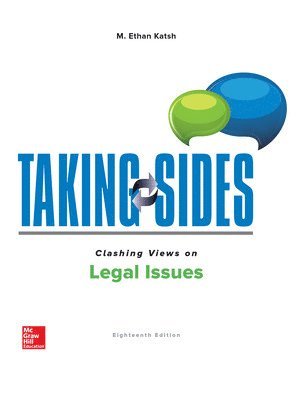
      Taking Sides: Clashing Views on Legal Issues

      AvM. Ethan Katsh

      Häftad, Engelska, 2017

      779 kr

      Tillfälligt slut

      Beskrivning

      The Taking Sides Collection on McGraw-Hill Create® includes current controversial issues in a debate-style forma designed to stimulate student interest and develop critical thinking skills. This Collection contains a multitude of current and classic issues to enhance and customize your course. You can browse the entire Taking Sides Collection on Create or you can search by topic, author, or keywords. Each Taking Sides issue is thoughtfully framed with Learning Outcomes, an Issue Summary, an Introduction, and an "Exploring the Issue" section featuring Critical Thinking and Reflection, Is There Common Ground?, Additional Resources, and Internet References. Go to the Taking Sides Collection on McGraw-Hill Create® at www.mcgrawhillcreate.com/takingsides and click on "Explore this Collection" to browse the entire Collection. Select individual Taking Sides issues to enhance your course, or access and select the entire Katsh, Taking Sides: Clashing Views on Legal Issues, 18/e book here http://create.mheducation.com/createonline/index.html#qlink=search%2Ftext%3Disbn:125988368X for an easy, pre-built teaching resource. Visit http://create.mheducation.com for more information on other McGraw-Hill titles and special collections.

      Produktinformation

      • Utgivningsdatum:2017-09-08
      • Mått:213 x 274 x 25 mm
      • Vikt:725 g
      • Format:Häftad
      • Språk:Engelska
      • Antal sidor:352
      • Upplaga:18
      • Förlag:McGraw-Hill Education
      • ISBN:9781259883682

      Utforska kategorier

      • Centralt styre och förvaltning inom Samhälle och politik
      • Straffrätt: process och brott inom Juridik
      • Sociologi inom Samhälle och politik

      Innehållsförteckning

      • Unit 1: Law and TerrorismIssue:  Should U.S. Citizens Who Are Declared to Be “Enemy Combatants” Be Able to Contest Their Detention before a Judge?Yes: Sandra Day O'Connor, from "Majority Opinion, Hamdi v. Rumsfeld," United States Supreme Court (2004)No: Clarence Thomas, from "Minority Opinion, Hamdi v. Rumsfeld," United States Supreme Court (2004)Supreme Court Justice Sandra Day O’Connor finds that the Authorization for Use of Military Force passed by Congress does not authorize the indefinite detainment of a person found to be an “enemy combatant.” Justice Clarence Thomas believes that the detention of an “enemy combatant” is permitted under the federal government’s war powers.Issue:  Does the President Possess Constitutional Authority to Order Wiretaps on U.S. Citizens?Yes: U.S. Department of Justice, from "Legal Authorities Supporting the Activities of the National Security Agency Described by the President," United States Department of Justice (2006)No: Letter to Congress, from "Letter to Congress from 14 Law Professors and Former Government Attorneys to Congressional Leaders," United States Congress (2006)The Department of Justice argues that the Constitution gives the President the right to engage in electronic surveillance, with or without congressional approval or judicial oversight. It further claims that the National Security Agency (NSA) wiretapping program ordered by President Bush does not violate federal law, specifically the Foreign Intelligence Surveillance Act (FISA), because such surveillance falls under the auspices of the military response to the 9/11 attacks, which was authorized by Congress. Several lawyers with expertise in constitutional law or experience in the federal government argue that the NSA wiretapping program violates FISA and the Fourth Amendment of the U.S. Constitution. They further argue that the President does not have any inherent authority either to engage in warrantless wiretapping or to violate federal law that limits such surveillance.Unit 2: Law and the IndividualIssue:  Is It Unconstitutional for a State to Require Physicians Who Perform Abortions to Have Admitting Privileges at a Nearby Hospital and for Abortion Clinics to Have Facilities Comparable to an Ambulatory Surgical Center?Yes: Stephen Breyer, from "Majority Opinion, Whole Woman's Health v. Hellerstedt," United States Supreme Court (2016)No: Clarence Thomas, from "Dissenting Opinion, Whole Woman's Health v. Hellerstedt," United States Supreme Court (2016)Justice Breyer argues that two provisions in a Texas law—requiring physicians who perform abortions to have admitting privileges at a nearby hospital and requiring abortion clinics in the state to have facilities comparable to an ambulatory surgical center—place a substantial obstacle in the path of women seeking an abortion, constitute an “undue burden” on abortion access, and therefore violate the Constitution. Justice Thomas finds that there is no “undue burden.”Issue:  Are Violent Video Games Protected by the First Amendment?Yes: Antonin Scalia, from "Majority Opinion, Brown v. Entertainment Merchants Association," United States Supreme Court (2011)No: Stephen Breyer, from "Dissenting Opinion, Brown v. Entertainment Merchants Association," United States Supreme Court (2011)Supreme Court Justice Antonin Scalia argues that legislation creating a whole new category of speech that is banned only for children violates the First Amendment. Justice Stephen Breyer believes that the California law restricting the purchase of video games by minors is clear and constitutional.Issue:  Can States Ban Physician Aid-in-Dying for Terminally Ill Patients?Yes: William H. Rehnquist, from "Majority Opinion, Washington v. Glucksberg," United States Supreme Court (1997)No: Stephen Reinhardt, from "Majority Opinion, Compassion in Dying v. State of Washington," United States Supreme Court (1996)Former Supreme Court Chief Justice William H. Rehnquist, writing one of six opinions of a unanimous Court in Washington v. Glucksberg, rules that although patients have the right to refuse life-sustaining medical treatment, “physician-assisted suicide” is not constitutionally protected, and states may ban that practice. Judge Stephen Reinhardt, writing the majority opinion for the Ninth Circuit case that became Washington v. Glucksberg when it reached the U.S. Supreme Court, argues that criminalizing physician assistance in hastening the death of competent, terminally ill patients who request life-ending prescriptions violates the Due Process Clause of the Constitution.Issue:  Does the Sharing of Music Files Through the Internet Violate Copyright Laws?Yes: Ruth Bader Ginsburg, from "Concurring Opinion, Metro-Goldwyn-Mayer Studios Inc., et al., v. Grokster, Ltd., et al.," United States Supreme Court (2005)No: Stephen Breyer, from "Concurring Opinion, Metro-Goldwyn-Mayer Studios Inc., et al., Petitioners v. Grokster, Ltd., et al.," United States Supreme Court (2005)Justice Ruth Bader Ginsburg believes that copyright laws are violated by a company when its software is used primarily for illegal file sharing, and lawful uses in the future are unlikely. Justice Stephen Breyer does not want copyright laws to hinder technological innovation and is more willing to take into account the potential use of the software for lawful file sharing.Issue:  Is the Eighth Amendment Protection Violated If Prisoners Are Deprived of Basic Sustenance?Yes: Anthony Kennedy, from "Majority Opinion, Brown v. Plata," United States Supreme Court (2011)No: Antonin Scalia, from "Dissenting Opinion, Brown v. Plata," United States Supreme Court (2011)Supreme Court Justice Anthony Kennedy rules that if a prison deprives prisoners of basic sustenance, including adequate medical care, the courts have a responsibility to remedy the resulting violation of the Eighth Amendment. Justice Antonin Scalia believes that a ruling that may result in the release of 40,000 prisoners is unwarranted and unprecedented.Unit 3: Law and the StateIssue:  Does the Constitution’s Commerce Clause Allow Congress to Require Uninsured Individuals to Buy Health Insurance?Yes: Ruth Bader Ginsburg, from "Majority Opinion, National Federation of Independent Businesses v. Sebelius," United States Supreme Court (2012)No: John G. Roberts, Jr., from "Dissenting Opinion, National Federation of Independent Businesses v. Sebelius," United States Supreme Court (2012)Justice Ruth Bader Ginsburg argues that, under existing Supreme Court interpretations of the Constitution’s Commerce Clause, Congress has the constitutional authority to require uninsured Americans to buy health insurance or pay a penalty. Chief Justice John G. Roberts, Jr., argues that a federal mandate to buy a service or product exceeds Congress’s power under the Commerce Clause.Issue:  Is It Constitutional to Open a Town Meeting with a Prayer?Yes: Anthony Kennedy, from "Majority Opinion, Town of Greece, New York v. Susan Galloway," United States Supreme Court (2014)No: Elena Kagan, et al., from "Dissenting Opinion, Town of Greece, New York v. Susan Galloway," United States Supreme Court (2014)Supreme Court Justice Anthony Kennedy, writing for the Majority, affirms the right of local government bodies to hold a prayer prior to conducting official business maintaining that the history of the United States is consistent with such a practice, and thus the Establishment Clause is not implicated. Supreme Court Justice Elena Kagan, dissenting from the Court’s opinion, argues that prayer prior to local town meetings is a violation of the Establishment Clause of the Constitution and is materially different from prayer held in other governmental forums, which had been previously upheld by the Court.Issue:  Is a Strip Search of Middle School Students That Is Aimed at Finding Drugs Prohibited Under the Fourth Amendment?Yes: David Souter, from "Majority Opinion, Safford Unified School District, et al., v. April Redding," United States Supreme Court (2009)No: Clarence Thomas, from "Dissenting Opinion, Safford Unified School District, et al., v. April Redding," United States Supreme Court (2009)Supreme Court Justice David Souter holds that a search in school requires a reasonable belief that evidence of wrongdoing will be found and that the search is not excessively intrusive in light of the age and sex of the student. Supreme Court Justice Clarence Thomas argues that the Fourth Amendment is not violated when there is reasonable suspicion that the student is in possession of drugs banned by school policy and the search is in an area where small pills could be concealed.Issue:  Is a Dog Sniffing for Drugs Outside a Home a Search Prohibited by the Fourth Amendment?Yes: Antonin Scalia, from "Majority Opinion, Florida v. Jardines," United States Supreme Court (2013)No: Samuel Anthony Alito, Jr., from "Dissenting Opinion, Florida v. Jardines," United States Supreme Court (2013)Supreme Court Justice Antonin Scalia finds that it is a search and a violation of the Fourth Amendment when police obtain evidence by allowing a trained dog to physically enter and occupy an area outside a home in which permission has not been obtained from the home owner. Supreme Court Justice Samuel Alito disagrees that there was a trespass here or that the dog sniff could be considered an invasion of any reasonable expectation of privacy given that one can expect that odors will float outside of a house.Issue:  Does the “Cruel and Unusual Punishment” Clause of the Eighth Amendment Bar the Imposition of the Death Penalty on Juveniles?Yes: Anthony Kennedy, from "Majority Opinion, Donald P. Roper, Superintendent, Potosi Correctional Center, Petitioner v. Christopher Simmons," United States Supreme Court (2005)No: Antonin Scalia, from "Minority Opinion, Donald P. Roper, Superintendent, Potosi Correctional Center, Petitioner v. Christopher Simmons," United States Supreme Court (2005)Supreme Court Justice Anthony Kennedy holds that the Constitution prohibits the execution of a person who was under the age of 18 at the time of the offense. Supreme Court Justice Antonin Scalia believes that the Constitution does not preclude the execution of a juvenile.Issue:  Does the Definition of “Sex” in Title IX Include Gender Identity and Allow Transgender Students to Use the Restrooms That Align with Their Gender Identities and Not Their Biological Sex?Yes: Henry Franklin Floyd, from "Majority Opinion, G.G. v. Gloucester County School Board," United States Court of Appeals for the Fourth Circuit (2016)No: Counsel for Amici Curiae, from "Amicus Brief of Christian Educators Association International, Gloucester County School Board v. G.G.," United States Supreme Court (2017)Circuit Judge Henry Franklin Floyd held that the term “sex” was ambiguous and that it must include gender identity and not just biological sex. The Christian Educators Association International argues that the term “sex” is unambiguous, and subject to one interpretation, that of biological sex.Issue:  Does a Facebook Poster Need More Than “General Intent” for a Post to Be Considered a “True Threat” Under Criminal Law?Yes: John G. Roberts, Jr., from "Majority Opinion, Elonis v. United States," United States Supreme Court (2015)No: Samuel Anthony Alito, Jr., from "Dissenting Opinion, Elonis v. United States," United States Supreme Court (2015)Supreme Court Chief Justice John Roberts holds that more than a “general intent,” standard is required to hold a Facebook poster criminally liable for the contents of the post. Supreme Court Justice Samuel Alito argues that the majority is unclear as to the state of mind necessary for someone posting a threat on Facebook to be criminally liable for a “true threat.”Unit 4: Law and the CommunityIssue:  Is There a Constitutional Right to Possess a Firearm for Private Use?Yes: Antonin Scalia, from "Majority Opinion, District of Columbia, et al., v. Heller," United States Supreme Court (2008)No: John Paul Stevens, from "Dissenting Opinion, District of Columbia, et al., v. Heller," United States Supreme Court (2008)Supreme Court Justice Antonin Scalia argues that the Second Amendment protects the right of a private citizen to own a handgun for self-defense. Supreme Court Justice John Paul Stevens argues that a previous case, United States v. Miller, held that the Second Amendment did not protect the right of a private citizen to own a handgun for self-defense.Issue:  Are Blanket Prohibitions on Cross Burnings Unconstitutional?Yes: Sandra Day O'Connor, from "Plurality Opinion, Virginia v. Black," United States Supreme Court (2003)No: Clarence Thomas, from "Dissenting Opinion, Virginia v. Black," United States Supreme Court (2003)Supreme Court Justice Sandra Day O’Connor argues that part of a Virginia statute proscribing cross burning with the intent to intimidate is constitutional because it is content discrimination based on the very reasons that make it constitutional; however, part of the statute is unconstitutional insofar as it requires an inference of intent to intimidate solely based on the action of cross burning itself, which is symbolic speech. Supreme Court Justice Clarence Thomas disagrees with part of the statute being held unconstitutional, arguing that the history and nature of cross burning in the United States inextricably links the act to threatening and menacing violence and that the intent to intimidate can therefore be inferred solely from the act of cross burning itself.Issue:  Does the Fourth Amendment Prohibit the Police from Collecting a DNA Sample from a Person Arrested, but Not Yet Convicted on Felony Charges?Yes: Anthony Kennedy, from "Majority Opinion, Maryland v. King," United States Supreme Court (2013)No: Antonin Scalia, from "Dissenting Opinion, Maryland v. King," United States Supreme Court (2013)Justice Anthony Kennedy rules that using a cheek swab to collect a person’s DNA during post-arrest processing is a reasonable search under the Fourth Amendment because it is predominantly used to confirm the identity of the arrestee. Justice Antonin Scalia argues that DNA collection at the time of arrest is an unreasonable search because the arrestee’s DNA profile is predominantly used to investigate unrelated crimes.Issue:  Is Same-sex Marriage Protected by the Fourteenth Amendment to the U.S. Constitution?Yes: Anthony Kennedy, from "Majority Opinion, Obergefell v. Hodges," United States Supreme Court (2015)No: John G. Roberts, Jr, from "Dissenting Opinion, Obergefell v. Hodges," United States Supreme Court (2015)Supreme Court Justice Anthony Kennedy holds that marriage is a fundamental right, and bans on same-sex marriage are unconstitutional under the Due Process and Equal Protection Clauses of the Fourteenth Amendment. Supreme Court Chief Justice John Roberts argues that it is no place for the Court, as unelected lawyers, to make the determination of what defines “marriage,” as that is the job of the legislature and not the judiciary.Issue:  Are Race-conscious Public University Admissions Policies Permitted Under the Fourteenth Amendment?Yes: Anthony Kennedy, from "Majority Opinion, Fisher v. University of Texas at Austin II," United States Supreme Court (2016)No: Samuel Anthony Alito, Jr., from "Dissenting Opinion, Fisher v. University of Texas at Austin II," United States Supreme Court (2016)Justice Anthony Kennedy holds that the race-conscious admissions program in use at the University of Texas does not violate the Equal Protection Clause of the Fourteenth Amendment. Justice Samuel Alito argues that the university failed to effectively demonstrate that its admission policy needs a racial element and that the one it employs does, in fact, foster diversity.Issue:  Is It Unconstitutional for States to Imprison Undocumented Immigrants?Yes: Anthony Kennedy, from "Opinion of the Court, Arizona v. United States," United States Supreme Court (2012)No: Antonin Scalia, from "Dissenting Opinion, Arizona v. United States," United States Supreme Court (2012)Justice Anthony Kennedy argues that a recent state law making it a crime to be an undocumented immigrant in Arizona impinges on the U.S. federal government’s authority to regulate immigration. Justice Antonin Scalia argues that it is not unconstitutional for a state to supplement U.S. federal immigration law with its own, harsher penalties for illegal immigration.
      Hoppa över listan

      Mer från samma författare

      M. Ethan Katsh - The Electronic Media and the Transformation of Law, Inbunden

      The Electronic Media and the Transformation of Law

      M. Ethan Katsh

      Inbunden, 1989

      2 545 kr

      M. Ethan Katsh - The Electronic Media and the Transformation of Law, Häftad

      The Electronic Media and the Transformation of Law

      M. Ethan Katsh

      Häftad, 1991

      914 kr

      M. Ethan Katsh - Law in a Digital World, Inbunden

      Law in a Digital World

      M. Ethan Katsh

      Inbunden, 1995

      3 810 kr

      M. Ethan Katsh - Law in a Digital World, E-bok

      Law in a Digital World

      M. Ethan Katsh

      E-bok
      1995

      1 616 kr

      M. Ethan Katsh - Electronic Media and the Transformation of Law, E-bok

      Electronic Media and the Transformation of Law

      M. Ethan Katsh

      E-bok
      1989

      295 kr

      Hoppa över listan

      Du kanske också är intresserad av

      M. Ethan Katsh - The Electronic Media and the Transformation of Law, Häftad

      The Electronic Media and the Transformation of Law

      M. Ethan Katsh

      Häftad, 1991

      914 kr

      M. Ethan Katsh - The Electronic Media and the Transformation of Law, Inbunden

      The Electronic Media and the Transformation of Law

      M. Ethan Katsh

      Inbunden, 1989

      2 545 kr

      M. Ethan Katsh - Law in a Digital World, Inbunden

      Law in a Digital World

      M. Ethan Katsh

      Inbunden, 1995

      3 810 kr

      M. Ethan Katsh - Law in a Digital World, E-bok

      Law in a Digital World

      M. Ethan Katsh

      E-bok
      1995

      1 616 kr

      M. Ethan Katsh - Electronic Media and the Transformation of Law, E-bok

      Electronic Media and the Transformation of Law

      M. Ethan Katsh

      E-bok
      1989

      295 kr

      Clara Lidström - SIGNERAD - Hemmets almanacka : underbara 2027, Inbunden
      • Signerad!

      SIGNERAD - Hemmets almanacka : underbara 2027

      Clara Lidström

      Inbunden, 2026

      239 kr

      Roland Paulsen - Avbegåvad : en essäberättelse om arv och miljö, Inbunden
      • -15%

      Avbegåvad : en essäberättelse om arv och miljö

      Roland Paulsen

      Inbunden, 2026

      225 kr265 kr

      Vendela Blomström, Jeanna Wennerberg - Akademiskt läsande och skrivande, Häftad
      • -10% student

      Akademiskt läsande och skrivande

      Vendela Blomström, Jeanna Wennerberg

      Häftad, 2026

      421 kr

      Joanna André - SIGNERAD - Ropet från rymden, Inbunden
      • Signerad!

      SIGNERAD - Ropet från rymden

      Joanna André

      Inbunden, 2026

      179 kr

      Klara Peters Bastin - SIGNERAD - Om julens wälgång, Inbunden
      • Signerad!

      SIGNERAD - Om julens wälgång

      Klara Peters Bastin

      Inbunden, 2026

      249 kr