• Fri frakt över 249 kr
  • •
  • Snabba leveranser
  • •
  • Billiga böcker
Kundservice

Du är på sajten för privatpersoner.

Företag, bibliotek eller offentlig verksamhet?

Du handlar på classic.bokus.com, där alla dina funktioner finns intakta.
Till classic.bokus.com
Bokus logotyp. Gå till startsidan.
  • Erbjudanden
  • Student
  • Topplistor
  • Barn & ungdom
  • Bokus Play
  • E-böcker
  • Ljudböcker
  • Pocketböcker
  • Spel & pussel

10% rabatt på allt med kod NYSTART10 →

Sidfot

Mina sidor

    Hjälp

    • Kundservice
    • Vanliga frågor och svar
    • Frakt och leverans
    • Retur vid ångerrätt
    • Reklamera vara
    • Betalning
    • Köpvillkor
    • Allmänna villkor
    • Information om webbplatsens tillgänglighet

    Om Bokus

    • Om oss
    • Pressrum
    • För studenter
    • För företag
    • För bibliotek och offentlig verksamhet
    • För leverantörer
    • Hållbarhet

    Populärt

    • Aktuella erbjudanden
    • Presentkort
    • Studentlitteratur
    • Nya böcker
    • Topplistor
    • Signerade böcker
    • Engelska böcker

    Inspiration

    • Boktips
    • BookTok
    • Populära bokserier
    • Barnbokskaraktärer
    • Populära författare
    Logotyp för Bokus
    Följ oss på Facebook (extern länk)Följ oss på Instagram (extern länk)Följ oss på YouTube (extern länk)Följ oss på TikTok (extern länk)
    bokus @ CookiesAnpassa cookiesIntegritetspolicyKöpvillkor
    Till Citymail hemsida (extern länk)Till Budbee hemsida (extern länk)Till Postnord hemsida (extern länk)Till Schenker hemsida (extern länk)Till Early Bird hemsida (extern länk)Till Walleys hemsida (extern länk)
    1. Naturvetenskap och teknik
    2. Geovetenskap
    3. Miljövetenskap och miljöpolitik

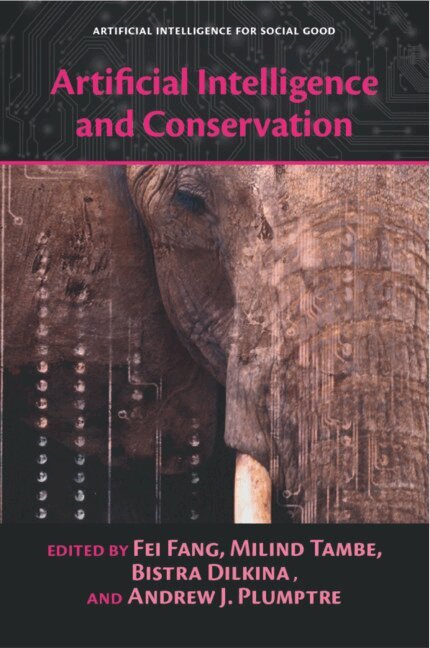
    Artificial Intelligence and Conservation

    AvFei Fang,Milind Tambe

    Inbunden, Engelska, 2019

    Del i serien Artificial Intelligence for Social Good

    1 630 kr

    Beställningsvara. Skickas inom 7-10 vardagar. Fri frakt över 249 kr.

    Beskrivning

    With the increasing public interest in artificial intelligence (AI), there is also increasing interest in learning about the benefits that AI can deliver to society. This book focuses on research advances in AI that benefit the conservation of wildlife, forests, coral reefs, rivers, and other natural resources. It presents how the joint efforts of researchers in computer science, ecology, economics, and psychology help address the goals of the United Nations' 2030 Agenda for Sustainable Development. Written at a level accessible to conservation professionals and AI researchers, the book offers both an overview of the field and an in-depth view of how AI is being used to understand patterns in wildlife poaching and enhance patrol efforts in response, covering research advances, field tests and real-world deployments. The book also features efforts in other major conservation directions, including protecting natural resources, ecosystem monitoring, and bio-invasion management through the use of game theory, machine learning, and optimization.

    Produktinformation

    • Utgivningsdatum:2019-03-28
    • Mått:157 x 235 x 18 mm
    • Vikt:490 g
    • Format:Inbunden
    • Språk:Engelska
    • Serie:Artificial Intelligence for Social Good
    • Antal sidor:246
    • Förlag:Cambridge University Press
    • ISBN:9781316512920

    Utforska kategorier

    • Miljövetenskap och miljöpolitik inom Naturvetenskap och teknik
    • Artificiell intelligens inom Data och IT
    • Tillämpad datateknik inom Data och IT

    Mer om författaren

    Fei Fang is Assistant Professor of Computer Science at Carnegie Mellon University, Pennsylvania. Her work won the Innovative Application Award at the Conference on Innovative Applications of Artificial Intelligence in 2016 and the Outstanding Paper Award in Computational Sustainability Track at the International Joint Conferences on Artificial Intelligence in 2015. Milind Tambe is Helen N. and Emmett H. Jones Professor of Engineering and Founding Co-Director of the University of Southern California Center for Artificial Intelligence in Society. He received the International Joint Conferences on Artificial Intelligence (IJCAI) John McCarthy Award, the Association for Computing Machinery's Special Interest Group on Artificial Intelligence (ACM/SIGAI) Autonomous Agents Research Award, Christopher Columbus Fellowship Foundation Homeland security award, an the Institute for Operations Research and the Management Sciences (INFORMS) Wagner prize in Operations Research and is a fellow of Association for Advanced Artificial Intelligence (AAAI) and Association of Computing Machinery ACM). Bistra Dilkina is Assistant Professor of Computer Science and Associate Director of the University of Southern California Center for Artificial Intelligence in Society. Prior to that, she was an Assistant Professor at Georgia Tech and a Co-Director of the Data Science for Social Good Atlanta program. She has published at top artificial intelligence conferences as well as journals such as Conservation Biology. Andrew J. Plumptre is Head of the Key Biodiversity Areas Secretariat, associated with the Conservation Science Group in the Zoology Department at the University of Cambridge. He previously was the Wildlife Conservation Society's senior scientist for Africa and managed a regional program of conservation in the Albertine Rift that supported conservation of some of Africa's most biodiverse sites.

    Recensioner i media

    'No question - we need to transform how we monitor, model, and ultimately manage Earth's natural resources. Artificial intelligence can accelerate that transition but requires a new community of AI inventors and conservation scientists working together. This book represents a gathering of the world's top minds in AI and conservation jointly building the future building blocks of a conservation revolution. Fascinating, future-making insights!' Lucas Joppa, Chief Environmental Officer, Microsoft

    Innehållsförteckning

    • Part I: 1. Introduction Fei Fang, Milind Tambe, Bistra Dilkina and Andrew J. Plumptre; Part II: 2. Law enforcement for wildlife conservation Andrew J. Plumptre; 3. Wildlife poaching forecasting based on ranger-collected data and evaluation through field tests Shahrzad Gholami, Benjamin Ford, Debarun Kar, Fei Fang, Andrew J. Plumptre, Milind Tambe, Margaret Driciru, Fred Wanyama, Aggrey Rwetsiba, Mustafa Nsubuga and Joshua Mabonga; 4. Optimal patrol planning against black-box attackers Haifeng Xu, Benjamin Ford, Fei Fang, Bistra Dilkina, Andrew J. Plumptre, Milind Tambe, Margaret Driciru, Fred Wanyama, Aggrey Rwetsiba, Mustafa Nsubuga and Joshua Mabonga; 5. Automatic detection of poachers and wildlife with UAVs Elizabeth Bondi, Fei Fang, Mark Hamilton, Debarun Kar, Donnabell Dmello, Venil Noronha, Jongmoo Choi, Robert Hannaford, Arvind Iyer, Lucas Joppa, Milind Tambe and Ram Nevatia; Part III: 6. Protecting coral reef ecosystems via efficient patrols Yue Yin and Bo An; 7. Simultaneous optimization of strategic and tactical planning for environmental sustainability and security Sara M. McCarthy, Milind Tambe, Christopher Kiekintveld, Meredith L. Gore and Alex Killion; 8. NECTAR Benjamin Ford, Matthew Brown, Amulya Yadav, Amandeep Singh, Arunesh Sinha, Biplav Srivastava, Christopher Kiekintveld and Milind Tambe; 9. Connecting conservation research and implementation Sean McGregor, Rachel M. Houtman, Ronald Metoyer and Thomas G. Dietterich; 10. Probabilistic inference with generating functions for animal populations Daniel Sheldon, Kevin Winner and Debora Sujono; 11. Engaging citizen scientists in data collection for conservation Yexiang Xue and Carla P. Gomes; 12. Simulator-defined Markov decision processes H. Jo Albers, Thomas G. Dietterich, Kim Hall, Majid A. Taleghan and Katherine Lee.