• Fri frakt över 249 kr
  • •
  • Snabba leveranser
  • •
  • Billiga böcker
Kundservice

Du är på sajten för privatpersoner.

Företag, bibliotek eller offentlig verksamhet?

Du handlar på classic.bokus.com, där alla dina funktioner finns intakta.
Till classic.bokus.com
Bokus logotyp. Gå till startsidan.
  • Erbjudanden
  • Nyheter
  • Student
  • Topplistor
  • Barn & ungdom
  • Bokus Play
  • E-böcker
  • Pocketböcker
  • Spel & pussel

10% rabatt på allt med kod: NYSTART10 →

Sidfot

Mina sidor

    Hjälp

    • Kundservice
    • Vanliga frågor och svar
    • Frakt och leverans
    • Retur vid ångerrätt
    • Reklamera vara
    • Betalning
    • Köpvillkor
    • Allmänna villkor
    • Information om webbplatsens tillgänglighet

    Om Bokus

    • Om oss
    • Pressrum
    • För studenter
    • För företag
    • För bibliotek och offentlig verksamhet
    • För leverantörer
    • Hållbarhet

    Populärt

    • Aktuella erbjudanden
    • Presentkort
    • Studentlitteratur
    • Nya böcker
    • Topplistor
    • Signerade böcker
    • Engelska böcker

    Inspiration

    • Boktips
    • BookTok
    • Populära bokserier
    • Barnbokskaraktärer
    • Populära författare
    Logotyp för Bokus
    Följ oss på Facebook (extern länk)Följ oss på Instagram (extern länk)Följ oss på YouTube (extern länk)Följ oss på TikTok (extern länk)
    bokus @ CookiesAnpassa cookiesIntegritetspolicyKöpvillkor
    Till Citymail hemsida (extern länk)Till Budbee hemsida (extern länk)Till Postnord hemsida (extern länk)Till Schenker hemsida (extern länk)Till Early Bird hemsida (extern länk)Till Walleys hemsida (extern länk)
    1. Ekonomi och Ledarskap
    2. Nationalekonomi
    3. Ekonomisk politik

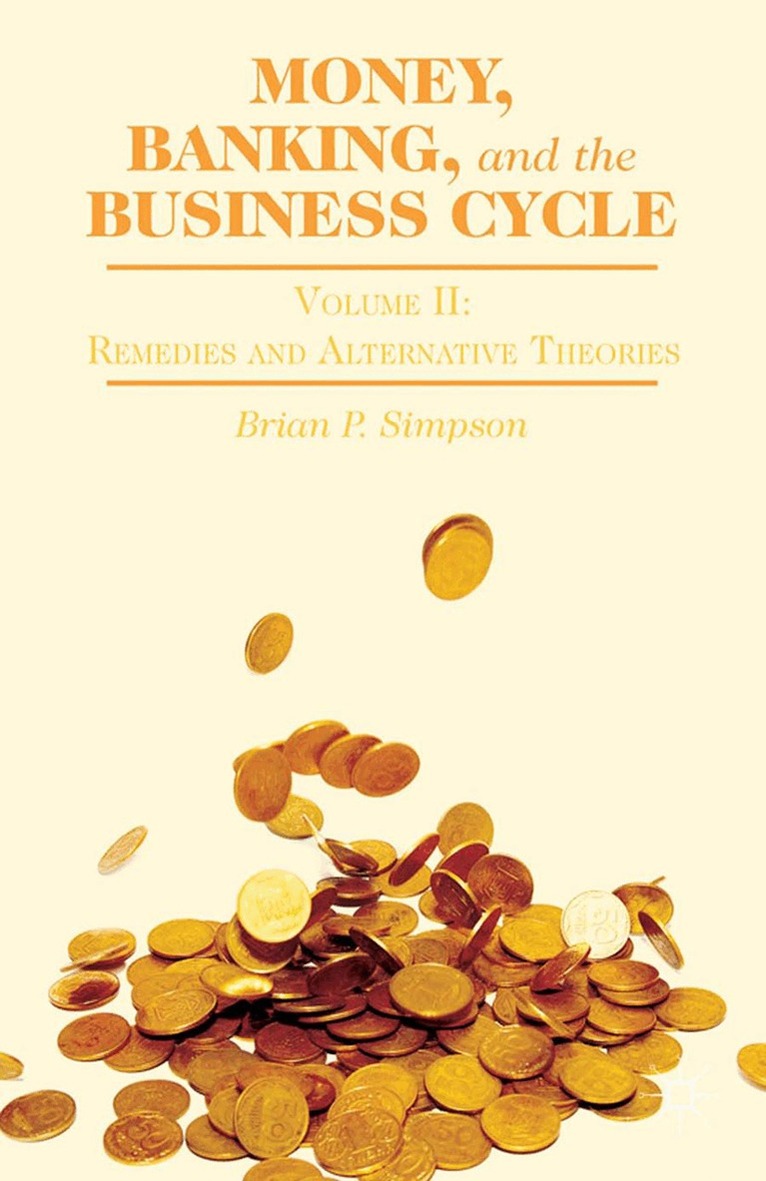
    Money, Banking, and the Business Cycle

    Volume II: Remedies and Alternative Theories

    AvB. Simpson

    Häftad, Engelska, 2014

    1 086 kr

    Beställningsvara. Skickas inom 10-15 vardagar. Fri frakt över 249 kr.

    Fler format och utgåvor

    E-bok

    1 501 kr

    Inbunden

    1 086 kr

    Beskrivning

    The business cycle is a complex phenomenon. On the surface, it involves a multitude of mechanisms, such as oscillations in interest rates, prices, wages, unemployment, output, and spending. But a deeper understanding requires a unifying theory to make these various parts whole. Money, Banking, and the Business Cycle provides a comprehensive framework for analyzing these mechanisms, and offers a robust prescription for reducing financial instability over the long-term. Volume II refutes Keynesian and real business cycle theories and provides policy prescriptions to virtually eliminate the cycle. Simpson offers a detailed analysis of several historical monetary systems around the world and shows the causes and effects of fiat money and fractional-reserve banking, as well as a 100-percent reserve gold standard.

    Produktinformation

    • Utgivningsdatum:2014-07-02
    • Mått:155 x 235 x 17 mm
    • Vikt:449 g
    • Format:Häftad
    • Språk:Engelska
    • Antal sidor:306
    • Upplaga:2014
    • Förlag:Palgrave Macmillan
    • ISBN:9781349464937

    Utforska kategorier

    • Ekonomisk politik inom Ekonomi och Ledarskap
    • Finansiering inom Ekonomi och Ledarskap
    • Sociologi inom Samhälle och politik

    Mer om författaren

    Brian P. Simpson is Professor and Economist at National University, USA.

    Recensioner i media

    "This two-volume work updates and extends the business cycle analysis inaugurated by Mises and Hayek. Particularly noteworthy are its incorporation of an aggregate economic accounting framework beyond GDP, its critique of so-called real business cycle theory, and its support of a 100-percent-reserve gold standard, which, it argues, would end the business cycle and, in the absence of government intervention, would come into being simply on the basis of free competition, without being required by law." -George Reisman, author of Capitalism: A Treatise on Economics and Pepperdine University Professor Emeritus of Economics "Brian Simpson's two volumes titled Money, Banking, and the Business Cycle are thorough yet plain language discussions of the causes and consequences of business cycles in modern economies. He weaves basic economic theory with historical analysis of various episodes, and demonstrates that the cyclical fluctuations that are identified with macroeconomic volatility are a consequence not of the inherent instability of capitalism, but the manipulation of money and credit by the government. These volumes are highly recommended to anyone who is trying to think through the question of macroeconomic volatility, and the recent economic history of the Great Recession in particular." -Peter Boettke, University Professor of Economics & Philosophy, George Mason University "Brian Simpson's "Money, Banking and the Business Cycle Volume 1 - Integrating Theory and Practice" truly breaks new ground. Other economists have attempted to explain how fiat money causes economy-wide business cycles, but none have fully validated their work because their data have been inadequate. Professor Simpson succeeds through analysis of the right data, thus bridging the chronic gap between theory and practice that has caused many to be skeptical of Austrian Business Cycle Theory. In a post-crash "QE World," dominated by money-printing, this book could not be more timely. In my many years as an investor, this is the first book I have read that provides a practical framework for understanding not only where the business cycle has been, but where it is going. Professional investors, practicing economists, free-market thinkers - anyone who wants to understand the crucial role of money in the business cycle - should read this book." -Walter (Jim) Brown, CFA, MBA, Investments Group Director, Brandes Investment Partners "Brian Simpson offers a lucid and illuminating explanation of why economies undergo periodic booms and crashes. He demonstrates how governments by increasing the money supply and artificially reducing the money supply stimulate excessive investment inevitably eventuating in contractions, and shows how governmental interventions prescribed by Keynes and others only prolong economic downturns. He makes a compelling case that the only solution to the 'business cycle' is a free market in money and banking." -Fred D. Miller, Jr., Research Professor, Center for the Philosophy of Freedom, University of Arizona "Brian Simpson's important new book, Money, Banking, and the Business Cycle, theoretically and empirically supports the perspective of Austrian Economics with respect to these topics. His clearly written, comprehensive, and complete treatise provides a convincing conceptual framework for analyzing and explaining the causes and effects of changes in interest rates, wages, prices, spending, output, and unemployment rates. The author successfully integrates history with his theoretical model ... and offers policy prescriptions that would reduce, and perhaps eliminate, monetary-induced financial instability in the forms of recessions, depressions, and other types of financial crises. Along the way, Professor Simpson provides new insights to familiar topics and presents and refutes a wide range of well-known and lesser-known theories. This precise and rigorous book will be a welcome addition to courses in Money and Banking and The Business Cycle." -Edward W. Younkins, Wheeling Jesuit University, Professor of Accountancy and Business Administration Director of Graduate Business Programs, Executive Director of the Institute for the Study of Capitalism and Morality

    Innehållsförteckning

    • Introduction PART I: REFUTATION OF ALTERNATIVE EXPLANATIONS OF THE BUSINESS CYCLE 1. Underconsumption and Overproduction Theories of the Business Cycle 2. Keynesian Business Cycle Theory, Part Deux: Inflexible Prices and Wages 3. Real Business Cycle Theory PART II: TO CURE THE BUSINESS CYCLE 4. Government Interference, Fiat Money, and Fractional-Reserve Banking 5. The Characteristics and Effects of a Free Market in Money and Banking 6. The Significance of Some of the Historically Freer Banking Periods 7. Gold and 100-Percent Reserves 8. How to Transition to a Free Market in Money and Banking Epilogue