• Fri frakt över 249 kr
  • •
  • Snabba leveranser
  • •
  • Billiga böcker
Kundservice

Du är på sajten för privatpersoner.

Företag, bibliotek eller offentlig verksamhet?

Du handlar på classic.bokus.com, där alla dina funktioner finns intakta.
Till classic.bokus.com
Bokus logotyp. Gå till startsidan.
  • Erbjudanden
  • Nyheter
  • Student
  • Topplistor
  • Barn & ungdom
  • Bokus Play
  • E-böcker
  • Pocketböcker
  • Spel & pussel

Må bättre, för mindre! Upp till 50% rabatt på hälsoböcker

Sidfot

Mina sidor

    Hjälp

    • Kundservice
    • Vanliga frågor och svar
    • Frakt och leverans
    • Retur vid ångerrätt
    • Reklamera vara
    • Betalning
    • Köpvillkor
    • Allmänna villkor
    • Information om webbplatsens tillgänglighet

    Om Bokus

    • Om oss
    • Pressrum
    • För studenter
    • För företag
    • För bibliotek och offentlig verksamhet
    • För leverantörer
    • Hållbarhet

    Populärt

    • Aktuella erbjudanden
    • Presentkort
    • Studentlitteratur
    • Nya böcker
    • Topplistor
    • Signerade böcker
    • Engelska böcker

    Inspiration

    • Boktips
    • BookTok
    • Populära bokserier
    • Barnbokskaraktärer
    • Populära författare
    Logotyp för Bokus
    Följ oss på Facebook (extern länk)Följ oss på Instagram (extern länk)Följ oss på YouTube (extern länk)Följ oss på TikTok (extern länk)
    bokus @ CookiesAnpassa cookiesIntegritetspolicyKöpvillkor
    Till Citymail hemsida (extern länk)Till Budbee hemsida (extern länk)Till Postnord hemsida (extern länk)Till Schenker hemsida (extern länk)Till Early Bird hemsida (extern länk)Till Walleys hemsida (extern länk)
    1. Samhälle och politik
    2. Sociologi och antropologi
    3. Antropologi

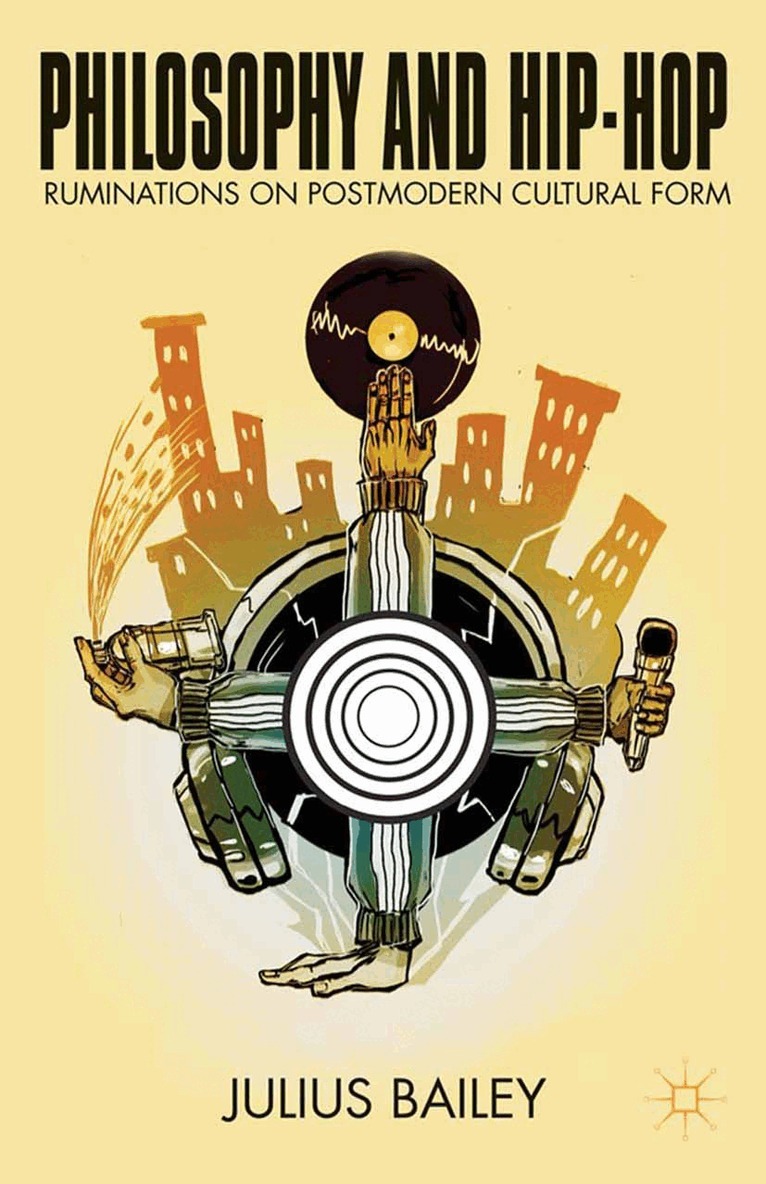
    Philosophy and Hip-Hop

    Ruminations on Postmodern Cultural Form

    AvJ. Bailey

    Häftad, Engelska, 2015

    601 kr

    Beställningsvara. Skickas inom 10-15 vardagar. Fri frakt över 249 kr.

    Fler format och utgåvor

    Inbunden

    547 kr

    E-bok

    755 kr

    Beskrivning

    Philosophy and Hip-Hop: Ruminations on Postmodern Cultural Form opens up the philosophical life force that informs the construction of Hip-hop by turning the gaze of the philosopher upon those blind spots that exist within existing scholarship. Traditional Departments of Philosophy will find this book a solid companion in Contemporary Philosophy or Aesthetic Theory. Inside these pages is a project that parallels the themes of existential angst, corporate elitism, social consciousness, male privilege and masculinity. This book illustrates the abundance of philosophical meaning in the textual and graphic elements of Hip-hop, and thus places Hip-hop within the philosophical canon.

    Produktinformation

    • Utgivningsdatum:2015-12-18
    • Mått:140 x 216 x 17 mm
    • Vikt:286 g
    • Format:Häftad
    • Språk:Engelska
    • Antal sidor:200
    • Upplaga:15001
    • Förlag:Palgrave Macmillan
    • ISBN:9781349491995

    Utforska kategorier

    • Antropologi inom Samhälle och politik
    • Filosofiska discipliner inom Filosofi och religion

    Mer om författaren

    Julius Bailey is Associate Professor of Philosophy at Wittenberg University, USA. He is a philosopher, cultural critic, social theorist, and diversity lecturer. He is the editor of Jay-Z: Essays on Hip Hop's Philosopher King (2011), and the author of The Cultural Impact of Kanye West (2014), as well as numerous articles on hip-hop pedagogy and social justice issues. He can be found at www.juliusbailey.com.

    Recensioner i media

    Recommendations for Philosophy as Hip Hop: Ruminations on a Post Modern Cultural Form. By Tommy J. Curry, Associate Professor, Department of Philosophy, Affiliate Professor, Program in Africana Studies, Texas A&M University Report: Overall, this version of the book is much better than the initial manuscript reviewed. Philosophy as Hip Hop embarks on a journey to show that Hip-Hop is an aesthetic engagement with the world that gives individuals various philosophical techniques to engage the obstacles and phenomenon before them. In the prologue, Bailey argues 'From an individual perspective Hip-Hop creates a space of relative freedom: freedom from the weight of a modern life that is demanding and exhausting. The importance of noting the relative in this statement cannot be overlooked. Hip-Hop is not a space of utopia, but a community that reconciles and embraces those who need an abode for their own intimate desires.' Unlike the previous version, this book is clearer in its purpose, and writing. This is a strength of this version of the text over the last, unfortunately however, the manuscript as a whole suffers from a sort of bipolarity at times reading as a summation of traditional white philosophical canons rather than a serious scholarly engagement with Hip-Hop. Bailey engages in a philosophical exploration of Hip-Hop aiming to show that Hip-Hop is in fact philosophical. This manuscript covers some of the same ground articulated in Hip Hop and Philosophy: Rhyme to Reason by Tommie Shelby and Derrick Darby. Bailey's text will further articulate such claims in a full monograph and most likely be the first or most recent text to do so in the discipline of philosophy. However, it must be noted that such projects have a long legacy in cultural studies and Black studies. Greg Thomas's Hip-Hop Revolution in the Flesh: Power, Knowledge, and Pleasure in Lil' Kim's Lyricism (2009), and Jared Ball's I Mix What I Like: A Mixtape Manifesto (2011) immediately come to mind, as they have been reviewed extensively, but I cannot find any engagement with these texts in Bailey's work. While Bailey has done some work in section two to introduce and cover the work of Ebony Utley's On Rap and Religion some of the more recent works like those mentioned above are still absent from consideration. As such, I would recommend this work for publication with some revisions. My specific section comments are attached, but I would like to make several general comments. I. This work will certainly find readership in philosophy. Unlike fields like media studies, Black studies, etc. philosophy has been the last on board to seriously investigate the work of Black artists as serious political and social commentary. The last major work on Hip-Hop in philosophy was Derrick Darby and Tommie Shelby's Hip Hop and Philosophy from 2005. 2. The success of this book will largely depend on who it is marketed towards. Bailey makes some interesting points and insights that could in fact convey to classical continental and American philosophers the importance of studying and understanding Hip Hop both pedagogically and as a post-modern aesthetic. However, it is important to understand the limitations of such a strategy in field like Black studies, cultural studies, or more radical art audiences. 3. The work seems to have two distinct tones from section one to section two. The transition between sections as well as between ideas within and between chapters needs attention. 4. This work seems to be more appropriately divided into Section 1: Existential Communalism/Pedagogy and then Section 2: Post Modern Cultural Art Form. As stated I am not clear about the purpose of distinction in the titles. 5. Bailey does make a worthwhile contribution to Hip Hop Studies in the discipline of philosophy, so it is a publishable manuscript in that regard. However, Bailey should be pushed to account for the scholarship and work done in other fields as well to make this book stand the test of time. Imani Perry's Prophets of the Hood have lots of overlap with his themes throughout but are not mentioned once in my reading. There needs to be more of a deliberate engagement with the literature of the field.

    Innehållsförteckning

    • Introduction1. Of the Beauty and Wisdom of Hip-Hop 2. Firebrands and Battle Plans: Jean-Paul Sartre, Friedrich Nietzsche and G.W.F. Hegel3. Conscious Hip-hop vs The Culture Industry4. A Philosopher's glance at Hip-hop Pedagogy: Facing the Realities of the Socratic Classroom 5. Lost in the City and Lost in the Self: Sin and Solipsism in Hip Hop's Dystopia; St. Augustine, Toni Morrison, Paul Tillich 6. Hip Hop and International Voices of Revolution: Brazil, Cuba, Ghana and Egypt 7. The Artist and the Image: Ervin Goffman; Marshall McLuhan; Roland Barthes8. The Catastrophe of Success: Marshall McLuhan, Gilles Delueze and Felix Guittari