• Fri frakt över 249 kr
  • •
  • Snabba leveranser
  • •
  • Billiga böcker
Kundservice

Du är på sajten för privatpersoner.

Företag, bibliotek eller offentlig verksamhet?

Du handlar på classic.bokus.com, där alla dina funktioner finns intakta.
Till classic.bokus.com
Bokus logotyp. Gå till startsidan.
  • Erbjudanden
  • Nyheter
  • Student
  • Topplistor
  • Barn & ungdom
  • Bokus Play
  • E-böcker
  • Pocketböcker
  • Spel & pussel

10% rabatt på allt med kod NYSTART10 →

Sidfot

Mina sidor

    Hjälp

    • Kundservice
    • Vanliga frågor och svar
    • Frakt och leverans
    • Retur vid ångerrätt
    • Reklamera vara
    • Betalning
    • Köpvillkor
    • Allmänna villkor
    • Information om webbplatsens tillgänglighet

    Om Bokus

    • Om oss
    • Pressrum
    • För studenter
    • För företag
    • För bibliotek och offentlig verksamhet
    • För leverantörer
    • Hållbarhet

    Populärt

    • Aktuella erbjudanden
    • Presentkort
    • Studentlitteratur
    • Nya böcker
    • Topplistor
    • Signerade böcker
    • Engelska böcker

    Inspiration

    • Boktips
    • BookTok
    • Populära bokserier
    • Barnbokskaraktärer
    • Populära författare
    Logotyp för Bokus
    Följ oss på Facebook (extern länk)Följ oss på Instagram (extern länk)Följ oss på YouTube (extern länk)Följ oss på TikTok (extern länk)
    bokus @ CookiesAnpassa cookiesIntegritetspolicyKöpvillkor
    Till Citymail hemsida (extern länk)Till Budbee hemsida (extern länk)Till Postnord hemsida (extern länk)Till Schenker hemsida (extern länk)Till Early Bird hemsida (extern länk)Till Walleys hemsida (extern länk)
    1. Filosofi och religion
    2. Filosofi
    3. Filosofiska discipliner

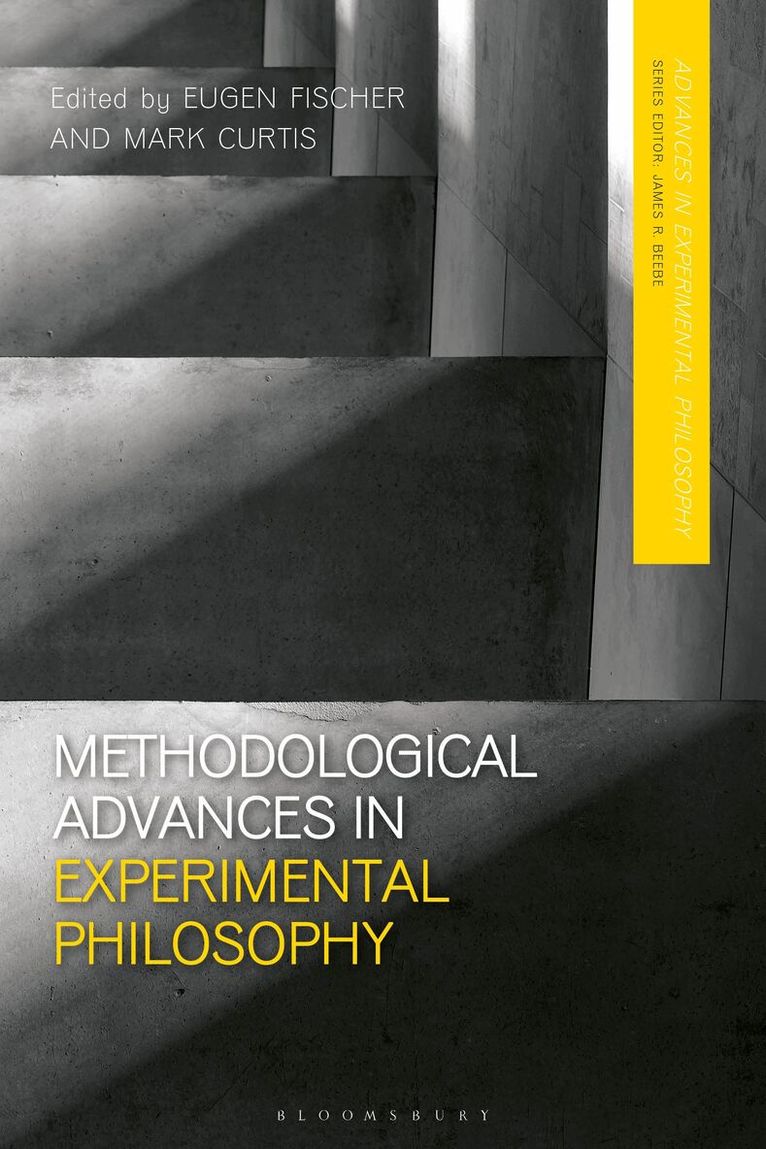
    Methodological Advances in Experimental Philosophy

    AvEugen Fischer,Mark Curtis

    Häftad, Engelska, 2020

    Del i serien Advances in Experimental Philosophy

    479 kr

    Beställningsvara. Skickas inom 10-15 vardagar. Fri frakt över 249 kr.

    Beskrivning

    Until recently, experimental philosophy has been associated with the questionnaire-based study of intuitions. This volume brings together established and emerging research leaders from several areas of experimental philosophy to explore how new empirical methods from the behavioural sciences and digital humanities can contribute to philosophical debates.Each chapter offers an accessible overview of these exciting innovations, demonstrating their application in a key area of philosophy and discussing their strengths and limitations. Methods covered include eye tracking, virtual reality technology, neuroimaging, statistical learning and experimental economics as well as corpus linguistics, visualisation techniques and data and text mining. The volume explores their use in moral philosophy and moral psychology, epistemology, philosophy of science, metaphysics, philosophy of language, philosophy of mind and the history of ideas.Methodological Advances in Experimental Philosophy is essential reading for undergraduates, graduate students and researchers working in experimental philosophy.

    Produktinformation

    • Utgivningsdatum:2020-09-17
    • Mått:154 x 234 x 22 mm
    • Vikt:540 g
    • Format:Häftad
    • Språk:Engelska
    • Serie:Advances in Experimental Philosophy
    • Antal sidor:352
    • Förlag:Bloomsbury Publishing PLC
    • ISBN:9781350190399

    Utforska kategorier

    • Filosofiska discipliner inom Filosofi och religion
    • Naturvetenskapens filosofi inom Naturvetenskap och teknik

    Mer om författaren

    Eugen Fischer is Reader in Philosophy at the University of East Anglia. He is the author of Linguistic Creativity, Philosophical Delusion and its Therapy, over forty papers, and three co-edited volumes including Experimental Philosophy, Rationalism and Naturalism: Rethinking Philosophical Method.Mark Curtis is Honorary Research Fellow at the School of Politics, Philosophy, Language and Communication Studies at the University of East Anglia, UK.

    Recensioner i media

    Do you want to know the latest and the best in experimental philosophy? Then, read Eugen Fischer and Mark Curtis’s agenda-setting Methodological Advances in Experimental Philosophy. By exploring the use of new, sophisticated methodologies, this collection dramatically extends the range of philosophical questions that can be addressed by empirical means and paves the way for the future of experimental philosophy, the most dynamic and important area of contemporary philosophy.

    Innehållsförteckning

    • Introduction, Eugen Fischer (University of East Anglia, UK) and Mark Curtis (University of East Anglia, UK) Part I: Behavioural experiments beyond the questionnaire 1. Experimental philosophy and statistical learning, Shaun Nichols (University of Arizona, USA)2. Eyes as Windows to Minds: Psycholinguistics for Experimental Philosophy, Eugen Fischer (University of East Anglia, UK) and Paul E. Engelhardt (University of East Anglia, UK)3. Judge no Evil, see no Evil: do people's moral choices influence to whom they visually attend?, Jennifer Cole Wright (College of Charleston, USA), Evan Reinhold (College of Charleston), Annie Galizio (Utah State University, USA) and Michelle DiBartolo (Johns Hopkins University, USA)4. Using fMRI in Experimental Philosophy: Exploring the Prospects, Rodrigo Diaz (University of Bern, Switzerland)5. Using VR Technologies to investigate the Flexibility of Human Self-conception, Adrian J. T. Alsmith (University of Copenhagen, Denmark) and Matthew R. Longo (Birkbeck, University of London, UK)6. Experimental Economics for Philosophers, Justin Bruner (Australian National University, Australia, Cailin O’Connor (University of California, Irvine, USA) and Hannah Rubin (University of Notre Dame, South Bend, Indiana)Part II: Digital X-Phi, DC: Introducing Digital and Computational Methods7. Causation Attributions and Corpus Analysis, Justin Sytsma (Victoria University of Wellington, New Zealand), Roland Bluhm, Pascale Willemsen (Ruhr-Universität Bochum, Germany), and Kevin Reuter (University of Bern, Switzerland)8. Using Corpus Linguistics to investigate Mathematical Explanation, Juan Pablo Mejia-Ramos (Rutgers University, USA), Lara Alcock (University of Loughborough, UK), Kristen Lew (Texas State University, USA), Paolo Rago, Chris Sangwin (University of Edinburgh, UK) and Matthew Inglis (University of Loughborough, UK)9. Natural Language Processing and Network Visualization for Philosophers, Andrew Higgins (Illinois State University, USA) and Mark Alfano (Delft University of Technology, the Netherlands and Australian Catholic University, Australia)10. History of Philosophy in Ones and Zeros, Arianna Betti (University of Amsterdam, Netherlands), Yvette Oortwijn (University of Amsterdam, Netherlands), Caspar Treijtel (University of Amsterdam, Netherlands) and Hein van den Berg (University of Amsterdam, Netherlands)Index