• Fri frakt över 249 kr
  • •
  • Snabba leveranser
  • •
  • Billiga böcker
Kundservice

Du är på sajten för privatpersoner.

Företag, bibliotek eller offentlig verksamhet?

Du handlar på classic.bokus.com, där alla dina funktioner finns intakta.
Till classic.bokus.com
Bokus logotyp. Gå till startsidan.
  • Erbjudanden
  • Nyheter
  • Student
  • Topplistor
  • Barn & ungdom
  • Bokus Play
  • E-böcker
  • Pocketböcker
  • Spel & pussel

10% rabatt på allt med kod: NYSTART10 →

Sidfot

Mina sidor

    Hjälp

    • Kundservice
    • Vanliga frågor och svar
    • Frakt och leverans
    • Retur vid ångerrätt
    • Reklamera vara
    • Betalning
    • Köpvillkor
    • Allmänna villkor
    • Information om webbplatsens tillgänglighet

    Om Bokus

    • Om oss
    • Pressrum
    • För studenter
    • För företag
    • För bibliotek och offentlig verksamhet
    • För leverantörer
    • Hållbarhet

    Populärt

    • Aktuella erbjudanden
    • Presentkort
    • Studentlitteratur
    • Nya böcker
    • Topplistor
    • Signerade böcker
    • Engelska böcker

    Inspiration

    • Boktips
    • BookTok
    • Populära bokserier
    • Barnbokskaraktärer
    • Populära författare
    Logotyp för Bokus
    Följ oss på Facebook (extern länk)Följ oss på Instagram (extern länk)Följ oss på YouTube (extern länk)Följ oss på TikTok (extern länk)
    bokus @ CookiesAnpassa cookiesIntegritetspolicyKöpvillkor
    Till Citymail hemsida (extern länk)Till Budbee hemsida (extern länk)Till Postnord hemsida (extern länk)Till Schenker hemsida (extern länk)Till Early Bird hemsida (extern länk)Till Walleys hemsida (extern länk)
    1. Psykologi och pedagogik
    2. Pedagogik
    3. Material och digital teknik i undervisningen

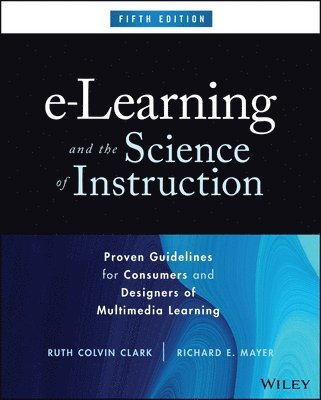
    e-Learning and the Science of Instruction

    Proven Guidelines for Consumers and Designers of Multimedia Learning

    AvRuth C. Clark,Richard E. Mayer

    Inbunden, Engelska, 2023

    783 kr

    Beställningsvara. Skickas inom 5-8 vardagar. Fri frakt över 249 kr.

    Beskrivning

    Improve the quality of your eLearning materials with evidence-based guidelinese-Learning and the Science of Instruction, 5th Edition: Proven Guidelines for Consumers and Designers of Multimedia Learning helps practitioners apply evidence-based principles to the design, development, and selection of digital instructional and training materials. This book goes beyond instructional design advice, providing actionable ideas and multimedia examples based on recent research findings. You will learn how to put evidence into practice, with proven e-learning design and development guidelines.During the pandemic, e-learning assumed a much greater role as an instructional delivery medium, especially with virtual classrooms using tools such as Zoom and MS Teams. The combination of new technological functionality, increases in a remote workforce, and new research findings have led to gaps regarding how to leverage digital learning most effectively. This book explains what instructional designers, multimedia developers, and e-learning consumers need to know to maximize the potential of their e-learning resources. In addition to guidelines regarding use of graphics, audio, text, engagement techniques and collaborative online learning, this new edition covers video-based instruction, digital games, and immersive virtual reality-, showing you when and how to utilize these tools effectively. Discover the latest research findings about how people learn—and how they learn best onlineBuild instructional materials, including video instruction, digital games, and immersive VR experiences, that empower learners to succeedGet ideas and inspiration for engaging learners in synchronous and asynchronous environmentsSee concrete examples of how research evidence in instructional design can be applied in practiceApply evidence regarding how best to leverage collaborative online learninge-Learning and the Science of Instruction is a valuable resource for students and practitioners who need to design, develop, and select effective eLearning and virtual training materials.

    Produktinformation

    • Utgivningsdatum:2023-11-30
    • Mått:185 x 234 x 38 mm
    • Vikt:907 g
    • Format:Inbunden
    • Språk:Engelska
    • Antal sidor:512
    • Upplaga:5
    • Förlag:John Wiley & Sons Inc
    • ISBN:9781394177370

    Utforska kategorier

    • Material och digital teknik i undervisningen inom Psykologi och pedagogik
    • Företagsekonomi inom Ekonomi och Ledarskap
    • Karriärplanering inom Ekonomi och Ledarskap

    Mer om författaren

    Richard E. Mayer, Ph.D., is a Distinguished Professor of Psychological and Brain Sciences at the University of California, Santa Barbara. His research focuses on the intersection of cognition, instruction, and technology. He is the author of more than 600 publications, including 40 books, and has been recognized as the most productive educational psychologist in the world. Ruth Colvin Clark, Ed.D., is the President and Principal Consultant of Clark Training & Consulting. She is a specialist in evidence-based training methods and bridging the gap between academic research and practitioner application.

    Innehållsförteckning

    • Preface xvPart I Foundations of e-Learning and the Science of Instruction 11 e-Learning: Promise and Pitfalls 3What Is e-Learning? 4The Evolution of e-Learning for Training 7Is e-Learning Better? 9The Promise of e-Learning 10The Pitfalls of e-Learning 13e-Learning Architectures 14Twenty Years Later 152 How People Learn from e-Courses 19How Do People Learn? 21Guiding the Learner’s Cognitive Processing During Learning 25Core Goals for Instructional Design in e-Learning 27How e-Lessons Affect Learning 31Summary of Learning Processes 34What We Don’t Know About Learning 353 Evidence-Based Practice 39What Is Evidence-Based Practice? 40Rationale for Evidence-Based Practice 41Three Approaches to Research on Instructional Effectiveness 42What to Look for in Experimental Comparisons 43What Are Boundary Conditions? 49What Is a Meta-Analysis? 49Limits of Experimental Research 50Where Can You Find Relevant Research? 50The Evolution of Evidence-Based Practice 51What We Don’t Know About Evidence-Based Practice 51Part II How to Leverage Visuals and Words in e-Learning 554 Applying the Multimedia Principle: Use Words and Graphics Rather than Words Alone 57Do Visuals Make a Difference? 59Multimedia Principle: Include Both Words and Graphics 60Some Ways to Use Graphics to Promote Learning 63Psychological Reasons for the Multimedia Principle 66Evidence for Using Words and Pictures 67When to Use Animations 72How to Optimize Learning from Graphics 73What We Don’t Know About Visuals 745 Applying the Contiguity Principle: Align Words to Corresponding Graphics 81Spatial Contiguity Principle: Place Printed Words near Corresponding Graphics 83Violations of Spatial Contiguity 85Psychological Reasons for the Spatial Contiguity Principle 90Evidence for the Spatial Contiguity Principle 90Temporal Contiguity Principle: Synchronize Spoken Words with Corresponding Graphics 94Psychological Reasons for the Temporal Contiguity Principle 96Evidence for the Temporal Contiguity Principle 97What We Don’t Know About Contiguity 986 Applying the Signaling Principle: Use Verbal and Visual Cues to Direct Attention 103What Is Signaling? 104How Does Signaling Work? 105Evidence for the Benefits of Signaling 106Signaling: The Bottom Line 110What We Don’t Know About Signaling 1107 Applying the Modality Principle: Present Words as Audio Narration Rather Than On-Screen Text 115Modality Principle: Present Words as Speech Rather Than On-Screen Text 117Psychological Reasons for the Modality Principle 119Evidence for Using Spoken Rather Than Printed Text 121When Audio Is Not Effective: Boundary Conditions for the Modality Principle 123What We Don’t Know About Modality 1278 When to Add Text to Audio Narration: Applying the Redundancy Principle 131What Is the Redundancy Principle? 133Psychological Reasons for the Redundancy Principle 133Evidence for Omitting Redundant On-Screen Text 137Add On-Screen Text to Narration in Special Situations 138The Bottom Line 142What We Don’t Know About Redundancy 1429 Applying the Coherence Principle: Adding Extra Material Can Hurt Learning 149Principle 1: Avoid e-Lessons with Extraneous Words 152Principle 2: Avoid e-Lessons with Extraneous Graphics 156Principle 3: Avoid e-Lessons with Extraneous Audio 165What We Don’t Know About Coherence 166Part III How to Promote Skill Building in e-Learning 17110 Engagement in e-Learning: Activities for Promoting Generative Learning 173What Is Engagement? 175Engagement and Generative Processing 176Behavioral Versus Psychological Engagement 177When Behavioral Engagement Impedes Learning 178Three Engagement Activities That Can Promote Generative Processing 180The Bottom Line to Engagement in e-Learning 185What We Don’t Know About Generative Learning 18611 Leveraging Examples in e-Learning 191What Is Example-Based Instruction? 192The Psychology of Example-Based Instruction 195Evidence for the Benefits of Example-Based Instruction 196How to Optimize the Benefits of Example-Based Instruction 197What We Don’t Know About Worked Examples 20812 Does Practice Make Perfect? 213What Is Practice in e-Learning? 215Is Practice a Good Investment? 217Principle 1: Add Sufficient Practice Interactions to Achieve the Objective 219Principle 2: Make Sure Practice Mirrors the Job 221Principle 3: Provide Effective Feedback on Practice Performance 221Principle 4: Distribute and Mix Practice Among Learning Events 227Principle 5: Arrange Practice That Increases in Challenge as Learners Progress 229Principle 6: Provide Scaffolding to Support Guided Practice When Needed 229Principle 7: Apply Multimedia Principles in Designing Feedback 231What We Don’t Know About Practice 232Part IV How to Organize Content in e-Learning 23513 Organizing Instruction: Applying the Segmenting and Pretraining Principles 237What Is the Segmenting Principle? 239What Is the Pretraining Principle? 244Psychological Reasons for the Pretraining Principle 248Managing Essential Overload 249What We Don’t Know About Segmenting and Pretraining 25014 Who’s in Control?: Guidelines for e-Learning Navigation 255Learner Control Versus Program Control 257Do Learners Make Good Instructional Decisions? 260The Psychology of Learner Decisions 263Four Principles for Learner Control in e-Learning 264The Bottom Line 271What We Don’t Know About Learner Control 271Part V How to Leverage Social Cues in e-Learning 27515 Applying the Personalization Principle: Use Conversational Style, Polite Wording, Friendly Voice, On-Screen Agents, and Social Presence in e-Learning 277Personalization Principle 1: Use Conversational Rather Than Formal Style 280Personalization Principle 2: Use Polite Wording 285Personalization Principle 3: Use a Friendly Human Voice Quality for Narrations 286Can On-Screen Agents Promote Learning in Asynchronous e-Learning? 287How Can Instructors in Video Lessons Leverage Personalization? 293What We Don’t Know About Personalization 29516 Online Collaborative Learning 299What Is Collaborative Learning? 301The Psychology of Collaborative Learning 303What Is Computer-Supported Collaborative Learning (CSCL)? 304Principle 1: Design Tasks and Team Assignments to Foster Interdependence 307Principle 2: Optimize Group Size, Prior Knowledge, and Collaboration Experience 309Principle 3: Consider Tradeoffs Between Synchronous and Asynchronous Collaboration 310Principle 4: Maximize Social Presence in Online Collaborative Environments 312Principle 5: Use Scripts to Optimize Team Outcomes 313What We Don’t Know About Online Collaborative Learning 316Part VI Special Applications of e-Learning 31917 e-Learning to Build Thinking Skills 321What Are Thinking Skills? 323What to Teach: Focused Target Skills Versus Improving the Mind in General 325Where to Teach: Domain-General Versus Domain-Specific Thinking Skills 325How to Teach: Expert Modeling with Learner Practice Versus Direct Instruction 326Can Thinking Skills Be Trained? 326Principle 1: Build Explicit Instruction to Teach Specific Job-Relevant Thinking Skills 328Principle 2: Incorporate Online Simulations of Authentic Work Scenarios 332Principle 3: Identify Job-Specific Thinking Processes 335Teaching Thinking Skills: The Bottom Line 336What We Don’t Know About Teaching Thinking Skills 33618 Designing Effective Instructional Video 341The Challenge of Instructional Video 343Historical Foundations of Instructional Video 343Uses of Instructional Video 343Principle 1: Record a Demonstration Video from a First-Person Perspective 345Principle 2: Have the Instructor Draw on the Board While Lecturing 346Principle 3: Embed Generative Activities During Breaks in the Video 347Principle 4: Add Subtitles for Learning in a Second Language 348Principle 5: Have the Instructor Exhibit Positive Voice and Gestures 349Principle 6: Have the Instructor Use Pointing and Eye Gaze to Direct Attention 350Principle 7: Avoid Overuse of Talking Heads or Static Instructor Images 351Principle 8: Apply Multimedia Design Principles 352What We Don’t Know About Instructional Video 35319 Learning with Computer Games 357Do Games Have a Place in the Serious Business of Training? 359Which Features Improve a Game’s Effectiveness? 359What Are the Cognitive Consequences of Playing Off-the-Shelf Computer Games? 365Are Games More Effective Than Conventional Media? 368What We Don’t Know About Learning with Computer Games 37520 Immersive Virtual Reality for Instruction 379The Promise and Pitfalls of Learning in Immersive Virtual Reality 381What Is Immersive Virtual Reality? 382Three Levels of Immersion 383Is Immersive Virtual Reality Better for Learning Than Traditional Media? 383When to Use Immersive Virtual Reality Learning Environments 386How to Use Immersive Virtual Reality Training Environments 386What We Don’t Know About Immersive Virtual Reality 38921 Applying the Multimedia Guidelines 395How Strong Is the Evidence for the Multimedia Principles? 395e-Learning Guidelines Checklists 400Trends in Multimedia Instructional Design Research 404The Future of Multimedia Instructional Design Research 405Conclusion 407Glossary 409References 429Acknowledgments 459About the Authors 461Author Index 463Subject Index 473