• Fri frakt över 249 kr
  • •
  • Snabba leveranser
  • •
  • Billiga böcker
Kundservice

Du är på sajten för privatpersoner.

Företag, bibliotek eller offentlig verksamhet?

Du handlar på classic.bokus.com, där alla dina funktioner finns intakta.
Till classic.bokus.com
Bokus logotyp. Gå till startsidan.
  • Erbjudanden
  • Nyheter
  • Student
  • Topplistor
  • Barn & ungdom
  • Bokus Play
  • E-böcker
  • Pocketböcker
  • Spel & pussel

10% rabatt på allt med kod NYSTART10 →

Sidfot

Mina sidor

    Hjälp

    • Kundservice
    • Vanliga frågor och svar
    • Frakt och leverans
    • Retur vid ångerrätt
    • Reklamera vara
    • Betalning
    • Köpvillkor
    • Allmänna villkor
    • Information om webbplatsens tillgänglighet

    Om Bokus

    • Om oss
    • Pressrum
    • För studenter
    • För företag
    • För bibliotek och offentlig verksamhet
    • För leverantörer
    • Hållbarhet

    Populärt

    • Aktuella erbjudanden
    • Presentkort
    • Studentlitteratur
    • Nya böcker
    • Topplistor
    • Signerade böcker
    • Engelska böcker

    Inspiration

    • Boktips
    • BookTok
    • Populära bokserier
    • Barnbokskaraktärer
    • Populära författare
    Logotyp för Bokus
    Följ oss på Facebook (extern länk)Följ oss på Instagram (extern länk)Följ oss på YouTube (extern länk)Följ oss på TikTok (extern länk)
    bokus @ CookiesAnpassa cookiesIntegritetspolicyKöpvillkor
    Till Citymail hemsida (extern länk)Till Budbee hemsida (extern länk)Till Postnord hemsida (extern länk)Till Schenker hemsida (extern länk)Till Early Bird hemsida (extern länk)Till Walleys hemsida (extern länk)
    1. Naturvetenskap och teknik
    2. Geovetenskap
    3. Miljövetenskap och miljöpolitik

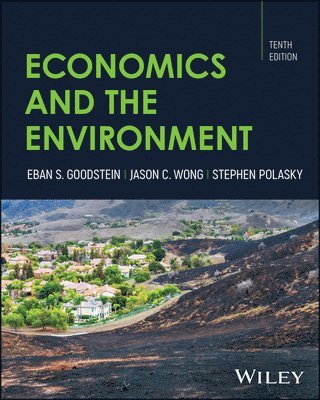
    Economics and the Environment

    AvEban S. Goodstein,Jason C. Wong

    Häftad, Engelska, 2025

    1 163 kr

    Beställningsvara. Skickas inom 5-8 vardagar. Fri frakt över 249 kr.

    Fler format och utgåvor

    Häftad

    1 125 kr

    Beskrivning

    Enables students to understand and shape environmental policy through economics Economics and the Environment equips students with a structured and insightful approach to examining critical questions at the heart of contemporary policy and sustainability debates through the lens of economics. Empowering students to evaluate real-world issues while building a strong foundation in environmental economics, this popular textbook explores critical questions such as “How much pollution is too much?” and “Is the government up to the job?” The fully updated tenth edition of Economics and the Environment combines theoretical rigor with practical application, employing case studies, illustrative examples, and end-of-chapter exercises that enhance understanding and retention. Each concise chapter is designed to foster critical thinking, covering topics including pollution control, government policy, clean technology, and sustainable development. Throughout the text, students are encouraged to consider economic incentives, ethical implications, and the role of global cooperation in the context of pressing environmental issues. A vital tool for analyzing and addressing environmental issues in today’s world, Economics and the Environment, Tenth Edition is perfect for undergraduate and graduate courses on environmental economics, policy analysis, and sustainable development within economics, business, and environmental studies programs. New to this Edition: New discussions on climate change, resource economics, and energy policyNew coverage of the implications of rapidly declining costs for solar power, battery storage, and electric vehiclesUp-to-date Social Cost of Carbon (SCC) estimates with the latest high-impact figures currently used in policy analysisInsights on the 2022 Inflation Reduction Act (IRA) and its technology-promotion strategiesNew analysis of the potential for a disruptive energy technology transition in the 2020s Revised content on “peak oil” centered on a demand-side peak rather than a supply-side peak Expanded coverage of the shifting regulatory environment at the Environmental Protection AgencyFully revised chapters on valuation of the environment and cost-benefit analysisNew and updated data, examples, figures, and review questions throughout the textWiley Advantage: Presents the latest debates, standards, and regulations to provide an engaging and relevant experience for students and instructors alikeFrames complex environmental issues through a unique four-question approach that strengthens critical thinkingEmphasizes sustainability and ecological economics with a focus on strong sustainability principlesOffers diverse perspectives on government roles and limitations in environmental regulationHighlights ethical foundations of environmental decision-making to support deeper discussions on policy impactsExplores ecological economic critiques of economic growth to prepare students for advanced environmental discussionsPresents a rigorous approach to efficient pollution control, benefit-estimation procedures, and incentive-based regulation techniques

    Produktinformation

    • Utgivningsdatum:2025-05-01
    • Mått:203 x 252 x 20 mm
    • Vikt:794 g
    • Format:Häftad
    • Språk:Engelska
    • Antal sidor:464
    • Upplaga:10
    • Förlag:John Wiley & Sons Inc
    • ISBN:9781394307951

    Utforska kategorier

    • Miljövetenskap och miljöpolitik inom Naturvetenskap och teknik
    • Miljöekonomi inom Ekonomi och Ledarskap

    Mer om författaren

    Eban S. Goodstein is Vice President for Environmental and Social Leadership and Director of Graduate Programs in Sustainability at Bard College. He has led numerous national educational initiatives on climate change involving over 2,500 institutions. He is the author of Fighting for Love in the Century of Extinction: How Passion and Politics Can Stop Global Warming and The Trade-off Myth: Fact and Fiction about Jobs and the Environment. His work has appeared in major publications such as The New York Times, Scientific American, and The Economist. He serves on the editorial board of Sustainability: The Journal of Record. Jason C. Wong is Assistant Professor of Economics at Babson College, specializing in applied microeconomics with a focus on connectivity and sustainable development. His research has been published in World Development, Energy Economics, and Energy Policy, among others. A Visiting Fellow at the London School of Economics, Wong has won numerous teaching awards, including the Presidential Award for Outstanding Teaching at Columbia University. He also served as an International Parliamentary Fellow at the German Bundestag. Stephen Polasky is Regents Professor and Fesler-Lampert Professor of Ecological/Environmental Economics at the University of Minnesota. His research bridges ecology and economics, exploring ecosystem services, biodiversity, sustainability, and renewable energy. Polasky’s work has been featured in Environmental Science & Technology, Proceedings of the National Academy of Sciences, and Nature Sustainability. A sought-after expert on environmental policy, he has recently collaborated with the Central Bank of Chile and the National Academy of Sciences.

    Innehållsförteckning

    • Preface ix1 Four Economic Questions About Climate Change 11.1 Introduction 11.2 Four Questions 21.3 How Much Pollution Is Too Much? 51.4 Is Government Up to the Job? 91.5 How Can We Do Better? 91.6 Can We Resolve Global Issues? 121.7 Summary 13Part I How Much Pollution Is Too Much?2 Ethics and Economics 192.1 Introduction 192.2 Utility and Utilitarianism 202.3 Social Welfare 222.4 Summary 243 Pollution and Resource Degradation as Externalities 273.1 Introduction 273.2 The Open- Access Problem 293.3 The Public Goods Problem 323.4 Is Sustainable Business a Solution? 353.5 Summary 364 The Efficiency Standard 404.1 Introduction 404.2 Efficiency Defined 404.3 Efficient Pollution Levels 434.4 Marginals and Totals 464.5 The Coase Theorem Introduced 474.6 Air Pollution Control in Baltimore: Calculating the Efficient Standard 484.7 The Ethical Basis of the Efficiency Standard 504.8 Real- World Benefit–Cost Analysis 514.9 Summary 545 Measuring the Benefits of Environmental Protection 635.1 Introduction 635.2 Use, Option, and Existence Value: Types of Nonmarket Benefits 645.3 Consumer Surplus, WTP, and WTA: Measuring Benefits 655.4 Risk and the Value of Statistical Life 675.5 Revealed Preference I: Hedonic Regression 725.6 Revealed Preference II: Travel Cost 735.7 Revealed Preference III: Defensive Expenditures 755.8 Stated Preference: Contingent Valuation 765.9 Summary 81Appendix 5A: WTA and WTP Redux 865A.1 An Indifference Curve Analysis 865A.2 The Endowment Effect or Substitutability? 886 Measuring the Costs of Environmental Protection 906.1 Introduction 906.2 Direct Costs of Environmental Regulation 916.3 Opportunity Costs of Environmental Regulation: Productivity 936.4 Opportunity Costs of Environmental Regulation: Employment 956.5 General Equilibrium Effects and the Double Dividend 1016.6 A Final Look at Benefit–Cost Analysis 1026.7 Summary 1057 The Safety Standard 1097.1 Introduction 1097.2 Defining the Right to Safety 1107.3 The Safety Standard: Inefficient 1127.4 The Safety Standard: Not Cost- Effective 1137.5 The Safety Standard: Environmental Justice or Regressive Impact? 1147.6 Siting Hazardous Waste Facilities: Safety versus Efficiency 1167.7 Summary 1198 The Sustainability Standard 1238.1 Introduction 1238.2 Sustainability: Neoclassical and Ecological Approaches 1248.3 Future Benefits, Costs, and Discounting 1278.4 An Example of Discounting: Light Bulbs 1298.5 Savings, Investment, and Market Interest Rates 1308.6 The Social Discount Rate and Dynamic Efficiency 1318.7 Discounting Climate Change 1348.8 Ecological Economics, Strong Sustainability, and the Precautionary Principle 1368.9 Strong Sustainability in Practice: Endangered Species, EIS, and Reach 1378.10 Summary 1399 Measuring Sustainability 1439.1 Introduction 1439.2 Malthus and Ecological Economics 1449.3 Modern Debates: Limits to Growth and Planetary Boundaries 1469.4 Measuring Strong Sustainability: Impacts and Footprints 1489.5 Measuring Weak Sustainability: Net National Welfare and Inclusive Wealth 1529.6 Natural Capital Depreciation 1569.7 Are We Achieving Sustainability? 1589.8 Discounting, Sustainability, and Investing for the Future 1629.9 The Ecological–Neoclassical Debate in Context 1649.10 Summary 16510 Natural Resources and Ecosystem Services 17110.1 Introduction 17110.2 Nonrenewable Resources and the Hotelling Model 17210.3 Testing the Nonrenewable Resource Model 17810.4 The Roller Coaster Ride of Oil Prices 17910.5 Peak Oil? 18010.6 Renewable Resources 18210.7 Renewable Resource Policy: Fisheries and Endangered Species 18610.8 Ecosystem Services and Natural Capital 18910.9 Summary 19211 Is More Really Better? Consumption, Welfare, and Behavior 19711.1 Introduction 19711.2 Money and Happiness 19811.3 Social Norms and the Rat Race 19911.4 Positional Goods and Consumption Externalities 20211.5 Welfare with Social Consumption 20311.6 Overconsumption Policy Solutions 20511.7 Behavioral Economics and Behavior Change 20811.8 Summary 209Part II Is Government Up to the Job?12 The Political Economy of Environmental Regulation 21512.1 Introduction 21512.2 The Process of Environmental Regulation 21612.3 Regulation under Imperfect Information 21812.4 Bureaucratic Discretion and Political Influence 21912.5 The Influence Game: Pre- 2016 22112.6 The End of the Bipartisan Consensus 22412.7 Better Information, More Democracy 22912.8 Summary 23113 An Overview of Environmental Legislation 23513.1 Introduction 23513.2 Cleaning the Air 23613.3 The Clean Air Act and Climate Change 23913.4 Fishable and Swimmable Waters 24213.5 Hazardous Waste Disposal on Land 24313.6 Chemicals and Pesticides 24613.7 Endangered Species Protection 24913.8 Summary 25114 The Regulatory Record: Achievements and Obstacles 25414.1 Introduction 25414.2 Accomplishments of Environmental Regulation 25414.3 Monitoring and Enforcement: Political Constraints 25814.4 The Appeal of Incentive- Based Regulation 26114.5 Beyond Regulation? Promoting Clean Technology 26214.6 Summary 264Part III How Can We Do Better?15 Incentive- Based Regulation: Theory 27115.1 Introduction 27115.2 The Cost- Effectiveness Rule 27215.3 IB Regulation and Cost- Effectiveness 27515.4 IB Regulation and Technological Progress 27815.5 Potential Problems with IB Regulation 27915.6 Summary 285Appendix 15A: Imperfect Regulation in an Uncertain World 28815A.1 Minimizing the Costs of Being Wrong 28915A.2 An Application to Greenhouse Gas Emissions 29115A.3 Summary 292Appendix 15B: Incentive- Compatible Regulation 29315B.1 Incentives to Lie 29315B.2 Incentives to Tell the Truth 29515B.3 Summary 29716 Incentive- Based Regulation: Practice 29816.1 Introduction 29816.2 Lead and Chlorofluorocarbons 29916.3 Trading Urban Air Pollutants 29916.4 Marketable Permits and Acid Rain 30316.5 Carbon Trading in the Northeast and California 30616.6 Two Failed U.S. Efforts: Mercury and Carbon 30916.7 The European Emissions Trading System 31116.8 Pollution Taxes and Their Relatives 31316.9 Summary 31717 Promoting Clean Technology: Theory 32117.1 Introduction 32117.2 Path Dependence and Clean Technology 32217.3 Clean Technology Defined 32317.4 If You’re So Smart, Why Aren’t You Rich? 32617.5 Picking the Winning Path 32917.6 Promoting Early- Stage Clean Technologies 33117.7 Promoting Late- Stage Clean Technologies 33317.8 Clean Technology: Two Case Studies 33617.9 Summary 34118 Energy Policy and the Future 34718.1 Introduction 34718.2 Technology Options: Electricity and Heat 34818.3 Policy Options: Electricity and Heat 35718.4 Technology Options: Transport 36118.5 Policy Options: Transport 36518.6 Summary 370Part IV How Can We Solve Global Challenges?19 Poverty, Population, and the Environment 37519.1 Introduction 37519.2 Poverty and the Environment 37719.3 The Population Picture in Perspective 38019.4 An Economic Approach to Family Size 38219.5 Controlling Population Growth 38319.6 Consumption and the Global Environment 38719.7 Envisioning a Sustainable Future 38919.8 Summary 39120 Environmental Policy in Low- Income Countries 39420.1 Introduction 39420.2 The Political Economy of Sustainable Development 39420.3 Ending Environmentally Damaging Subsidies 39720.4 Establishing and Enforcing Property Rights 39820.5 Regulatory Approaches 40120.6 Sustainable Technology: Development and Transfer 40520.7 Resource Conservation and Debt Relief 40720.8 Trade and the Environment 41220.9 Summary 41621 The Economics of Global Agreements 42021.1 Introduction 42021.2 Agreements as Public Goods 42121.3 Monitoring and Enforcement 42221.4 The Ozone Layer and Biodiversity 42421.5 Stopping Global Warming: Theory 42721.6 Stopping Global Warming: Reality 42921.7 Summary 432Selected Websites for Environmental and Natural Resource Economists 437Index I- 1