• Fri frakt över 249 kr
  • •
  • Snabba leveranser
  • •
  • Billiga böcker
Kundservice

Du är på sajten för privatpersoner.

Företag, bibliotek eller offentlig verksamhet?

Du handlar på classic.bokus.com, där alla dina funktioner finns intakta.
Till classic.bokus.com
Bokus logotyp. Gå till startsidan.
  • Erbjudanden
  • Nyheter
  • Student
  • Topplistor
  • Barn & ungdom
  • Bokus Play
  • E-böcker
  • Pocketböcker
  • Spel & pussel

10% rabatt på allt med kod NYSTART10 →

Sidfot

Mina sidor

    Hjälp

    • Kundservice
    • Vanliga frågor och svar
    • Frakt och leverans
    • Retur vid ångerrätt
    • Reklamera vara
    • Betalning
    • Köpvillkor
    • Allmänna villkor
    • Information om webbplatsens tillgänglighet

    Om Bokus

    • Om oss
    • Pressrum
    • För studenter
    • För företag
    • För bibliotek och offentlig verksamhet
    • För leverantörer
    • Hållbarhet

    Populärt

    • Aktuella erbjudanden
    • Presentkort
    • Studentlitteratur
    • Nya böcker
    • Topplistor
    • Signerade böcker
    • Engelska böcker

    Inspiration

    • Boktips
    • BookTok
    • Populära bokserier
    • Barnbokskaraktärer
    • Populära författare
    Logotyp för Bokus
    Följ oss på Facebook (extern länk)Följ oss på Instagram (extern länk)Följ oss på YouTube (extern länk)Följ oss på TikTok (extern länk)
    bokus @ CookiesAnpassa cookiesIntegritetspolicyKöpvillkor
    Till Citymail hemsida (extern länk)Till Budbee hemsida (extern länk)Till Postnord hemsida (extern länk)Till Schenker hemsida (extern länk)Till Early Bird hemsida (extern länk)Till Walleys hemsida (extern länk)
    1. Filosofi och religion
    2. Religion och tro
    3. Religion: allmänt

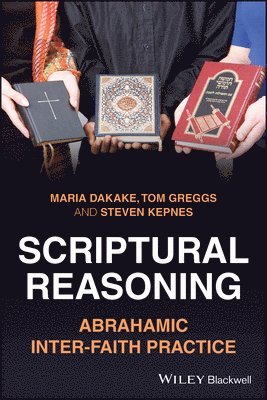
    Scriptural Reasoning

    Abrahamic Inter-faith Practice

    AvMaria Dakake,Tom Greggs

    Häftad, Engelska, 2026

    420 kr

    Beställningsvara. Skickas inom 5-8 vardagar. Fri frakt över 249 kr.

    Beskrivning

    Fosters deep inter-faith understanding through shared scriptural study and mutual religious hospitality Scriptural Reasoning: Abrahamic Inter-faith Practice provides an accessible and practical introduction to a unique form of inter-faith engagement centered on shared sacred text study. Rather than minimizing deep commitments to one's own faith, this approach encourages participants to enter more fully into their own traditions while offering and receiving hospitality across religious boundaries. Focusing on the Abrahamic faiths—Judaism, Christianity, and Islam—this book equips students and lay practitioners to participate meaningfully in Scriptural Reasoning (SR) groups, where members of different faiths read and reason together from their respective Scriptures. The authors—scholars and practitioners from the three traditions—guide readers through the origins, aims, and methods of SR while offering theological context, practical guidance, and real-world examples. Chapters explore common questions about the nature of Scripture, revelation, interpretation, and the challenges and promises of inter-religious study. Designed for classroom use, religious institutions, or community initiatives, this concise and clear resource helps participants “hit the ground running.” By grounding the practice in deep respect, conviction, and curiosity, the authors position Scriptural Reasoning as a tool not only for dialogue, but for healing and reconciliation across difference. Encouraging cross-faith understanding in a world marked by religious plurality and social fragmentation, Scriptural Reasoning: Provides the foundation for understanding, practicing, and reflecting on Abrahamic Scriptural Reasoning Contains tools and texts for launching SR in classroom, religious, and civic settings Includes foundational background on the Scriptures and interpretive traditions of Judaism, Christianity, and Islam Addresses common questions and misconceptions about inter-faith engagement and religious pluralism Features real-world examples of SR used in diverse contexts, from prisons to hospitals to inter-faith dialogue programsCombining theological reflection with practical instruction for first-time SR facilitators and participants, Scriptural Reasoning: Abrahamic Inter-faith Practice is ideal for undergraduate and graduate students in theology, religious studies, and interfaith engagement programs. It can be used in courses such as Interfaith Dialogue, Comparative Religion, and Abrahamic Traditions, and is appropriate for degrees in divinity, religious studies, and civic leadership.

    Produktinformation

    • Utgivningsdatum:2026-02-05
    • Mått:150 x 226 x 18 mm
    • Vikt:340 g
    • Format:Häftad
    • Språk:Engelska
    • Antal sidor:256
    • Förlag:John Wiley & Sons Inc
    • ISBN:9781394366583

    Utforska kategorier

    • Religion: allmänt inom Filosofi och religion
    • Judendom inom Filosofi och religion
    • Kristendom inom Filosofi och religion

    Mer om författaren

    MARIA DAKAKE is Associate Professor of Religious Studies at George Mason University, where she directs programs in Islamic Studies and Middle East Studies. She holds a PhD from Princeton University and is widely published in Islamic intellectual history, Qur’anic studies, Shiism, Sufism, and women’s spirituality She is co-author and co-editor of The Study Quran (HarperOne 2015) and co-editor of The Routledge Companion to the Qur’an (Routledge, 2022). TOM GREGGS is Director of the Center of Theological Inquiry, Princeton, New Jersey. He previously held the Marischal Chair of Divinity at the University of Aberdeen, UK. A Methodist preacher and international ecumenical leader, his many publications include Dogmatic Ecclesiology, The Breadth of Salvation, and Barth and Bonhoeffer as Contributors to a Postliberal Ecclesiology. STEVEN KEPNES is Professor of Religion and Jewish Studies at Colgate University. A prominent voice in Jewish theology, he is the author of Jewish Liturgical Reasoning, Reviving Jewish Theology, and editor of the Cambridge Companion to Jewish Theology. He has also taught at the Jewish Theological Seminary and the Gregorian University in Rome, Italy.

    Innehållsförteckning

    • Acknowledgments xiiChapter 1 Introduction: Come; Let Us Reason Together 1The History of SR 4Muslim Engagement in SR (Mahan Mirza) 8The Practice of SR and How to Use This Book 11Texts to Use for an SR Session 16Chapter 2 Delving Deeper: Guidelines and Practical Advice 17Fifteen Guidelines of SR 18What Is Abrahamic SR? 18Scriptures as Living Texts 18Scripture’s Surplus of Meaning 19Scriptural Warrants for SR 19Bringing Your Internal Library— Nothing Is Alien, The Text Is Judge 20SR Space as a Tent of Meeting 20SR and Prophetic Critique 21SR, Religion and Conflict Resolution 22Preserve Difference, Establish Relations 22Themes, Hypotheses, and the Interrogative Mood 23SR and Commentary Texts 23SR Theory and Scholarship 24Monotheism and Beyond 24Our Time and the End Time 25How SR Is Done 26Texts to Use for an SR Session 32Chapter 3 But Isn’t Religion the Problem? 34Isn’t Religion Just a Problem? 35The Reassertion of Religion 40Shouldn’t Religious People Just Become a Bit Less Religious, Then? 42The Detriments of Maximal Secularism and Attraction of Religion 46SR As Another Way 47Texts to Use for an SR Session 51Chapter 4 So What Are the Jewish, Muslim, and Christian Scriptures? 53What Is Scripture: A Jewish View 54Torah as Holy 56Torah as Holy Object 57What Is Scripture: A Christian View— The Bible 58The Old Testament 59The New Testament 61How Christians Read and View Scripture 64What Is Scripture in Islam? 66The Qur’an 66Muslim Belief Regarding the Qur’an 67The Qur’an and Muhammad 68The Structure and Content of the Qur’an 72Texts to Use for an SR Session 76Chapter 5 Are Scripture and Revelation the Same Thing for Judaism, Christianity, and Islam? 78What Is Revelation in Judaism? 79What Happened at Sinai? 81Revelation in the Torah 84Revelation of God’s Self 86What Is Revelation in Christianity? 88Natural and Special Revelation 89Revelation and the Incarnation of God in Jesus Christ 91Revelation Today Through the Holy Spirit 92What Is Revelation in Islam? 94The Qur’anic ayat: The “Signs of God” 95Direct Divine Revelation: Wahy and Tanzil 99Texts to Use for an SR Session 103Chapter 6 Why “Reasoning”? 105Reason in Scripture 107SR Through Metaphors 108Contemporary Philosophies of Metaphor and Religious Language 108Interpretation: The Reason That Is Brought to Scripture 111The Attitude of I- Thou 112The Group Reasoning Process 115Reflective SR 116Application: SR as Healing 117Texts to Use for an SR Session 119Chapter 7 But Don’t We Read with Commentaries and Traditions? 121Jewish Practices of Reading Scripture 123Hebrew Language and the Hebrew of Torah 124Bereshit- Genesis 125Pshat 126Beyond One Study Partner 127Rashi 129Modern Biblical Criticism 130Commentary and Tradition in Christianity 131Creeds, Symbols, and Definitions 131The Authority of Tradition in Christianity 135Traditional Approaches to Scripture 138Higher Biblical Criticism 140Challenges for SR of Christian Uses of Tradition 141What Is Commentary in Islam? 143Complexity and Clarity in Reading Scripture 143Tradition and Commentary 144Tafsir 147Tafsir and Ta’wil 148Texts to Use for an SR Session 151Chapter 8 Are Our Religions Allowed to Engage in This Kind of Practice? 153Some Suggested Jewish Warrants 157Hagar and Ishmael as Other and Same 157Hagar and the Ger 162Christian Warrants 164Jesus and the Samaritans 166Jesus and the Gentiles 169Warrants for SR from an Islamic Perspective 172The Qur’an on People of the Book 174Engaging Scriptures 176Texts to Use for an SR Session 178Chapter 9 What Kinds of Discussions and Insights Happen in SR Sessions? 181Reflections by Jewish Participants 182A Jewish Participant Reflecting on Their First Exposure to SR 182A Jewish Participant Reflecting on Mark 4 183A Jewish Participant Reflecting on Surah 6, Isaiah 6, Deuteronomy 6, and Mark 4 185Reflections by Christian Participants 186A Christian Reflection on John 3 with Commentaries in the Context of SR 186A Christian Participant Reflecting on Psalm 8, Deuteronomy 6, and Sura 2:30– 39 188A Christian Participant Reflecting on Psalm 1 and Sura 2 191A Christian Participant Reflecting on Deuteronomy 6:4– 9 and Sura 2 191Reflections by Muslim Participants 193A Muslim Participant’s Reflection on Deuteronomy 6:4– 9 and Sura 2 193A Muslim Participant’s Reflection on Deuteronomy 6, John 3, and the Qur’anic Account of Abraham 195A Muslim Reflects on Her First Encounter with SR and on Sura 2:20– 33 197The Reflections in Light of the Guidelines and Ideals of SR 198Practices of Reading 199Scriptures as Living Texts 200The Tent of Meeting and SR as a Liminal Space 201Traditional Commentary and Internal Libraries 202Prophetic Critique and Interrogative Mood 203Religion and Religious Texts in the Spirit of Peace and with Hope for the Future 204Texts to Use for an SR Session 204Chapter 10 Conclusion: Why Does SR Have Such Promise as a Mode of Inter- Faith Engagement? 206Texts to Use for an SR Session 210Online Resources 212Bibliography 213Scriptural Hermeneutics 213Theology/Philosophy of Interreligious Engagement 216Universities 218Public Issues 218Other 219Index 223