• Fri frakt över 249 kr
  • •
  • Snabba leveranser
  • •
  • Billiga böcker
Kundservice

Du är på sajten för privatpersoner.

Företag, bibliotek eller offentlig verksamhet?

Du handlar på classic.bokus.com, där alla dina funktioner finns intakta.
Till classic.bokus.com
Bokus logotyp. Gå till startsidan.
  • Erbjudanden
  • Student
  • Topplistor
  • Barn & ungdom
  • Bokus Play
  • Bokus Play
  • E-böcker
  • Ljudböcker
  • Pocketböcker
  • Spel & pussel

10% rabatt på allt med kod NYSTART10 →

Sidfot

Mina sidor

    Hjälp

    • Kundservice
    • Vanliga frågor och svar
    • Frakt och leverans
    • Retur vid ångerrätt
    • Reklamera vara
    • Betalning
    • Köpvillkor
    • Allmänna villkor
    • Information om webbplatsens tillgänglighet

    Om Bokus

    • Om oss
    • Pressrum
    • För studenter
    • För företag
    • För bibliotek och offentlig verksamhet
    • För leverantörer
    • Hållbarhet

    Populärt

    • Aktuella erbjudanden
    • Presentkort
    • Studentlitteratur
    • Nya böcker
    • Topplistor
    • Signerade böcker
    • Engelska böcker

    Inspiration

    • Boktips
    • BookTok
    • Populära bokserier
    • Barnbokskaraktärer
    • Populära författare
    Logotyp för Bokus
    Följ oss på Facebook (extern länk)Följ oss på Instagram (extern länk)Följ oss på YouTube (extern länk)Följ oss på TikTok (extern länk)
    bokus @ CookiesAnpassa cookiesIntegritetspolicyKöpvillkor
    Till Citymail hemsida (extern länk)Till Budbee hemsida (extern länk)Till Postnord hemsida (extern länk)Till Schenker hemsida (extern länk)Till Early Bird hemsida (extern länk)Till Walleys hemsida (extern länk)
    1. Data och IT
    2. Programmeringsböcker
    3. Programvaruutveckling

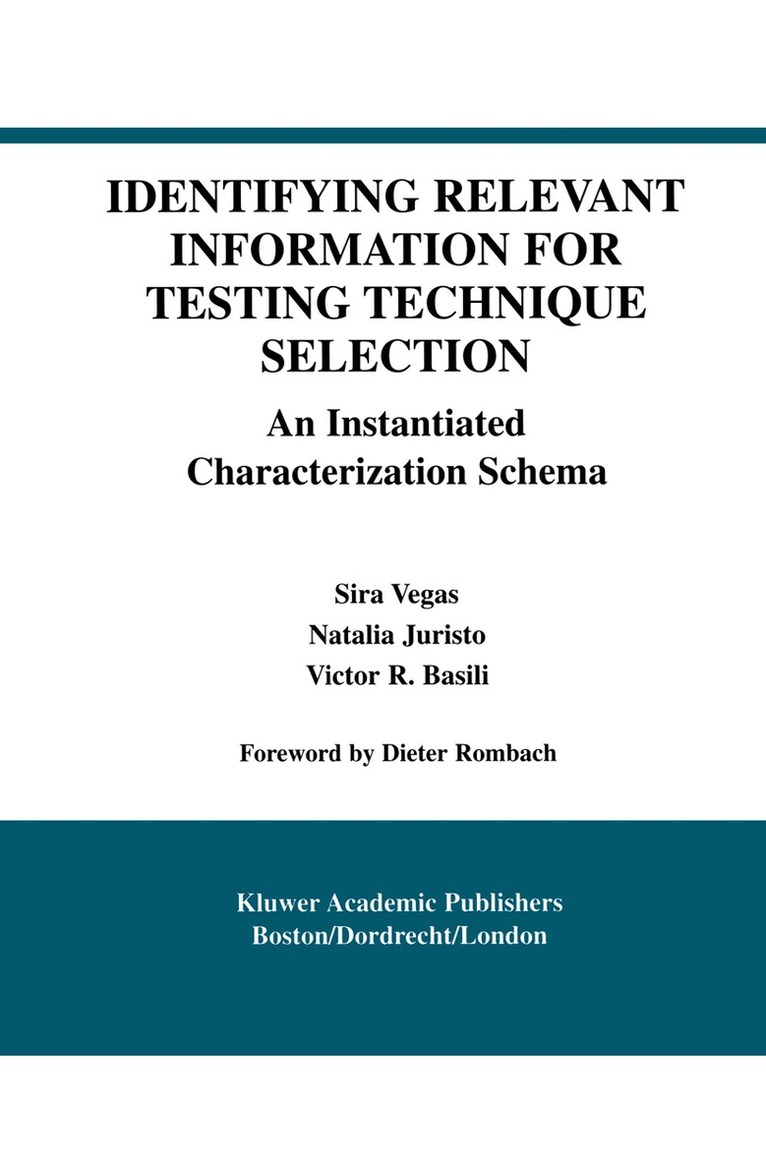
    Identifying Relevant Information for Testing Technique Selection

    An Instantiated Characterization Schema

    AvSira Vegas,Natalia Juristo

    Inbunden, Engelska, 2003

    Del i serien International Series in Software Engineering

    1 116 kr

    Beställningsvara. Skickas inom 10-15 vardagar. Fri frakt över 249 kr.

    Fler format och utgåvor

    Häftad

    1 084 kr

    Beskrivning

    The importance of properly selecting testing techniques is widely accepted in the software engineering community. However, there are chiefly two reasons why the selections now made by software developers are difficult to evaluate as correct. First, there are several techniques with which the average developer is unfamiliar, often leaving testers with limited knowledge of all the techniques currently available. Second, the available information regarding the different testing techniques is primarily procedure (focused on how to use the technique), rather than pragmatic (focused on the effect and appropriateness of using the technique). The problem addressed in this book is that of improving software testing technique selection.

    Produktinformation

    • Utgivningsdatum:2003-04-30
    • Mått:155 x 235 x 22 mm
    • Vikt:629 g
    • Format:Inbunden
    • Språk:Engelska
    • Serie:International Series in Software Engineering
    • Antal sidor:281
    • Upplaga:2003
    • Förlag:Kluwer Academic Publishers
    • ISBN:9781402074356

    Utforska kategorier

    • Programvaruutveckling inom Data och IT

    Innehållsförteckning

    • 1. Introduction.- 1 Basics on Software Testing.- 2 The Problem of Selecting Testing Techniques.- 3 Getting a Characterisation Schema for Testing Techniques.- 4 Organisation of the Book.- 2. State of the Practice.- 1 Areas Surveyed.- 2 Testing Area.- 3 Area of Characterisation.- 4 Conclusions on the State of the Practice.- 3. Research Goals.- 1 Description of the Problem.- 2 Problem-Solving Approach.- 3 Hypotheses.- 4. Problem Solving Process.- 1 Research Methods.- 2 Objectives of Technological Research.- 3 Applying the Scientific Method to Technological Research.- 4 Expert Peer Review versus Experimental Testing.- 5 The Problem-Solving Process Used in this Book.- 5. First Generative Iteration: Deductive Theoretical Schema.- 1 Description of the Research Stage: Generation of a Theoretical Schema.- 2 Testing Process.- 3 Stratification of Testing-Related Information.- 4 Testing Process Elements.- 5 Attributes of the Theoretical Schema.- 6 Result of the Construction of the Theoretical Schema.- 7 Use and Evolution of the Characterisation Schema.- 6. Second Generative Iteration: Inductive Empirical Schema.- 1 Description of the Research Stage: Generation of an Empirical Schema.- 2 Data Collection.- 3 Data Analysis.- 4 Result of Building the Empirical Schema.- 5 Study of the Evolution of the Empirical Schema.- 7. Synthesis of Perspectives: Proposal of the Preliminary Schema.- 1 Description of the Research Stage: Synthesis of Schemas.- 2 Rules of Synthesis.- 3 Synthesis of the Theoretical and Empirical Schemas.- 4 Result of Schema Synthesis.- 5 Study of Schema Synthesis.- 8. Improvement of the Schema: Expert Peer Review.- 1 Description of the Research Stage: Improvement.- 2 Questionnaire for Experts.- 3 Questionnaire Analysis Method.- 4 Analysis of Responses.- 5 Improved Schema.- 9. Empirical Evaluation.- 1 Objective of the Empirical Evaluation.- 2 Choice of the Workload.- 3 Analysis of the Results.- 4 Conclusions on the Empirical Evaluation.- 10. Experimental Evaluation.- 1 Objective of the Experiment.- 2 Experiment Planning.- 3 Experimental Design.- 4 Data Analysis.- 5 Conclusions on Experimental Evaluation.- 6 Characterisation Schema Improvement.- 11. Conclusions.- Appendices.- Forms Used to Obtain the Empirical Schema.- Questionnaires Used in Expert Peer Review.- Schema Instantiation.- Experiment Forms.