• Fri frakt över 249 kr
  • •
  • Snabba leveranser
  • •
  • Billiga böcker
Kundservice

Du är på sajten för privatpersoner.

Företag, bibliotek eller offentlig verksamhet?

Du handlar på classic.bokus.com, där alla dina funktioner finns intakta.
Till classic.bokus.com
Bokus logotyp. Gå till startsidan.
  • Erbjudanden
  • Student
  • Topplistor
  • Barn & ungdom
  • Bokus Play
  • E-böcker
  • Ljudböcker
  • Pocketböcker
  • Spel och pussel

Pocketfynda! Hundratals böcker för 49 kr/st →

Sidfot

Mina sidor

    Hjälp

    • Kundservice
    • Vanliga frågor och svar
    • Frakt och leverans
    • Retur vid ångerrätt
    • Reklamera vara
    • Betalning
    • Köpvillkor
    • Allmänna villkor
    • Information om webbplatsens tillgänglighet

    Om Bokus

    • Om oss
    • Pressrum
    • För studenter
    • För företag
    • För bibliotek och offentlig verksamhet
    • För leverantörer
    • Hållbarhet

    Populärt

    • Aktuella erbjudanden
    • Presentkort
    • Studentlitteratur
    • Nya böcker
    • Topplistor
    • Signerade böcker
    • Engelska böcker

    Inspiration

    • Boktips
    • BookTok
    • Barnbokskaraktärer
    • Populära författare
    Logotyp för Bokus
    Följ oss på Facebook (extern länk)Följ oss på Instagram (extern länk)Följ oss på YouTube (extern länk)Följ oss på TikTok (extern länk)
    bokus @ CookiesAnpassa cookiesIntegritetspolicyKöpvillkor
    Till Citymail hemsida (extern länk)Till Budbee hemsida (extern länk)Till Postnord hemsida (extern länk)Till Schenker hemsida (extern länk)Till Early Bird hemsida (extern länk)Till Walleys hemsida (extern länk)
    1. Naturvetenskap och teknik
    2. Geovetenskap
    3. Miljövetenskap och miljöpolitik

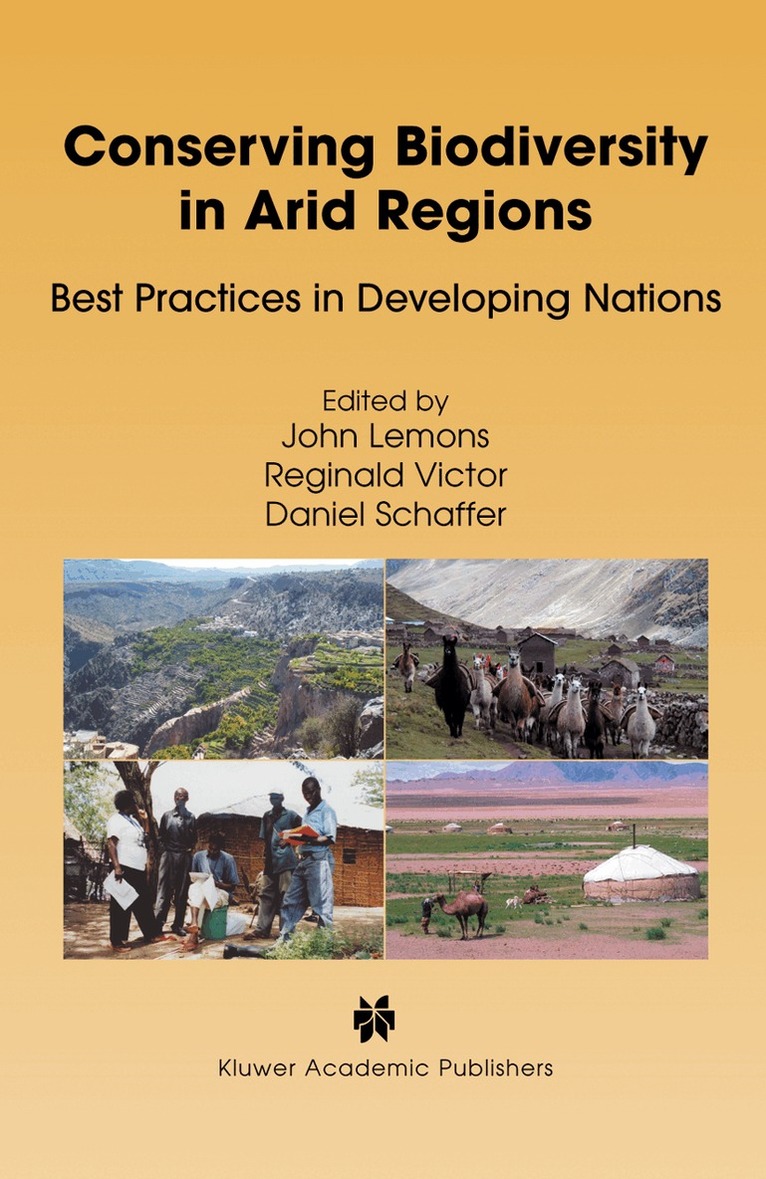
    Conserving Biodiversity in Arid Regions

    Best Practices in Developing Nations

    AvJ. Lemons,Reginald Victor

    Inbunden, Engelska, 2003

    1 613 kr

    Beställningsvara. Skickas inom 10-15 vardagar. Fri frakt över 249 kr.

    Beskrivning

    The protection of biodiversity and sustainable use of resources in arid and semiarid regions is important because: more than one-third of the earth's land area is drylands; up to one billion people (mostly poor) depend on drylands for their survival; the biological resources of drylands are both unique and vulnerable; and loss of dryland species increases the threats to the lives of millions of people. In Southern (developing) nations, successful experiences in conserving biodiversity and utilizing sustainable resources have not been publicized widely and hence have not been replicated in other relevant circumstances. For example, much of the available information on a wide variety of best practices and lessons learned for protecting and sustainably using arid and semiarid zone biodiversity remains within the institutions in which it has been generated and has not been shared between others working on similar issues for the mutual benefit of the global environment.Lack of financial resources constrains developing nations and their scientific institutions to widely disseminate the results of studies and projects as well as their ability to increase partnerships, cooperation, and capacity building between institutions and various stakeholders. The overall goal of this book is to increase the size of and more widely disseminate the "portfolio" of research and other works aimed at protecting and sustainably utilizing biodiversity of global significance in arid and semiarid areas in developing nations. Specifically, the book focuses on best practices and lessons learnt for science, for public policy and management, for increasing the participation of local people in decision making, and for enhancing partnerships and capacity building between institutions. In part, the successful practices and programmes described in this book are a follow up to the Earth Summit Conference and the ratification of the Convention on Biological Diversity (CBD) and the Convention to Combat Desertification (CCD) and, hence, provide examples of understudied measures by Southern nations to conserve and sustainably use biodiversity.

    Produktinformation

    • Utgivningsdatum:2003-07-31
    • Mått:155 x 235 x 33 mm
    • Vikt:945 g
    • Format:Inbunden
    • Språk:Engelska
    • Antal sidor:497
    • Upplaga:2003
    • Förlag:Kluwer Academic Publishers
    • ISBN:9781402074837

    Utforska kategorier

    • Miljövetenskap och miljöpolitik inom Naturvetenskap och teknik

    Innehållsförteckning

    • 1 Case Studies on Conserving and Sustainably Using Biodiversity in Arid and Semiarid Regions of Southern Nations.- Africa.- 2 The Domestication of Indigenous Trees as the Basis of Sustainable Land Use in Africa.- 3 Conservation Farming with Biodiversity in South Africa: A Preliminary Evaluation of Ecosystem Goods and Services in the Bokkeveld Plateau.- 4 Strategies for In Situ Conservation of Crop Genetic Resources in Dryland Areas of Africa.- 5 A Participatory Approach for Conservation of Forest Genetic Resources.- 6 Agriculture and Biodiversity Conservation in Africa Through Indigenous Knowledge.- 7 Participation of Local Communities in the Management of Wetlands in Magadi Area, Kenya.- 8 The Value of Local and Indigenous Knowledge for the Development of Information Systems for Conservation Management.- 9 Best Practices in the World’s Oldest Desert.- 10 A Commentary on Strategies and Incentives to Improve Biodiversity in Arid and Semi-Arid Zones.- Asia.- 11 Conservation and Sustainable Use of Biodiversity in the Trans-Altai Gobi Desert of Mongolia.- 12 Ecological Assessment of Degradation Processes in the Mongolian Part of Baikal Basin.- 13 Plant Diversity and Succession of Artificial Vegetation Types and Environment in an Arid Desert Region of China.- 14 Plant Production and Diversity at Desertification Stages in Horqin Sand Grassland Region, China.- 15 Aquatic Biodiversity in Arid and Semi-Arid Zones of Asia and Water Management.- 16 Traditional Management of Biodiversity in India’s Cold Desert.- 17 Conserving Biodiversity in Arid Regions: Experiences with Protected Areas in India.- 18 Co-Management Processes to Maintain Livestock Mobility and Biodiversity in Alpine Rangelands of the Tibetan Plateau.- Latin America and the Caribbean.- 19 Theoretical Models forRegeneration of Medicinal Plants and Their Application in Sustainable Wild-Harvesting.- 20 Plants of Northeastern Brazil: A Programme in Sustainable Use of Plant Resources.- 21 Choice of Species for Recovering a Degraded Mining Area in the Semiarid Zone of Brasil.- 22 Use of Creeping Fog Water as a Non-Traditional Water Resource in Chile.- 23 Genetic Diversity and Management Implications for Vicuña Populations in Peru.- 24 Sustainable Use of the Vicuña: A Critical Analysis and the MACS Project.- 25 Sustainable Use of Andean Wildlife and Local Development of Rural Communities in Dry Areas of Latin America: A Commentary.- 26 Conflicts and Dilemmas Between Poverty and Biodiversity in the Semi-Arid Seridó of Northeast Brazil.- 27 Latin American Plant Sciences Network: A Program for the Development of Plant Sciences and Conservation of Biodiversity in Latin America.- 28 The Brazilian Biodiversity Virtual Institute.- 29 Capacity Building to Sustainably Use Biodiversity in Dryland Regions of Latin America and the Caribbean.- North Africa and the Middle East.- 30 The Importance of Native Trees in Sustaining Biodiversity in Arid Lands.- 31 Site Selection Criteria for Mangrove Afforestation Projects in Oman.- 32 The Globally Threatened Corncrake Crex crex (Egypt).- 33 Conservation of Fig (Ficus Carica L.) and Pomegranate (Punica Granatum L.) Varieties in Tunisia.- 34 A Sociological Perspective on In Situ Conservation of On-Farm Crop Genetic Diversity in Morocco.- 35 Biodiversity Conservation and Sustainable Development: A Case Study of Oman’s National Biodiversity Strategy and Action Plan.- Regionwide.- 36 Achieving Institutional Cooperation for Implementation of Sustainable Development Plans and Strategies.