• Fri frakt över 249 kr
  • •
  • Snabba leveranser
  • •
  • Billiga böcker
Kundservice

Du är på sajten för privatpersoner.

Företag, bibliotek eller offentlig verksamhet?

Du handlar på classic.bokus.com, där alla dina funktioner finns intakta.
Till classic.bokus.com
Bokus logotyp. Gå till startsidan.
  • Erbjudanden
  • Student
  • Topplistor
  • Barn & ungdom
  • Bokus Play
  • E-böcker
  • Ljudböcker
  • Pocketböcker
  • Spel och pussel

Pocketfynda! Hundratals böcker för 49 kr/st →

Sidfot

Mina sidor

    Hjälp

    • Kundservice
    • Vanliga frågor och svar
    • Frakt och leverans
    • Retur vid ångerrätt
    • Reklamera vara
    • Betalning
    • Köpvillkor
    • Allmänna villkor
    • Information om webbplatsens tillgänglighet

    Om Bokus

    • Om oss
    • Pressrum
    • För studenter
    • För företag
    • För bibliotek och offentlig verksamhet
    • För leverantörer
    • Hållbarhet

    Populärt

    • Aktuella erbjudanden
    • Presentkort
    • Studentlitteratur
    • Nya böcker
    • Topplistor
    • Signerade böcker
    • Engelska böcker

    Inspiration

    • Boktips
    • BookTok
    • Barnbokskaraktärer
    • Populära författare
    Logotyp för Bokus
    Följ oss på Facebook (extern länk)Följ oss på Instagram (extern länk)Följ oss på YouTube (extern länk)Följ oss på TikTok (extern länk)
    bokus @ CookiesAnpassa cookiesIntegritetspolicyKöpvillkor
    Till Citymail hemsida (extern länk)Till Budbee hemsida (extern länk)Till Postnord hemsida (extern länk)Till Schenker hemsida (extern länk)Till Early Bird hemsida (extern länk)Till Walleys hemsida (extern länk)
    1. Samhälle och politik
    2. Politik och statsskick
    3. Centralt styre och förvaltning

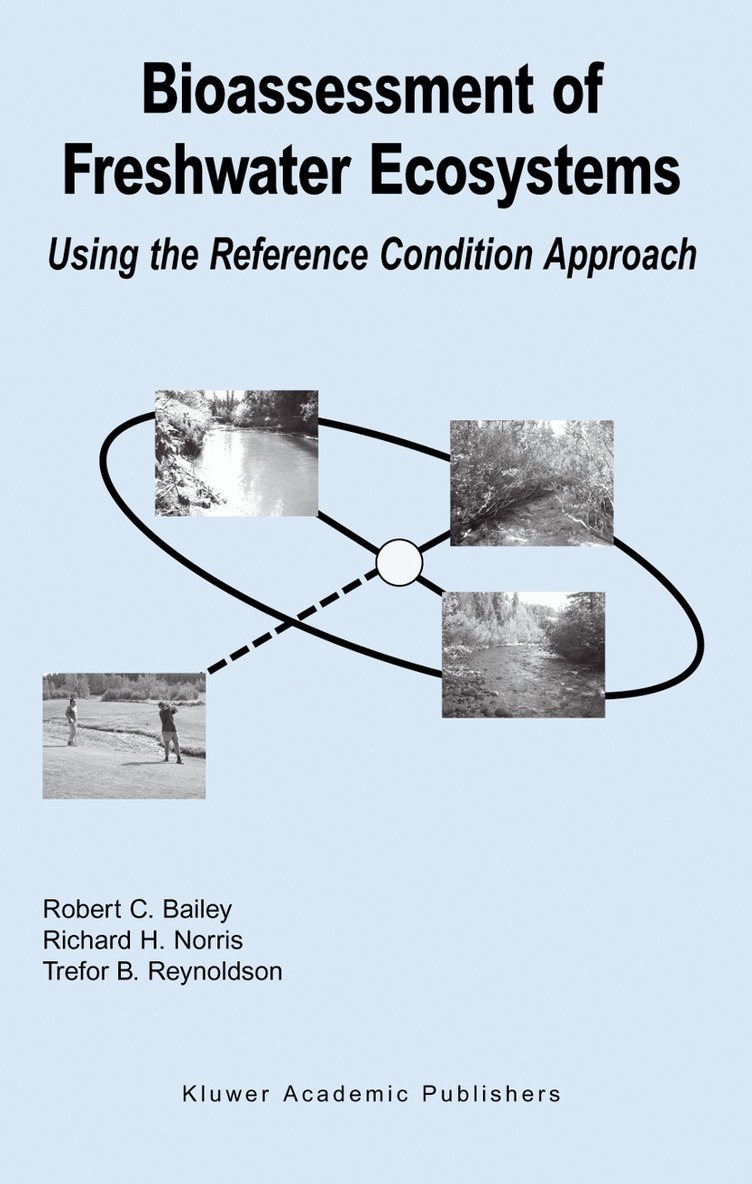
    Bioassessment of Freshwater Ecosystems

    Using the Reference Condition Approach

    AvRobert C. Bailey,Richard H. Norris

    Inbunden, Engelska, 2003

    1 078 kr

    Beställningsvara. Skickas inom 10-15 vardagar. Fri frakt över 249 kr.

    Fler format och utgåvor

    Häftad

    1 078 kr

    Beskrivning

    Aquatic ecosystem assessment is a rapidly developing field, and one of the newer approaches to assessing the condition of rivers and lakes is the Reference Condition Approach. This is a significant advancement in biomonitoring because it solves the problem of trying to locate nearby control or reference sites when studying an ecosystem that may be degraded, a problem that bedevils traditional approaches. Rather than using upstream reference sites in a river system or next-bay-over reference sites in a lake, an array of ecologically similar, least-exposed to stress sites scattered throughout a catchment or region is used. Once the reference condition has been established, any site suspected of being impacted can be assessed by comparison to the reference sites, and its status determined. The Reference Condition database, once formed, can be used repeatedly.

    Produktinformation

    • Utgivningsdatum:2003-11-30
    • Mått:155 x 235 x 15 mm
    • Vikt:448 g
    • Format:Inbunden
    • Språk:Engelska
    • Antal sidor:170
    • Upplaga:2004
    • Förlag:Kluwer Academic Publishers
    • ISBN:9781402076701

    Utforska kategorier

    • Centralt styre och förvaltning inom Samhälle och politik
    • Miljövetenskap och miljöpolitik inom Naturvetenskap och teknik

    Innehållsförteckning

    • Bioassessment Of Freshwater Ecosystems.- 1. Introduction.- 2. Key concepts.- 3. Development of the Reference Condition Approach.- 4. Points to remember.- To The Case Studies.- 1. Sediment assessment of the near shore environment of North American Great Lakes.- 2. Fraser River (British Columbia) biomonitoring program.- 3. Spring and Autumn Assessment of Streams in the Australian Capital Territory.- 4. Points to remember.- Defining The Reference Condition.- 1. Define the objectives of the study.- 2. Determine the spatial extent, time-scale and grain-size of the study.- 3. Determine the criteria for acceptable reference sites.- 4. Determine the appropriate number and locations of reference sites.- 5. Choose descriptors of the benthic invertebrate community and its environment.- 6. Design a data storage and management system.- 7. Ensure data quality.- 8. Case Studies.- 9. Points to remember.- Variation In The Reference Condition.- 1. Why characterizing reference site variation is important.- 2. How to describe variation among reference sites.- 3. Case Studie.- 4. Why it is important to model and explaine variation among reference sites.- 5. How to model variation among reference sites.- 6. Why residual variation among reference communities is important.- 7. Case studies.- 8. Points to remember.- Decision-Making.- 1. Why do we need decision rules on passing and failing test sites.- 2. How are decision rules arrived at.- 3. Sensitivity of assessments: how often do real test sites fail.- 4. Case Studies.- 5. Points to remember.- Beyond Pass And Fail.- 1. Severity of fail: Magnitude and nature of deviation from Reference Condition.- 2. Why did it fail.- 3. Scenario building: What will be the effect of rehabilitation or stress.- 4. Points to remember.- The Reference Condition Approach.- 1. Bioassessment of freshwater ecosystems using the Reference Condition Approach.- 2. Case Studies.- 3. Defining the Reference Condition.- 4. Describing and modeling variation in the Reference Condition.- 5. Decision-Making.- 6. Beyond Pass and Fail.- 7. Finish.- References.