• Fri frakt över 249 kr
  • •
  • Snabba leveranser
  • •
  • Billiga böcker
Kundservice

Du är på sajten för privatpersoner.

Företag, bibliotek eller offentlig verksamhet?

Du handlar på classic.bokus.com, där alla dina funktioner finns intakta.
Till classic.bokus.com
Bokus logotyp. Gå till startsidan.
  • Erbjudanden
  • Nyheter
  • Student
  • Topplistor
  • Barn & ungdom
  • Bokus Play
  • E-böcker
  • Pocketböcker
  • Spel & pussel

10% rabatt på allt med kod NYSTART10 →

Sidfot

Mina sidor

    Hjälp

    • Kundservice
    • Vanliga frågor och svar
    • Frakt och leverans
    • Retur vid ångerrätt
    • Reklamera vara
    • Betalning
    • Köpvillkor
    • Allmänna villkor
    • Information om webbplatsens tillgänglighet

    Om Bokus

    • Om oss
    • Pressrum
    • För studenter
    • För företag
    • För bibliotek och offentlig verksamhet
    • För leverantörer
    • Hållbarhet

    Populärt

    • Aktuella erbjudanden
    • Presentkort
    • Studentlitteratur
    • Nya böcker
    • Topplistor
    • Signerade böcker
    • Engelska böcker

    Inspiration

    • Boktips
    • BookTok
    • Populära bokserier
    • Barnbokskaraktärer
    • Populära författare
    Logotyp för Bokus
    Följ oss på Facebook (extern länk)Följ oss på Instagram (extern länk)Följ oss på YouTube (extern länk)Följ oss på TikTok (extern länk)
    bokus @ CookiesAnpassa cookiesIntegritetspolicyKöpvillkor
    Till Citymail hemsida (extern länk)Till Budbee hemsida (extern länk)Till Postnord hemsida (extern länk)Till Schenker hemsida (extern länk)Till Early Bird hemsida (extern länk)Till Walleys hemsida (extern länk)
    1. Naturvetenskap och teknik
    2. Matematik och naturvetenskap
    3. Naturvetenskap:allmänt
    4. Naturvetenskapens filosofi

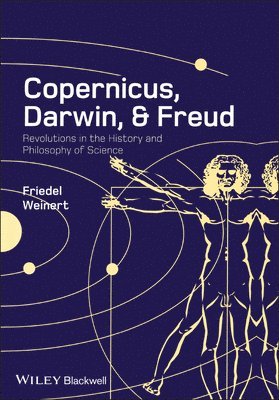
    Copernicus, Darwin, and Freud

    Revolutions in the History and Philosophy of Science

    AvFriedel Weinert

    Häftad, Engelska, 2008

    431 kr

    Beställningsvara. Skickas inom 5-8 vardagar. Fri frakt över 249 kr.

    Fler format och utgåvor

    Inbunden

    1 238 kr

    E-bok

    1 420 kr

    Beskrivning

    Copernicus, Darwin, & Freud “Why is Darwin less the Copernicus than the Kepler of biology? What are good criteria for scientific revolutions? Shift of perspective? Replacement of paradigms? Reweaving conceptual networks? Explanatory gain? Restructuring the constraint space? Threatening worldviews? Whoever wants to learn more about these and many other important issues of history and philosophy of science will have to read on!”Klaus Hentschel, University of Stuttgart “Friedel Weinert has done a rare and excellent thing in this book: he has shown how the philosophy of science is intimately connected with the development of physical, biological, and social sciences and that argument concerning the foundations of these sciences cannot be advanced without reference to philosophy. It is a clearly written and engaging book that will be informative for teachers, students, and the lay public alike.”Robert Nola, University of Auckland

    Produktinformation

    • Utgivningsdatum:2008-10-10
    • Mått:173 x 246 x 15 mm
    • Vikt:526 g
    • Format:Häftad
    • Språk:Engelska
    • Antal sidor:304
    • Förlag:John Wiley and Sons Ltd
    • ISBN:9781405181839

    Utforska kategorier

    • Naturvetenskapens filosofi inom Naturvetenskap och teknik
    • Naturvetenskapens historia inom Naturvetenskap och teknik

    Mer om författaren

    Friedel Weinert is Professor of Philosophy at Bradford University and a former Visiting Research Fellow at Harvard University and Visiting Fellow at the Centre for the Philosophy of Natural and Social Science at the LSE in London. He holds a PhD in Philosophy, a BA in Sociology, and a BSc in Physics. Dr. Weinert is the editor of Laws of Nature (1995), the author of The Scientist as Philosopher (2004) and chief editor of the forthcoming Compendium of Quantum Physics: Concepts, Experiments, History and Philosophy .

    Recensioner i media

    "Whether used as a textbook or as a review of issues concerning scientific revolutions and theory change in their historical context, Copernicus, Darwin, and Freud may be strongly recommended." (The Journal of the International Society for the History of Philosophy of Science, 2011) "Those seeking a more conventional approach to the history and philosophy of science may well find Weinert's book informative...there is much to be learned from Weinert's comparison of Copernicus, Darwin, and Freud." (Science & Education, January 2011)

    Innehållsförteckning

    • Preface ixAcknowledgments xIntroduction 1I Nicolaus Copernicus: The Loss of Centrality 31 Ptolemy and Copernicus 32 A Clash of Two Worldviews 42.1 The geocentric worldview 52.2 Aristotle’s cosmology 52.3 Ptolemy’s geocentrism 92.4 A philosophical aside: Outlook 142.5 Shaking the presuppositions: Some medieval developments 173 The Heliocentric Worldview 203.1 Nicolaus Copernicus 213.2 The explanation of the seasons 253.3 Copernicus and the Copernican turn 283.3.1 A philosophical aside: From empirical adequacy to theoretical validity 323.4 Copernicus consolidated: Kepler and Galileo 324 Copernicus was not a Scientific Revolutionary 374.1 The Copernican method 394.2 The relativity of motion 425 The Transition to Newton 435.1 On hypotheses 456 Some Philosophical Lessons 476.1 The loss of centrality 486.2 Was Copernicus a realist? 516.2.1 Lessons for instrumentalism and realism 526.3 Modern realism 556.4 The underdetermination of theories by evidence 586.4.1 The Duhem–Quine thesis 596.4.2 The power of constraints 616.5 Theories, models, and laws 646.5.1 Theories and models 646.5.2 Laws of nature, laws of science 686.5.3 Philosophical views of laws 696.5.3.1 The inference view 696.5.3.2 The regularity view 706.5.3.3 The necessitarian view 736.5.3.4 The structural view 757 Copernicus and Scientific Revolutions 778 The Anthropic Principle: A Reversal of the Copernican Turn? 83Reading List 87Essay Questions 91II Charles Darwin: The Loss of Rational Design 931 Darwin and Copernicus 932 Views of Organic Life 942.1 Teleology 942.1.1 The Great Chain of Being 972.1.2 Design arguments 992.1.3 Jean Baptiste Lamarck 1043 Fossil Discoveries 1063.1 Of bones and skeletons 1083.2 The antiquity of man 1104 Darwin’s Revolution 1124.1 The Darwinian view of life 1144.1.1 Principles of evolution 1164.2 The descent of man 1195 Philosophical Matters 1245.1 Philosophical presuppositions: Mechanical worldview, determinism, materialism 1255.2 From biology to the philosophy of mind 1295.2.1 Empiricism 1295.2.2 Philosophy of mind 1325.2.3 Emergent minds 1345.3 The loss of rational design 1365.4 Intelligent design (ID) 1396 A Question of Method 1436.1 Darwinian inferences 1436.2 Philosophical empiricism 1476.3 Some principles of elimination 1496.4 Essential features of eliminative induction 1506.5 Falsifiability or testability? 1556.6 Explanation and prediction 1576.7 Some models of scientific explanation 1596.7.1 Hempel’s models 1606.7.2 Functional models 1616.7.3 Causal models 1636.7.3.1 A counterfactual-interventionist account 1636.7.3.2 A conditional model of causation 1656.7.4 Structural explanations 1696.8 A brief return to realism 1726.9 Darwin and scientific revolutions 1746.9.1 Philosophical consequences 176Reading List 177Essay Questions 183III Sigmund Freud: The Loss of Transparency 1851 Copernicus, Darwin, and Freud 1852 Some Views of Humankind 1872.1 Enlightenment views of human nature 1882.2 Nietzsche’s view of human nature 1903 Scientism and the Freudian Model of Personality 1913.1 Freud’s model of the mind 1923.1.1 A summary of psychoanalytic theory 1923.1.2 Analogy with physics 1953.1.3 Freud as an Enlightenment thinker 2003.1.4 The scientific status of the Freudian model 2023.1.4.1 Freud’s methods 2023.1.4.2 The method of eliminative induction, again 2053.1.5 Freud stands between the empirical and the hermeneutic models 2083.1.6 The role of mind in the social world 2094 The Social Sciences beyond Freud 2104.1 Two standard models of the social sciences – some history 2104.1.1 The naturalistic model 2114.1.2 The hermeneutic model 2134.2 Essential features of social science models 2184.2.1 Essential features of the naturalistic model 2184.2.2 Essential features of the hermeneutic model 2214.3 Questions of methodology 2244.3.1 What is Verstehen? 2254.3.2 Weber’s methodology of ideal types 2294.3.3 Verstehen and objectivity 2344.4 Causation in the social sciences 2364.4.1 Weber on causation 2364.4.2 On the existence of social laws 2394.4.3 Explanation and prediction in the social sciences 2424.4.4 Underdetermination 2434.4.5 Realism and relativism 2444.4.6 Reductionism and functionalism 2485 Evolution and the Social Sciences 2535.1 Sociobiology – the fourth revolution? 2545.2 Evolutionary psychology 2576 Freud and Revolutions in Thought 2616.1 Revolutions in thought vs. revolutions in science 263Reading List 263Essay Questions 269Name Index 271Subject Index 274